PDMS Droplet Formation Chip (200 um)
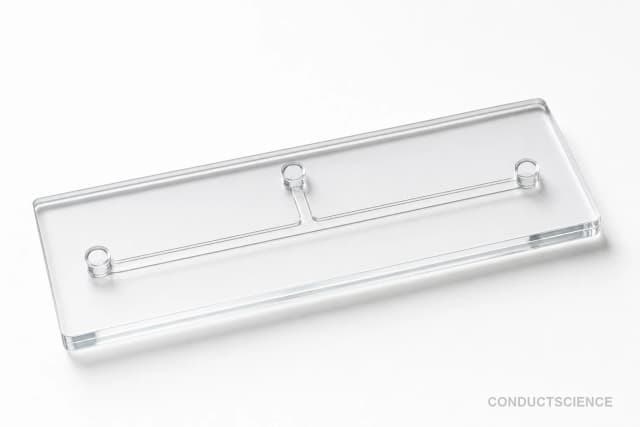
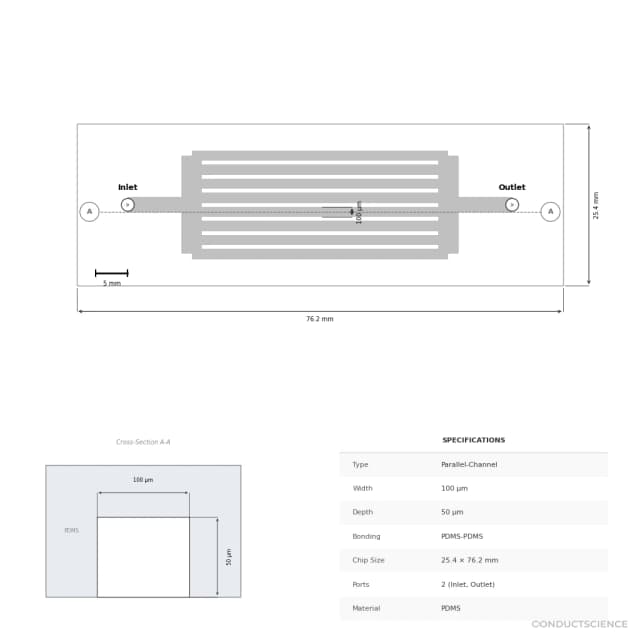
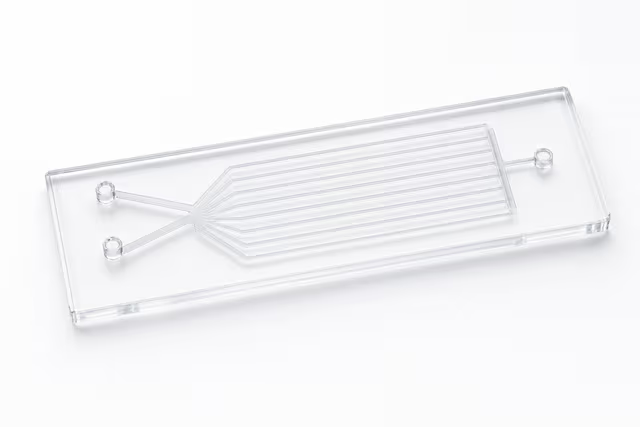
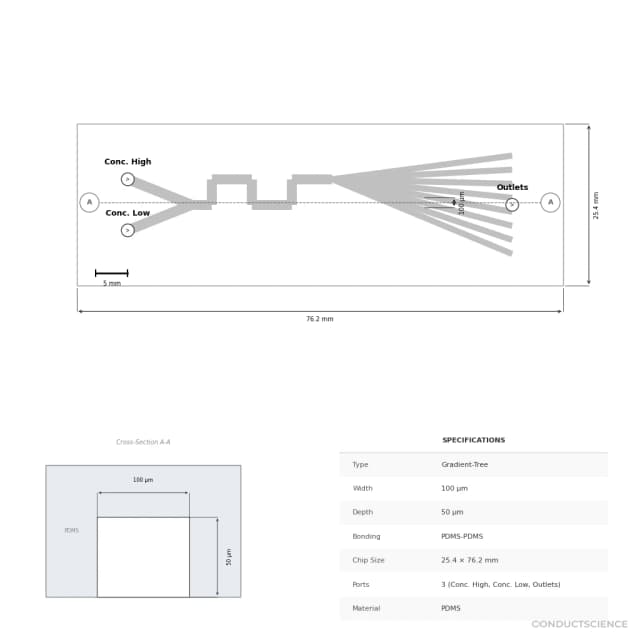
Precision PDMS microfluidic chip with 200 x 200 μm channels for controlled monodisperse droplet generation in flow focusing applications.
Reusable chip — designed for multiple experimental runs. Compatible with standard microfluidic tubing: steel pins (0.7 mm ID / 1.0 mm OD) and silicone tubing (0.8 mm ID / 1.9 mm OD). Available in bulk packs (5‑, 10‑, and 25‑unit) for lab-scale and consumable workflows.

Louise Corscadden, PhD
Director of Science · ConductScience
Ask Louise about PDMS Droplet Formation Chip (200 um) fit, setup, configuration, or quote prep.
Already working with us? Sign in to connect this with My Scientist.
Key Specifications
Full details →- Model fit
- 3 selectable configurations
- SKU family
- WHM-0089
- Shipping box
- 181.8 x 136.3 x 90.9 cm
- Ordering
- Online checkout and quote request available
- Category
- Droplet Generator Chips
- Build notes
- Confirm accessories, station layout, and support needs before purchase
The PDMS Droplet Formation Chip (200 μm) is a precision microfluidic device designed for controlled droplet generation in laboratory applications. Fabricated from polydimethylsiloxane (PDMS), this chip features symmetrical 200 x 200 μm channel dimensions that enable reproducible formation of monodisperse droplets through flow focusing geometry. The biocompatible PDMS construction provides optical transparency for real-time observation and imaging of droplet formation processes.
This microfluidic chip serves as a fundamental tool for researchers requiring precise control over droplet size and generation frequency. The standardized channel architecture supports consistent fluid dynamics for applications ranging from single-cell encapsulation to emulsion-based assays. The chip integrates seamlessly with standard microfluidic pumping systems and microscopy platforms commonly used in droplet microfluidics research.
How It Works
The chip operates on flow focusing principles, where two immiscible fluids converge at a junction within the 200 μm channels. The dispersed phase (inner fluid) is sheared by the continuous phase (outer fluid) at the flow focusing geometry, resulting in controlled droplet breakup. The channel dimensions and flow rate ratios determine droplet size, with the 200 μm channel providing sufficient space for droplets typically ranging from 50-150 μm diameter depending on fluid properties and flow conditions.
PDMS construction enables rapid prototyping and modification while maintaining biocompatibility for biological applications. The polymer's flexibility allows for reversible bonding to glass substrates and integration with external fluidic connections. Optical transparency across visible wavelengths facilitates real-time monitoring of droplet formation using standard brightfield or fluorescence microscopy techniques.
Features & Benefits
Shipping weight
- 3.3 lb
Shipping box
- L: 181.8 cm
- W: 136.3 cm
- H: 90.9 cm
| Feature | This Product | Typical Alternative | Advantage |
|---|---|---|---|
| Channel Cross-Section | 200 x 200 μm square channels | Entry-level chips often feature larger channels (300-500 μm) or non-uniform geometries | Smaller channels enable better control over droplet uniformity and size distribution for precision applications. |
| Material Construction | PDMS (polydimethylsiloxane) | Some alternatives use rigid materials like glass or PMMA | PDMS flexibility allows reversible bonding and easier fluidic connections while maintaining biocompatibility. |
| Optical Properties | Transparent across visible spectrum | Some polymer chips show optical distortion or limited transparency | Clear visualization enables real-time optimization of droplet formation parameters and quality control. |
| Application Focus | Optimized for droplet generation | Multi-purpose chips may compromise droplet formation efficiency | Dedicated design ensures reliable monodisperse droplet production without competing design constraints. |
The 200 μm PDMS chip provides standardized geometry for reproducible droplet formation with biocompatible construction and optical transparency. The dedicated flow focusing design prioritizes droplet generation performance over multi-functionality.
| Model | SKU | Listed price | Status | Shipping box |
|---|---|---|---|---|
| 25-Pack | WHM-0089-25PK | Quote | Available | 181.8 x 136.3 x 90.9 cm |
| 10-Pack | WHM-0089-10PK | $1,490.00 | Available | 181.8 x 136.3 x 90.9 cm |
| 5-Pack | WHM-0089-5PK | Quote | Available | 181.8 x 136.3 x 90.9 cm |
Practical Tips
Establish baseline droplet sizes using known flow rate ratios before starting experiments, as small variations in pump performance can significantly affect results.
Why: Consistent calibration ensures reproducible droplet sizes across experimental sessions and different operators.
Store the chip in a dust-free environment and avoid touching channel surfaces to prevent contamination that could affect droplet formation.
Why: Surface contamination can alter wetting properties and lead to irregular droplet formation or channel blockage.
Pre-wet channels with continuous phase before introducing dispersed phase to ensure stable droplet formation from the start.
Why: Proper wetting eliminates air bubbles and establishes consistent flow patterns for immediate stable operation.
If droplet formation becomes irregular, check for bubble formation in feed lines and verify that all connections remain leak-free.
Why: Air bubbles or pressure fluctuations from leaks are the most common causes of droplet formation instability.
Allow the system to stabilize for several minutes after changing flow parameters before collecting data or samples.
Why: Transient effects during parameter changes can temporarily affect droplet uniformity until steady-state conditions are reestablished.
Use appropriate chemical compatibility charts when selecting solvents, as some organic solvents can cause PDMS swelling or degradation.
Why: Incompatible solvents can compromise chip integrity and lead to experimental failure or safety hazards.
Monitor droplet formation under microscope throughout experiments to catch any drift in droplet size or generation frequency early.
Why: Real-time monitoring allows immediate parameter adjustment before significant data quality degradation occurs.
Flush channels thoroughly with clean solvent immediately after use to prevent residue buildup that could affect future experiments.
Why: Prompt cleaning prevents protein or polymer deposits that become increasingly difficult to remove over time.
Setup Guide
What’s in the Box
- PDMS Droplet Formation Chip (200 μm channels)
- Protective storage container (typical)
- User guide with operating parameters (typical)
Warranty
ConductScience provides a 1-year manufacturer warranty covering material defects and workmanship. Technical support includes application guidance and troubleshooting assistance for optimal droplet formation performance.
Compliance
What droplet size range can be achieved with the 200 μm channels?
Droplet sizes typically range from 50-150 μm diameter, controlled primarily by the flow rate ratio between continuous and dispersed phases. Consult application notes for specific fluid combinations and optimal operating parameters.
Is the chip compatible with organic solvents?
PDMS shows good compatibility with most aqueous solutions and many organic solvents, though prolonged exposure to highly swelling solvents may cause dimensional changes. Test compatibility with specific solvent systems before extended use.
How should the chip be cleaned between experiments?
Flush channels thoroughly with appropriate cleaning solvents followed by the next continuous phase. For biological applications, consider ethanol sterilization followed by buffer equilibration.
What surface modifications are recommended for different applications?
Water-in-oil emulsions typically require hydrophobic surface treatment, while oil-in-water systems may need hydrophilic modification. Surface treatment protocols depend on specific fluid combinations and droplet stability requirements.
Can the chip be reused for multiple experiments?
Yes, with proper cleaning protocols between uses. Inspect channels for fouling or damage that might affect droplet formation consistency. Replace if channel geometry appears compromised.
What pressure ranges are suitable for operation?
Operating pressures depend on fluid viscosities and desired flow rates. Start with low pressures (< 1 bar) and increase gradually while monitoring for stable droplet formation. Excessive pressure may cause channel deformation.
How does this compare to glass microfluidic chips?
PDMS offers greater flexibility and easier handling compared to glass, with similar optical properties. Glass chips provide higher solvent resistance and dimensional stability but at higher cost and fragility.
Have a question about this product?
Have a question? Just ask.
Send it over and we'll email you a personalized answer — no call, no scheduling.
Prefer to talk it through?