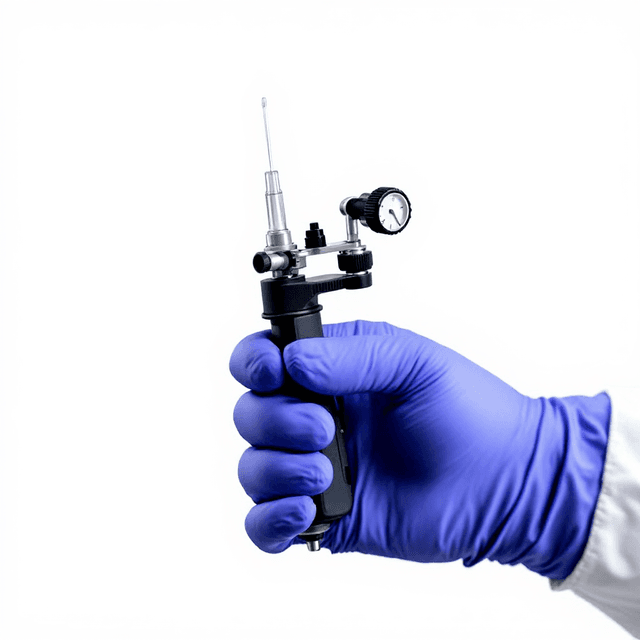
PDMS Electric Cutting and Punching Machine
Electric-powered cutting and punching machine for precise post-processing of PDMS microfluidic devices, providing consistent hole punching and trimming capabilities.

Louise Corscadden, PhD
Director of Science · ConductScience
Ask Louise about PDMS Electric Cutting and Punching Machine fit, setup, configuration, or quote prep.
Already working with us? Sign in to connect this with My Scientist.
Key Specifications
Full details →- Model fit
- Configured during quote
- SKU family
- WHM-0044
- Shipping box
- 250.0 x 200.0 x 250.0 cm
- Ordering
- Online checkout and quote request available
- Category
- Lab Equipment
- Build notes
- Confirm accessories, station layout, and support needs before purchase
Motorized preparation of soft microfluidic chips
TWO OPERATIONS. ONE COMPACT DEVICE.
The PDMS Electric Cutting and Punching Machine enables vertical punching and cutting for PDMS and other soft chips with membrane-button control of motorized tool height.
KEY FEATURES:
• Controlled Movement - Separate up/down buttons for punching and cutting
• Flexible Preparation - Interchangeable needles and cutting blade with gridded mat for alignment
• 100 x 100 mm cutting area
• Compact design (4 kg unit weight)
TECHNICAL SPECIFICATIONS:
• Needle outer diameters: 0.7 / 0.8 / 0.9 / 1.07 / 1.26 / 1.47 / 1.66 / 1.8 / 2.1 / 2.4 / 2.8 / 3.0 / 3.45 / 4 mm
• Cutting thickness: <10 mm
• Maximum punching thickness: <13 mm
• Dimensions (L x W x H): 200 x 218 x 270 mm
• Weight: 4 kg
• Operating environment: 0-40 °C; relative humidity <80%
WORKFLOW:
1. Install the required tool
2. Adjust its height using membrane buttons
3. Align the chip to the gridded mat
4. Actuate the corresponding control (punch or cut)
Use on a stable, level surface in a clean, dry, ventilated environment.
How It Works
The electric cutting and punching mechanism operates through controlled force application using precision tooling. The system positions PDMS substrates against cutting dies or punching tools, then applies consistent downward force to create clean cuts or circular holes. Electric motor control ensures repeatable force profiles and eliminates operator fatigue associated with manual methods.
For hole punching operations, the machine uses sharp circular punches that penetrate the PDMS material completely, creating clean-edged ports suitable for tubing connections. The cutting function employs blade assemblies that slice through PDMS with minimal deformation, maintaining dimensional accuracy of microfluidic features. The controlled electric operation prevents the tearing or irregular edges common with manual cutting approaches.
Features & Benefits
Functions
- Cutting and hole punching
Automation Level
- semi-automated
Brand
- ConductScience
Research Domain
- Analytical Chemistry
- Cell Biology
- Developmental Biology
- Materials Science
- Pharmaceutical QC
Shipping weight
- 8.0 lb
Shipping box
- L: 250.0 cm
- W: 200.0 cm
- H: 250.0 cm
| Feature | This Product | Typical Alternative | Advantage |
|---|---|---|---|
| Force Application Method | Electric motor-controlled force application | Manual lever or punch press systems require operator force | Eliminates operator variability and provides consistent results across multiple devices |
| Cutting Capability | Dual cutting and hole punching functions | Single-function tools require multiple setups | Streamlines workflow by handling both trimming and port creation in one system |
| Size and Portability | Compact 250mm × 200mm × 250mm footprint | Larger industrial punches consume more bench space | Fits standard laboratory benchtops while maintaining operational stability |
| Application Focus | Specialized for PDMS chip post-processing | General-purpose tools not optimized for polymer properties | Purpose-built design optimizes cutting parameters for microfluidic device fabrication |
This machine combines electric precision with compact laboratory-friendly design, specifically engineered for PDMS microfluidic device post-processing. The dual cutting and punching capability streamlines fabrication workflows compared to manual or single-function alternatives.
Practical Tips
Test cutting force on PDMS scraps with the same thickness and curing ratio as your devices before processing finished chips.
Why: Optimal force varies significantly between different PDMS formulations and can prevent device damage.
Clean punch tools immediately after use with isopropanol and inspect cutting edges for dulling or PDMS buildup.
Why: PDMS residue accumulation degrades cutting quality and can cause tool binding during operation.
Support thin PDMS substrates with rigid backing material during cutting to prevent flexing and ensure clean cuts.
Why: Unsupported thin PDMS can deform under cutting force, resulting in angled holes or incomplete cuts.
Always verify cutting area is clear and use appropriate hand positioning away from cutting zone during operation.
Why: Electric-powered cutting tools maintain consistent force that can cause injury if hands contact cutting area.
Measure hole diameters periodically with calipers to verify punch performance and detect tool wear.
Why: Gradual tool dulling can cause hole size drift that affects microfluidic connection reliability.
If holes appear oval rather than circular, check tool sharpness and reduce cutting speed to prevent PDMS stretching.
Why: Dull tools or excessive speed can cause material deformation rather than clean cutting action.
Mark optimal force settings for different PDMS thicknesses on the machine for consistent results across operators.
Why: Documented parameters ensure reproducible results and reduce setup time for routine processing.
Setup Guide
What’s in the Box
- PDMS Electric Cutting and Punching Machine
- Power cord (typical)
- Basic tooling set (typical)
- Operation manual (typical)
- Safety instructions (typical)
Warranty
ConductScience provides standard one-year manufacturer warranty covering defects in materials and workmanship. Technical support includes application guidance for PDMS processing parameters and tooling selection.
Compliance
What PDMS thickness range can this machine process effectively?
The machine accommodates PDMS substrates from 1-10mm thickness, with optimal cutting performance depending on PDMS formulation and curing ratio. Thicker substrates may require multiple passes or specialized tooling.
How do I select appropriate punch sizes for microfluidic connections?
Common punch sizes include 0.5mm for small molecule delivery, 1.5mm for standard tubing connections, and 2.0mm for larger flow applications. Match punch diameter to your tubing outer diameter minus 0.1-0.2mm for secure fit.
Can the machine handle PDMS with embedded features or multilayer devices?
Yes, the controlled force application prevents delamination of bonded PDMS layers. Use reduced cutting force for devices with delicate internal features to avoid channel collapse.
What maintenance is required for optimal cutting performance?
Regular cleaning of cutting tools to remove PDMS residue, periodic sharpening or replacement of punches, and verification of force calibration. Clean tooling with isopropanol after each use session.
How does electric operation compare to manual punching methods?
Electric operation provides consistent force application, reduces operator fatigue, and improves hole circularity and edge quality. Manual methods often produce variable results and can cause hand strain during extended processing.
What factors affect cutting quality in different PDMS formulations?
PDMS hardness (base:curing agent ratio), curing temperature, and substrate thickness all influence optimal cutting parameters. Softer PDMS requires lower force to prevent material stretching.
Can the machine process other polymer materials besides PDMS?
While designed for PDMS, the machine may process other soft polymers of similar hardness. Test cutting parameters on sample material first to verify compatibility and optimize settings.
Have a question about this product?
Have a question? Just ask.
Send it over and we'll email you a personalized answer — no call, no scheduling.
Prefer to talk it through?