PDMS Fluid Mixing Chip (500 um)
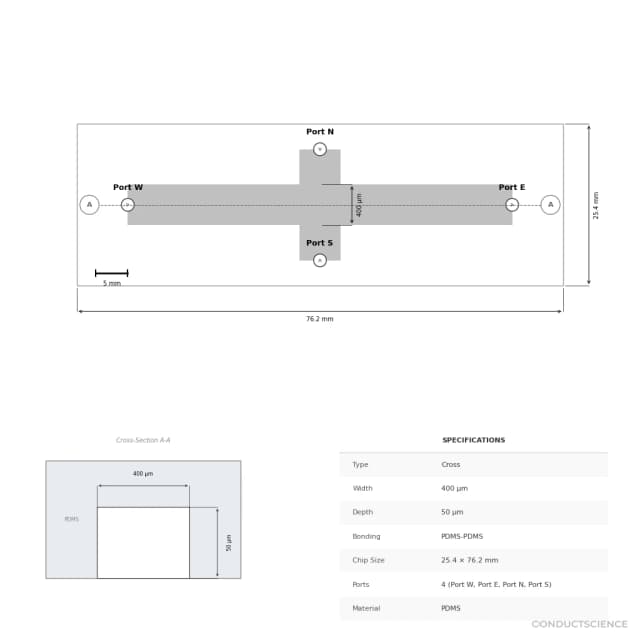
PDMS microfluidic chip with 500 x 500 μm channels designed for controlled mixing of viscous fluids and multi-channel laminar flow applications.
Reusable chip — designed for multiple experimental runs. Compatible with standard microfluidic tubing: steel pins (0.7 mm ID / 1.0 mm OD) and silicone tubing (0.8 mm ID / 1.9 mm OD). Available in bulk packs (5‑, 10‑, and 25‑unit) for lab-scale and consumable workflows.

Louise Corscadden, PhD
Director of Science · ConductScience
Ask Louise about PDMS Fluid Mixing Chip (500 um) fit, setup, configuration, or quote prep.
Already working with us? Sign in to connect this with My Scientist.
Key Specifications
Full details →- Model fit
- 3 selectable configurations
- SKU family
- WHM-0118
- Shipping box
- 181.8 x 136.3 x 90.9 cm
- Ordering
- Online checkout and quote request available
- Category
- Microfluidic Chips
- Build notes
- Confirm accessories, station layout, and support needs before purchase
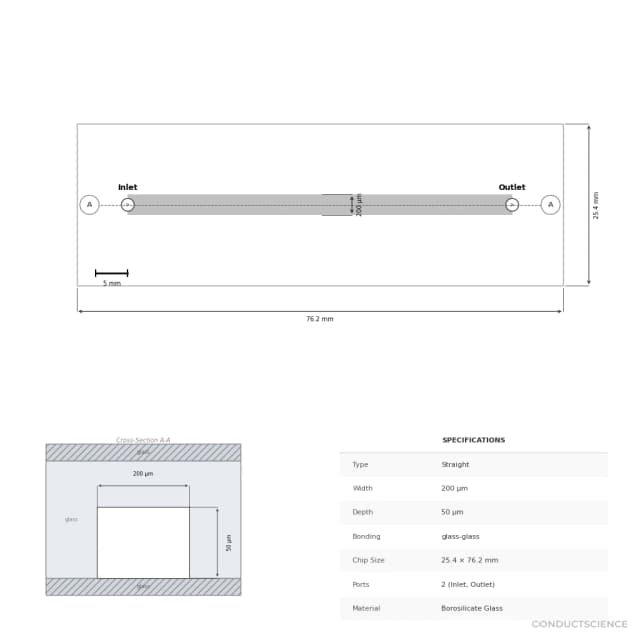
The PDMS Fluid Mixing Chip (500 μm) is a polydimethylsiloxane-based microfluidic device designed for controlled fluid mixing applications. The chip features 500 x 500 μm channel dimensions, providing sufficient cross-sectional area for handling viscous fluids and achieving efficient laminar flow mixing. This channel geometry enables researchers to process samples that require larger flow volumes or contain suspended particles that would otherwise clog smaller microfluidic systems.
The PDMS construction offers excellent biocompatibility and optical transparency for real-time monitoring of mixing processes. The device supports multi-channel operations, allowing simultaneous processing of multiple fluid streams or parallel experiments. The 500 μm channel width makes this chip particularly suitable for applications involving cell suspensions, protein solutions, or other viscous biological samples that benefit from laminar flow conditions and predictable fluid dynamics.
How It Works
The PDMS Fluid Mixing Chip operates on laminar flow principles within its 500 x 500 μm channels. When fluids are introduced at low Reynolds numbers (typically Re < 100), they flow in parallel streams with minimal turbulent mixing. Molecular diffusion across the interface between fluid streams becomes the primary mixing mechanism, creating predictable concentration gradients that can be controlled by adjusting flow rates, channel geometry, and residence time.
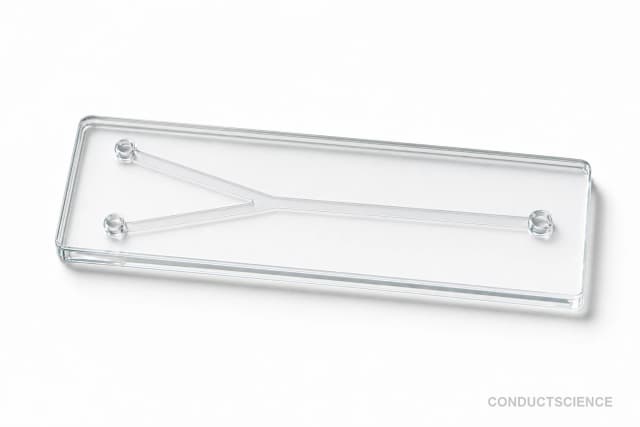
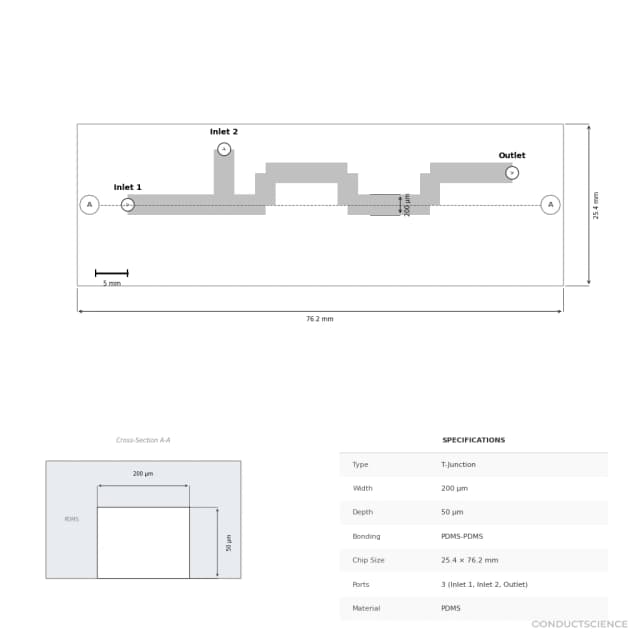
The relatively large channel cross-section (500 μm) accommodates viscous fluids and suspended particles while maintaining laminar flow conditions. Multiple inlet channels converge within the chip, allowing precise control over the ratio and timing of fluid introduction. The PDMS material provides excellent optical clarity for real-time observation of mixing processes using standard microscopy techniques, enabling researchers to monitor concentration gradients, particle distributions, or cellular responses during the mixing process.
Features & Benefits
Shipping weight
- 3.3 lb
Shipping box
- L: 181.8 cm
- W: 136.3 cm
- H: 90.9 cm
| Feature | This Product | Typical Alternative | Advantage |
|---|---|---|---|
| Channel Dimensions | 500 x 500 μm channels | Entry-level mixing chips often feature 50-200 μm channels | Larger channels accommodate viscous fluids and suspended particles that would clog smaller devices. |
| Material Construction | PDMS (polydimethylsiloxane) | Glass or thermoplastic alternatives available | PDMS provides excellent biocompatibility and flexibility for easy handling in research applications. |
| Application Focus | Optimized for viscous fluid mixing | General-purpose mixing chips may not handle high-viscosity samples effectively | Specific design for viscous fluids enables processing of cell suspensions, protein solutions, and polymer formulations. |
| Multi-Channel Capability | Multi-channel design for parallel processing | Single-channel devices require sequential processing | Parallel processing capability increases experimental throughput and enables complex mixing patterns. |
This chip offers larger channel dimensions specifically designed for viscous fluid applications, providing researchers with reliable mixing performance for challenging samples that may not work effectively in smaller microfluidic systems. The PDMS construction ensures biocompatibility while maintaining optical clarity for process monitoring.
| Model | SKU | Listed price | Status | Shipping box |
|---|---|---|---|---|
| 25-Pack | WHM-0118-25PK | Quote | Available | 181.8 x 136.3 x 90.9 cm |
| 10-Pack | WHM-0118-10PK | $1,490.00 | Available | 181.8 x 136.3 x 90.9 cm |
| 5-Pack | WHM-0118-5PK | Quote | Available | 181.8 x 136.3 x 90.9 cm |
Practical Tips
Use fluorescent dyes or colored tracers to visualize mixing patterns and determine optimal flow rate ratios for your specific application.
Why: Visual confirmation ensures mixing efficiency before processing valuable samples.
Flush channels immediately after use with appropriate cleaning solution to prevent sample buildup or cross-contamination.
Why: Prompt cleaning maintains channel integrity and prevents blockages that could affect future experiments.
Degas all fluids before introduction to minimize bubble formation in the channels during operation.
Why: Dissolved gases can form bubbles under flow conditions, disrupting laminar flow patterns and mixing efficiency.
If flow becomes uneven between channels, check for partial blockages or air bubbles and verify pump pressure settings.
Why: Flow imbalances can significantly affect mixing ratios and experimental reproducibility.
Allow sufficient residence time for complete mixing based on your fluid properties and desired concentration uniformity.
Why: Incomplete mixing can lead to concentration gradients that may not represent your intended experimental conditions.
Use appropriate personal protective equipment when handling organic solvents that may cause PDMS swelling.
Why: Some solvents can alter PDMS properties and potentially compromise chip performance or safety.
Store chips in a clean, dry environment away from dust and particles that could contaminate channels.
Why: Contamination can affect experimental results and may be difficult to remove once it enters the microfluidic channels.
Setup Guide
What’s in the Box
- PDMS Fluid Mixing Chip (500 μm channels)
- User manual with operating guidelines (typical)
- Protective storage case (typical)
Warranty
ConductScience provides a standard one-year manufacturer warranty covering defects in materials and workmanship. Technical support is available for device operation and application guidance.
Compliance
What is the maximum viscosity that can be processed through the 500 μm channels?
The 500 x 500 μm channel dimensions accommodate viscous fluids significantly better than smaller microfluidic devices. Specific viscosity limits depend on your pump pressure capabilities and acceptable flow rates - consult product datasheet for pressure drop calculations.
How do I prevent bubble formation in the channels during operation?
Prime channels thoroughly with degassed buffers, maintain steady flow rates without sudden pressure changes, and consider using bubble traps upstream of the chip. The larger channel geometry reduces bubble retention compared to smaller devices.
Can this chip be reused after biological sample processing?
PDMS chips can be cleaned and reused depending on the application. Use appropriate cleaning protocols (detergents, solvents, or plasma treatment) based on your sample type. Verify channel integrity and flow characteristics after each cleaning cycle.
What mixing efficiency can I expect with this channel geometry?
Mixing efficiency depends on flow rates, fluid properties, and residence time within the channels. The 500 μm width provides good diffusion-based mixing for most applications - consult product datasheet for specific performance data under your operating conditions.
How do I connect standard laboratory tubing to the chip ports?
Port geometry accommodates standard microfluidic fittings and tubing connections. Use appropriate connectors for leak-tight seals - specific fitting recommendations depend on your tubing inner diameter and pressure requirements.
What flow rate range is recommended for optimal mixing?
Flow rates should maintain laminar conditions (Re < 100) for predictable mixing. Specific rates depend on fluid viscosity and desired residence time - start with low rates (μL/min range) and optimize based on mixing visualization.
Have a question about this product?
Have a question? Just ask.
Send it over and we'll email you a personalized answer — no call, no scheduling.
Prefer to talk it through?