PMMA Cell Culture Biochip (200 um)
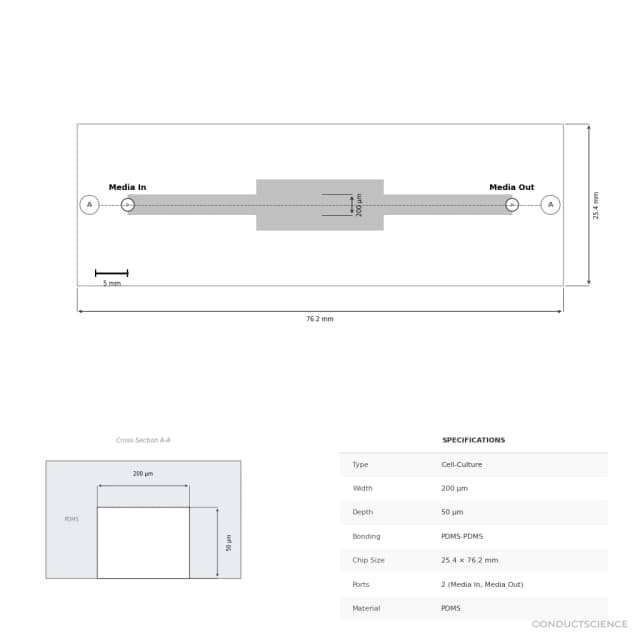
PMMA microfluidic biochip with 200 x 200 μm channels designed for mammalian cell culture and perfusion applications.

Louise Corscadden, PhD
Director of Science · ConductScience
Ask Louise about PMMA Cell Culture Biochip (200 um) fit, setup, configuration, or quote prep.
Already working with us? Sign in to connect this with My Scientist.
Key Specifications
Full details →- Model fit
- 3 selectable configurations
- SKU family
- WHM-0073
- Shipping box
- 181.8 x 136.3 x 90.9 cm
- Ordering
- Online checkout and quote request available
- Category
- Cell Culture Chips
- Build notes
- Confirm accessories, station layout, and support needs before purchase
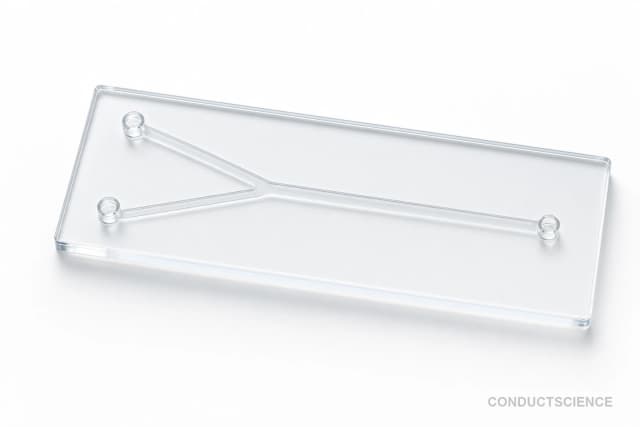
The PMMA Cell Culture Biochip (200 μm) is a microfluidic platform engineered for mammalian cell culture applications requiring large channel cross-sections. Fabricated from polymethyl methacrylate (PMMA), this biochip features 200 x 200 μm channels optimized for cell perfusion studies and continuous culture monitoring.
The 200 μm channel dimensions accommodate a wide range of mammalian cell types while enabling controlled nutrient delivery and waste removal through microfluidic flow control. The PMMA construction provides optical clarity for real-time microscopic observation and biocompatibility for extended cell culture protocols. This platform supports both static culture and dynamic perfusion experiments in microfluidic environments.
How It Works
The PMMA Cell Culture Biochip operates on microfluidic principles to create controlled cellular microenvironments within 200 x 200 μm channels. Cells are introduced into the channels either through direct seeding or flow-based loading, where they can adhere to channel surfaces and establish culture conditions.
Perfusion flow through the microchannels enables continuous nutrient delivery and metabolic waste removal, maintaining cell viability over extended culture periods. The channel dimensions allow for laminar flow characteristics while providing sufficient space for cell attachment and proliferation. The PMMA material provides excellent optical properties for real-time microscopic imaging and cell monitoring throughout experimental protocols.
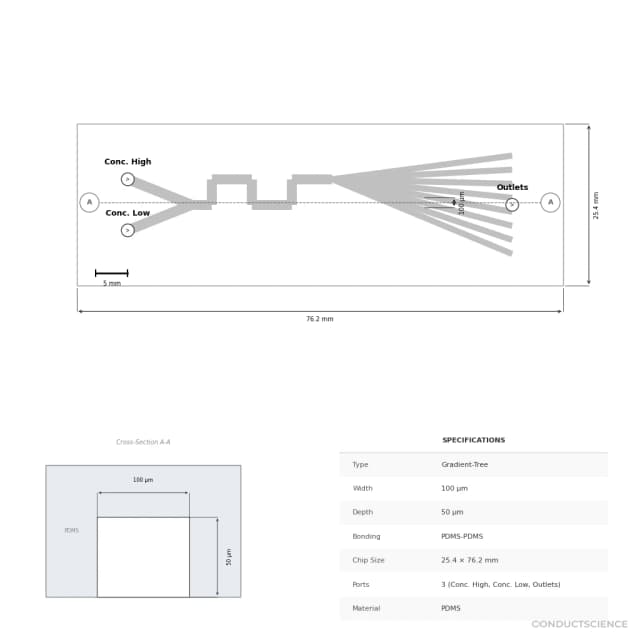
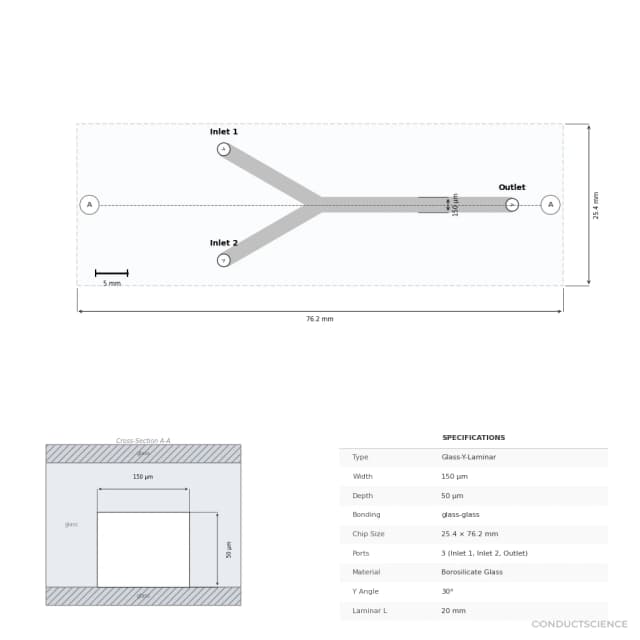
Chemical gradients can be established across the channel width through controlled inlet conditions, enabling studies of chemotaxis, drug response, and cellular differentiation under spatially varying conditions.
Features & Benefits
Shipping weight
- 3.3 lb
Shipping box
- L: 181.8 cm
- W: 136.3 cm
- H: 90.9 cm
| Feature | This Product | Typical Alternative | Advantage |
|---|---|---|---|
| Channel Dimensions | 200 x 200 μm square channels | Many microfluidic chips offer smaller channels (50-100 μm) that may constrain larger cell types | Larger channels accommodate diverse mammalian cell types and support three-dimensional culture organization. |
| Material Construction | PMMA (polymethyl methacrylate) | Glass chips offer higher chemical resistance but at increased cost and fabrication complexity | PMMA provides cost-effective fabrication while maintaining biocompatibility and optical clarity for routine applications. |
| Application Focus | Optimized for cell culture and perfusion | General microfluidic platforms may lack cell culture-specific design features | Purpose-built design supports cell adhesion, perfusion protocols, and microscopic monitoring requirements. |
| Channel Geometry | Square cross-section channels | Rounded channels are common in soft lithography fabrication methods | Square channels provide defined corners for cell positioning studies and consistent flow profiles. |
The PMMA Cell Culture Biochip offers 200 μm square channels specifically designed for mammalian cell culture applications. The PMMA construction balances optical clarity, biocompatibility, and cost-effectiveness for routine microfluidic cell biology studies.
| Model | SKU | Listed price | Status | Shipping box |
|---|---|---|---|---|
| 25-Pack | WHM-0073-25PK | Quote | Available | 181.8 x 136.3 x 90.9 cm |
| 10-Pack | WHM-0073-10PK | $1,490.00 | Available | 181.8 x 136.3 x 90.9 cm |
| 5-Pack | WHM-0073-5PK | Quote | Available | 181.8 x 136.3 x 90.9 cm |
Practical Tips
Pre-treat PMMA surfaces with appropriate coating protocols before cell seeding to ensure consistent adhesion across experimental replicates.
Why: Surface treatment standardization reduces variability in cell attachment and behavior between experiments.
Clean channels immediately after use with appropriate solvents to prevent protein or debris buildup that could affect subsequent experiments.
Why: Prompt cleaning maintains channel integrity and optical clarity for microscopic observation.
Verify flow rates using tracer particles or dyes before cell experiments to ensure accurate perfusion conditions.
Why: Flow rate verification prevents experimental artifacts from unexpected pressure variations or channel blockages.
Establish imaging reference points before cell loading to maintain consistent field positioning throughout time-lapse studies.
Why: Reference positioning enables accurate tracking of cellular changes and quantitative analysis of experimental data.
If cells fail to adhere, check surface treatment effectiveness and consider alternative coating strategies for specific cell types.
Why: Cell adhesion issues often stem from inadequate surface preparation rather than flow or environmental conditions.
Handle PMMA chips with appropriate forceps to avoid surface scratching that could interfere with optical measurements.
Why: Surface damage creates optical artifacts and potential sites for cell attachment irregularities.
Setup Guide
What’s in the Box
- PMMA Cell Culture Biochip (200 μm)
- User manual with protocols (typical)
- Quality certificate (typical)
Warranty
ConductScience provides a 1-year manufacturer warranty covering defects in materials and workmanship, with technical support for setup and application guidance.
Compliance
What cell types are compatible with the 200 μm channel dimensions?
The 200 x 200 μm channels accommodate most mammalian cell lines including adherent cells, suspended cells, and primary cultures. Channel size supports single cell analysis as well as small cell clusters and organoids.
How do I achieve proper cell adhesion on PMMA surfaces?
PMMA surfaces typically require treatment with oxygen plasma, UV-ozone, or protein coating (fibronectin, collagen) to enhance cell adhesion. Treatment protocols depend on specific cell type requirements.
What flow rates are recommended for perfusion culture?
Flow rates depend on cell type and experimental objectives. Typical ranges are 0.1-10 μL/min to maintain nutrient supply while avoiding excessive shear stress. Consult product datasheet for specific recommendations.
Can the chip be reused for multiple experiments?
PMMA chips can be cleaned and reused with proper sterilization protocols, though surface properties may change with repeated treatments. Single-use application is recommended for critical experiments.
What microscopy techniques are compatible with PMMA chips?
PMMA transparency supports bright-field, phase contrast, and fluorescence microscopy. The material is compatible with standard objective lenses and imaging systems used in cell biology applications.
How are chemical gradients established in the channels?
Gradients form through diffusive mixing of different inlet solutions or by controlling relative flow rates of multiple input streams. Gradient profiles depend on channel geometry and flow conditions.
Have a question about this product?
Have a question? Just ask.
Send it over and we'll email you a personalized answer — no call, no scheduling.
Prefer to talk it through?