PMMA Curved-Channel Droplet Generator Chip
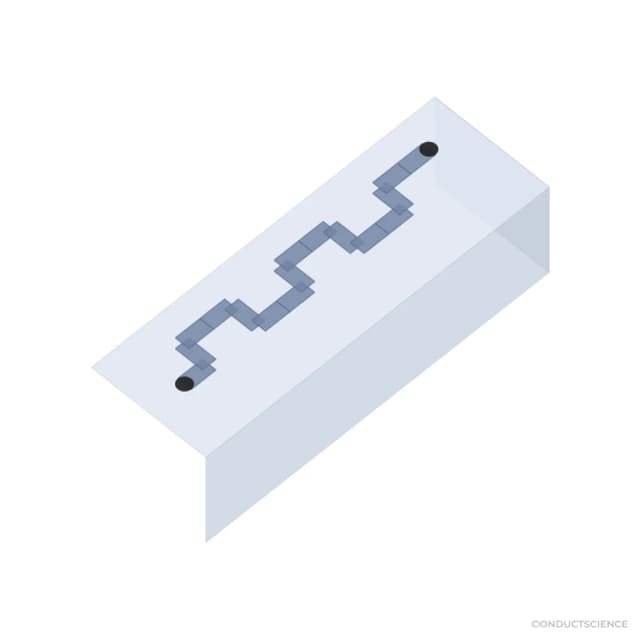
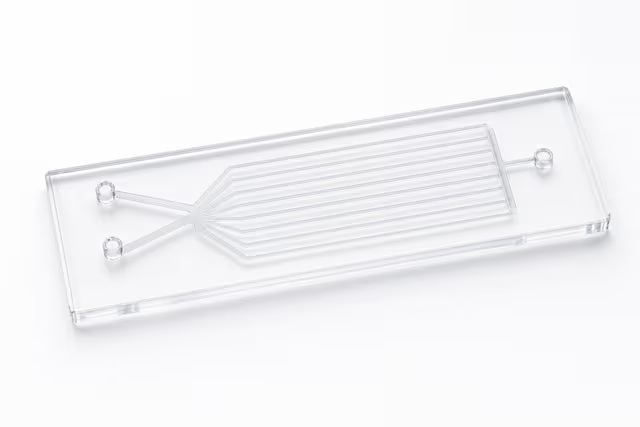
PMMA microfluidic chip with curved 200 x 200 μm channels for generating monodisperse droplets in organic solvent applications where chemical resistance is essential.
Reusable chip — designed for multiple experimental runs. Compatible with standard microfluidic tubing: steel pins (0.7 mm ID / 1.0 mm OD) and silicone tubing (0.8 mm ID / 1.9 mm OD). Available in bulk packs (5‑, 10‑, and 25‑unit) for lab-scale and consumable workflows.

Louise Corscadden, PhD
Director of Science · ConductScience
Ask Louise about PMMA Curved-Channel Droplet Generator Chip fit, setup, configuration, or quote prep.
Already working with us? Sign in to connect this with My Scientist.
Key Specifications
Full details →- Model fit
- 3 selectable configurations
- SKU family
- WHM-0095
- Shipping box
- 181.8 x 136.3 x 90.9 cm
- Ordering
- Online checkout and quote request available
- Category
- Droplet Generator Chips
- Build notes
- Confirm accessories, station layout, and support needs before purchase
The PMMA Curved-Channel Droplet Generator Chip is a microfluidic device designed for controlled droplet formation in organic solvent applications. Fabricated from polymethyl methacrylate (PMMA), this chip provides superior chemical resistance compared to traditional PDMS-based devices, enabling stable droplet generation with aggressive solvents that would compromise elastomeric materials. The curved channel geometry facilitates consistent droplet breakup through controlled flow focusing, producing monodisperse droplets for emulsion-based assays and encapsulation studies.
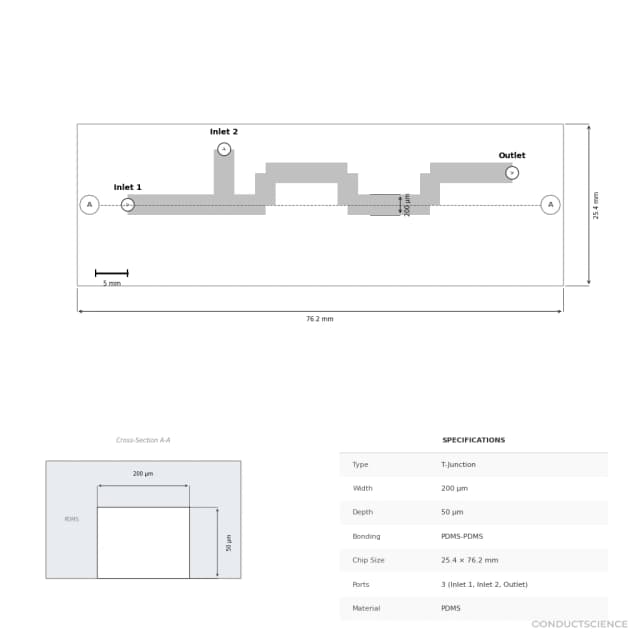
The 200 x 200 μm channel dimensions are optimized for generating droplets in the tens to hundreds of micron size range, suitable for cell encapsulation, particle synthesis, and chemical reaction compartmentalization. The curved channel design promotes stable droplet formation across a range of flow rate ratios, reducing the sensitivity to flow fluctuations that can affect droplet size uniformity in straight-channel devices. This microfluidic chip serves as a critical component in lab-on-chip systems requiring precise control over droplet characteristics in chemically challenging environments.
How It Works
Droplet generation in curved-channel microfluidics relies on the controlled breakup of an immiscible dispersed phase by a continuous phase at the channel junction. The curved geometry creates a favorable pressure gradient that promotes droplet pinch-off, as the dispersed phase experiences varying shear forces around the bend. This design stabilizes the droplet formation process compared to T-junction or straight flow-focusing devices, resulting in more consistent droplet sizes across varying flow conditions.
The PMMA construction provides chemical inertness essential for organic solvent applications. Unlike PDMS, which can swell and degrade in organic solvents, PMMA maintains dimensional stability and surface properties when exposed to alcohols, ketones, and other organic phases commonly used in droplet microfluidics. The 200 x 200 μm square channels provide sufficient Reynolds numbers for stable flow while maintaining the laminar flow regime necessary for predictable droplet formation.
Droplet size is primarily controlled by the flow rate ratio between continuous and dispersed phases, with the curved channel geometry providing additional stability through geometric flow focusing. The resulting droplets serve as isolated microreactors, each containing identical volumes of reactants or samples for parallel processing applications.
Features & Benefits
Shipping weight
- 3.3 lb
Shipping box
- L: 181.8 cm
- W: 136.3 cm
- H: 90.9 cm
| Feature | This Product | Typical Alternative | Advantage |
|---|---|---|---|
| Channel Material | PMMA construction with organic solvent resistance | PDMS-based devices dominate the market but swell in organic solvents | Enables stable droplet formation with aggressive solvents that would compromise elastomeric alternatives. |
| Channel Geometry | Curved flow-focusing design | Most devices use T-junction or straight flow-focusing geometries | Curved geometry provides more stable droplet formation with reduced sensitivity to flow fluctuations. |
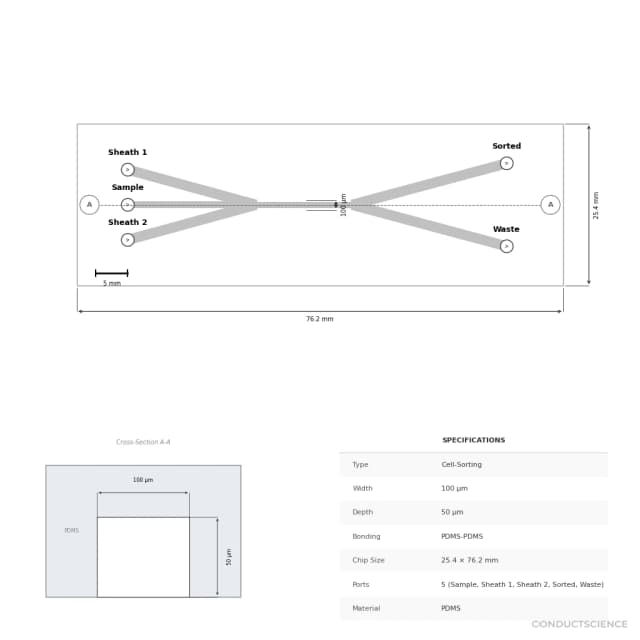
| Channel Dimensions | 200 x 200 μm square channels | Channel sizes vary widely from 50-500 μm depending on application | Optimized dimensions balance droplet size range with reasonable pressure requirements for most applications. |
| Chemical Compatibility | Compatible with alcohols, ketones, and aliphatic hydrocarbons | Standard PDMS devices limited to aqueous and mild organic systems | Expands accessible chemistry for droplet-based synthesis and encapsulation studies. |
| Dimensional Stability | Rigid PMMA maintains channel geometry under pressure | PDMS devices can deform under pressure affecting droplet consistency | Provides more predictable and reproducible droplet formation for quantitative applications. |
This PMMA curved-channel device addresses key limitations of PDMS-based droplet generators by providing organic solvent compatibility and dimensional stability. The curved geometry enhances droplet formation stability compared to conventional T-junction designs, making it suitable for demanding applications requiring consistent droplet characteristics in chemically challenging environments.
| Model | SKU | Listed price | Status | Shipping box |
|---|---|---|---|---|
| 25-Pack | WHM-0095-25PK | Quote | Available | 181.8 x 136.3 x 90.9 cm |
| 10-Pack | WHM-0095-10PK | $1,490.00 | Available | 181.8 x 136.3 x 90.9 cm |
| 5-Pack | WHM-0095-5PK | Quote | Available | 181.8 x 136.3 x 90.9 cm |
Practical Tips
Pre-wet all channels with continuous phase before introducing the dispersed phase to ensure proper wetting and stable droplet formation.
Why: Proper wetting prevents irregular droplet formation and reduces the time to establish stable operation.
Flush channels with clean solvent immediately after use, followed by isopropanol and compressed air drying to prevent residue buildup.
Why: Prompt cleaning prevents crystallization or polymerization of residues that could block channels permanently.
Characterize droplet size versus flow rate ratio for your specific fluid system using microscopy and image analysis before critical experiments.
Why: Fluid properties significantly affect droplet formation, and calibration ensures predictable results for your application.
If droplet formation becomes irregular, check for air bubbles in inlet lines and verify that pump flow rates match setpoints.
Why: Air bubbles and flow rate drift are the most common causes of droplet size variation and formation instability.
Use appropriate chemical-resistant tubing and fittings throughout the fluidic system when working with organic solvents.
Why: Incompatible materials can contaminate samples, degrade system performance, or create safety hazards from solvent leakage.
Allow the system to reach steady state for at least 5 minutes before collecting droplets for analysis or downstream processing.
Why: Initial droplets may have irregular sizes as flow profiles stabilize, affecting the quality of collected samples.
Monitor droplet formation continuously under magnification during critical experiments to detect any formation irregularities early.
Why: Visual monitoring allows immediate detection of problems before they affect large sample volumes or experimental outcomes.
Store the chip in a dust-free environment with inlet and outlet ports capped to prevent contamination between uses.
Why: Dust or debris in channels can disrupt droplet formation and require extensive cleaning to remove.
Setup Guide
What’s in the Box
- PMMA curved-channel droplet generator chip
- Product specification sheet (typical)
- Handling and storage instructions (typical)
Warranty
ConductScience provides a one-year manufacturer warranty covering defects in materials and workmanship. Technical support is available for setup optimization and troubleshooting droplet formation parameters.
Compliance
What organic solvents are compatible with PMMA construction?
PMMA is compatible with most alcohols, ketones, esters, and aliphatic hydrocarbons. Avoid aromatic solvents like toluene or chlorinated solvents which may cause stress cracking. Consult chemical compatibility charts for specific solvent systems.
What droplet size range can be achieved with 200 μm channels?
Droplet sizes typically range from 50-500 μm depending on flow rate ratios and fluid properties. Smaller droplets require higher continuous phase flow rates, while larger droplets are achieved with lower ratios.
How do I prevent channel clogging during operation?
Filter all fluids through 0.2 μm filters before use, avoid particles larger than 20 μm in the dispersed phase, and maintain positive pressure to prevent backflow. Regular flushing with clean solvent prevents buildup.
Can this chip be cleaned and reused?
Yes, flush thoroughly with clean solvent followed by isopropanol and air drying. Sonication in appropriate solvents can remove stubborn residues. Avoid harsh alkaline cleaners that may etch PMMA.
What flow rate ranges work best with this geometry?
Total flow rates of 0.1-10 mL/hr work well, with continuous to dispersed phase ratios of 5:1 to 20:1. Higher ratios produce smaller droplets but require higher pressures.
How does curved geometry compare to T-junction designs?
Curved channels provide more stable droplet formation with less sensitivity to flow fluctuations. The geometry creates favorable pressure gradients that promote consistent droplet breakup compared to sharp T-junctions.
What pressure limits should I observe?
PMMA can handle pressures up to several bar, but avoid sudden pressure changes that may cause stress cracking. Gradual flow rate changes and pressure relief valves help protect the chip integrity.
How do I achieve monodisperse droplets?
Maintain constant flow rates using precision syringe pumps, ensure complete wetting of channel walls, and optimize the flow rate ratio for your specific fluid system. Temperature stability also improves droplet uniformity.
Have a question about this product?
Have a question? Just ask.
Send it over and we'll email you a personalized answer — no call, no scheduling.
Prefer to talk it through?