Rigid Chemical Synthesis Chip
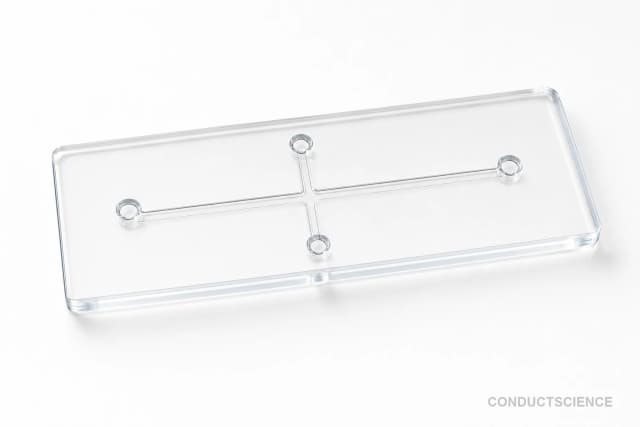
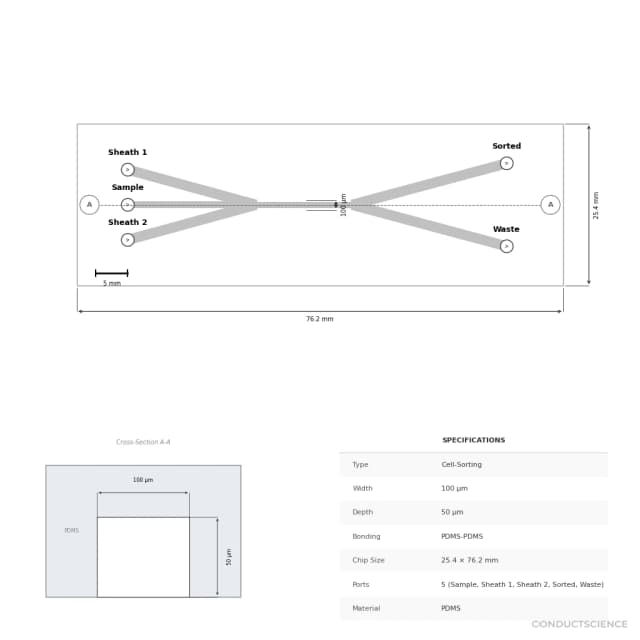
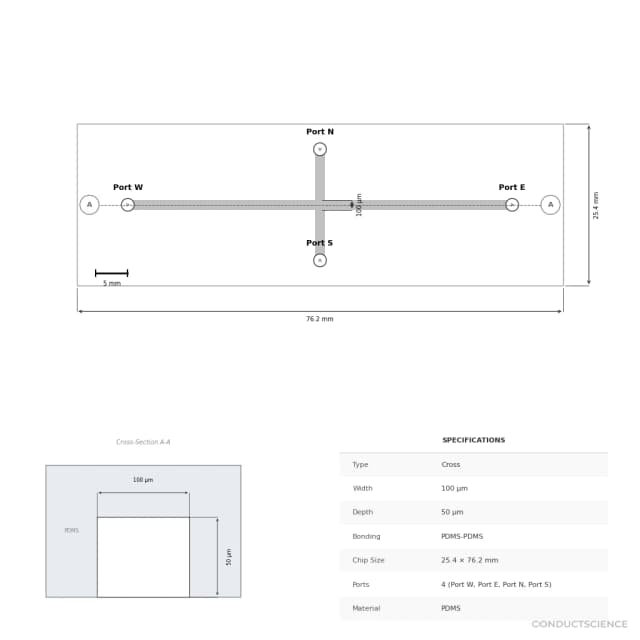
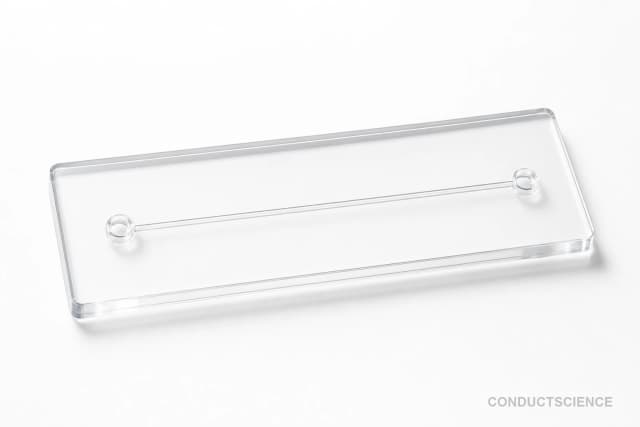
Rigid substrate microfluidic chip with 100 x 100 μm channels designed for chemical synthesis applications requiring high chemical resistance and thermal stability.
Reusable chip — designed for multiple experimental runs. Compatible with standard microfluidic tubing: steel pins (0.7 mm ID / 1.0 mm OD) and silicone tubing (0.8 mm ID / 1.9 mm OD). Available in bulk packs (5‑, 10‑, and 25‑unit) for lab-scale and consumable workflows.

Louise Corscadden, PhD
Director of Science · ConductScience
Ask Louise about Rigid Chemical Synthesis Chip fit, setup, configuration, or quote prep.
Already working with us? Sign in to connect this with My Scientist.
Key Specifications
Full details →- Model fit
- 3 selectable configurations
- SKU family
- WHM-0103
- Shipping box
- 181.8 x 136.3 x 90.9 cm
- Ordering
- Online checkout and quote request available
- Category
- Chemical Synthesis Chips
- Build notes
- Confirm accessories, station layout, and support needs before purchase
The Rigid Chemical Synthesis Chip is a microfluidic device engineered for demanding chemical synthesis applications requiring high chemical resistance and thermal stability. Featuring 100 x 100 μm channels fabricated on a rigid substrate, this chip enables continuous flow synthesis under aggressive chemical conditions and elevated temperatures that would compromise standard microfluidic materials.
The rigid substrate construction provides dimensional stability and chemical inertness essential for reproducible synthetic protocols, while the precisely defined channel geometry ensures predictable residence times and mixing characteristics. This platform supports organic synthesis workflows where traditional batch chemistry is impractical or where miniaturization offers advantages in reagent consumption, heat transfer, and process control.
How It Works
The chip operates on principles of continuous flow microfluidics, where reactants are introduced through separate inlets and mixed within the microchannel network. The 100 x 100 μm square cross-section provides laminar flow conditions with Reynolds numbers typically below 1, enabling predictable fluid dynamics and controlled mixing through diffusion or engineered mixing elements.
Chemical resistance is achieved through the rigid substrate material selection, which maintains structural integrity when exposed to organic solvents, acids, bases, and elevated temperatures. The channel dimensions create high surface-area-to-volume ratios that enhance heat and mass transfer rates compared to conventional batch reactors.
Reaction progression is controlled by residence time, determined by flow rate and channel geometry, allowing precise temporal control over chemical transformations. The rigid construction prevents channel deformation under pressure, maintaining consistent flow profiles and reproducible reaction conditions across multiple runs.
Features & Benefits
Shipping weight
- 3.3 lb
Shipping box
- L: 181.8 cm
- W: 136.3 cm
- H: 90.9 cm
| Feature | This Product | Typical Alternative | Advantage |
|---|---|---|---|
| Channel Dimensions | 100 x 100 μm square channels | Entry-level chips often feature larger channels (200-500 μm) with less precise geometry | Smaller channels provide better heat and mass transfer while maintaining reasonable pressure drops for most pump systems |
| Substrate Material | Rigid substrate with high chemical resistance | Many chips use PDMS or glass with limited solvent compatibility | Enables use with aggressive solvents and reactive intermediates that would swell or damage elastomeric materials |
| Temperature Capability | High-temperature synthesis compatibility | Standard microfluidic devices often limited to room temperature or mild heating | Supports thermal synthesis protocols requiring elevated temperatures for improved reaction kinetics |
| Channel Geometry | Square cross-section design | Round or rectangular channels with varying aspect ratios | Provides predictable flow profiles and mixing characteristics essential for reproducible synthesis protocols |
This rigid chemical synthesis chip combines precise 100 μm channel fabrication with high chemical resistance and thermal stability. The square channel geometry and rigid substrate construction provide superior performance for demanding synthesis applications compared to standard microfluidic platforms.
| Model | SKU | Listed price | Status | Shipping box |
|---|---|---|---|---|
| 25-Pack | WHM-0103-25PK | Quote | Available | 181.8 x 136.3 x 90.9 cm |
| 10-Pack | WHM-0103-10PK | $1,490.00 | Available | 181.8 x 136.3 x 90.9 cm |
| 5-Pack | WHM-0103-5PK | Quote | Available | 181.8 x 136.3 x 90.9 cm |
Practical Tips
Start with well-characterized reactions before attempting novel chemistry to establish baseline performance.
Why: Validates system operation and identifies potential issues before investing in experimental optimization.
Establish cleaning protocols specific to your chemistry and store chips in appropriate solvents between uses.
Why: Prevents cross-contamination and extends chip lifetime by avoiding residue buildup or material degradation.
Verify flow rates gravimetrically rather than relying solely on pump settings, especially with viscous solvents.
Why: Pump calibrations can drift and solvent properties affect actual delivery rates, impacting residence time calculations.
Allow sufficient equilibration time when changing reaction conditions to reach steady-state before collecting data.
Why: Transient behavior during condition changes can lead to irreproducible results and incorrect kinetic interpretations.
Use appropriate secondary containment and ventilation when working with volatile or toxic reagents in microfluidic systems.
Why: Small channel volumes can lead to rapid solvent evaporation and concentrated vapor exposure in enclosed spaces.
Monitor pressure trends during operation - increasing pressure may indicate channel blockage or precipitation.
Why: Early detection of flow problems prevents damage to pumps and enables timely intervention to maintain experimental continuity.
Setup Guide
What’s in the Box
- Rigid chemical synthesis chip
- Inlet/outlet port specifications (typical)
- Compatibility guide (typical)
- Handling instructions (typical)
Warranty
ConductScience provides a one-year manufacturer warranty covering material defects and fabrication issues. Technical support includes application guidance and troubleshooting assistance for optimal performance.
Compliance
What is the maximum operating temperature for this chip?
Consult product datasheet for specific temperature limits. The rigid substrate is designed for high-temperature synthesis applications, but exact thermal specifications depend on the substrate material composition.
How do I determine appropriate flow rates for my reaction?
Calculate residence time based on channel volume and desired reaction time. Start with low flow rates (1-10 μL/min) and optimize based on conversion and selectivity. Higher flow rates reduce residence time but may improve mixing.
Can this chip handle organometallic reagents?
The high chemical resistance design supports aggressive chemistry, but specific compatibility with organometallic compounds depends on the substrate material. Test compatibility with small volumes before full-scale use.
How do I clean the chip between different reactions?
Flush with appropriate solvents (typically starting with reaction solvent, then cleaning solvent, then storage solvent). Use sonication if needed for stubborn residues, ensuring the rigid substrate can withstand ultrasonic treatment.
What pressure drop should I expect across the chip?
Pressure drop depends on flow rate, fluid viscosity, and channel length. For water-like solvents at 10 μL/min, expect pressures in the range of 0.1-1 bar. Consult Poiseuille's law calculations for specific conditions.
Can I monitor reaction progress in real-time?
Yes, the chip design accommodates in-line analytical techniques such as UV-Vis spectroscopy, FTIR, or mass spectrometry for real-time reaction monitoring, depending on optical transparency of the substrate.
How does this compare to batch synthesis methods?
Microfluidic synthesis offers better heat and mass transfer, reduced reagent volumes, and improved safety for exothermic or hazardous reactions. However, throughput may be lower than batch methods for large-scale production.
Have a question about this product?
Have a question? Just ask.
Send it over and we'll email you a personalized answer — no call, no scheduling.
Prefer to talk it through?