Short-Segment Cross Electrophoresis Chip
Microfluidic electrophoresis chip with cross-channel design and shortened separation segment for rapid screening applications in standard slide format.
Reusable chip — designed for multiple experimental runs. Compatible with standard microfluidic tubing: steel pins (0.7 mm ID / 1.0 mm OD) and silicone tubing (0.8 mm ID / 1.9 mm OD). Available in bulk packs (5‑, 10‑, and 25‑unit) for lab-scale and consumable workflows.

Louise Corscadden, PhD
Director of Science · ConductScience
Ask Louise about Short-Segment Cross Electrophoresis Chip fit, setup, configuration, or quote prep.
Already working with us? Sign in to connect this with My Scientist.
Key Specifications
Full details →- Model fit
- 3 selectable configurations
- SKU family
- WHM-0110
- Shipping box
- 181.8 x 136.3 x 90.9 cm
- Ordering
- Online checkout and quote request available
- Category
- Electrophoresis Chips
- Build notes
- Confirm accessories, station layout, and support needs before purchase
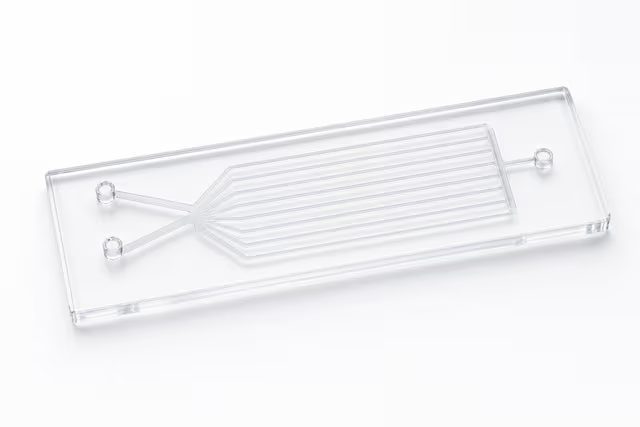
The Short-Segment Cross Electrophoresis Chip represents a specialized microfluidic platform designed for rapid electrophoretic analysis in a standard slide format. Built on a 25 x 76 mm substrate, this chip features a cross-channel design with a shortened separation segment optimized for high-throughput screening applications. The reduced path length enables faster analysis times while maintaining adequate resolution for separation-based assays.
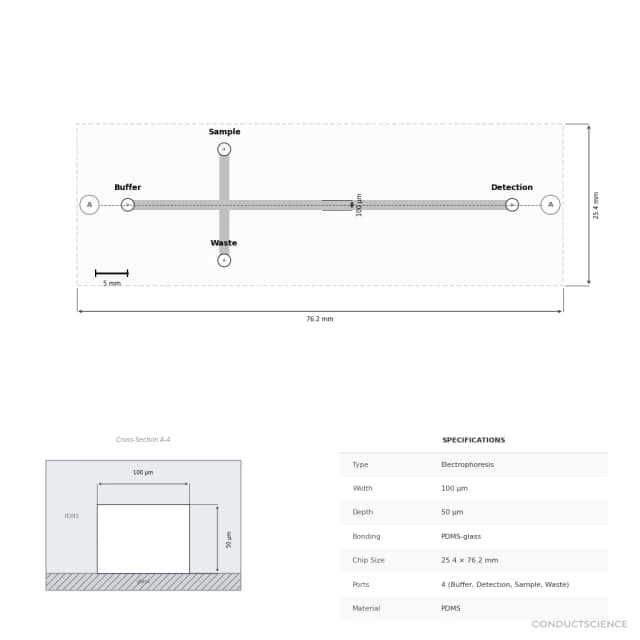
The cross-intersection architecture allows for precise sample injection and electrokinetic manipulation, making this device suitable for applications requiring rapid turnaround times without the extended separation distances of conventional electrophoresis systems. The standard slide dimensions ensure compatibility with existing microscopy and detection platforms commonly found in analytical laboratories.
How It Works
The Short-Segment Cross Electrophoresis Chip operates on the principle of electrokinetic separation within a microfluidic channel network. Sample injection occurs at the cross-intersection, where precise voltage control allows for defined sample plugs to be introduced into the separation channel. Applied electric fields drive charged analytes through the shortened separation segment based on their electrophoretic mobility differences.
The cross-channel geometry enables electrokinetic injection without mechanical valves, relying on voltage switching to control sample introduction and separation timing. The reduced separation length decreases analysis time while maintaining sufficient resolution for many screening applications. Detection typically occurs at the end of the separation channel using optical methods such as fluorescence or UV absorption.
The standard slide format allows integration with conventional microscopy systems and automated detection platforms, enabling real-time monitoring of the separation process and quantitative analysis of separated components.
Features & Benefits
Shipping weight
- 3.3 lb
Shipping box
- L: 181.8 cm
- W: 136.3 cm
- H: 90.9 cm
| Feature | This Product | Typical Alternative | Advantage |
|---|---|---|---|
| Separation Channel Length | Short separation segment for rapid analysis | Longer separation channels in standard electrophoresis chips | Enables faster throughput for screening applications where high resolution is not critical. |
| Chip Dimensions | 25 x 76 mm standard slide format | Custom chip dimensions vary by manufacturer | Ensures compatibility with existing microscopy and detection platforms in most laboratories. |
| Channel Architecture | Cross-channel injection design | Various injection schemes including T-junction and simple channel designs | Provides precise electrokinetic sample introduction without requiring mechanical components. |
| Application Focus | Optimized for rapid screening applications | General-purpose electrophoresis chips with longer analysis times | Specifically designed for high-throughput workflows requiring fast turnaround times. |
This electrophoresis chip offers rapid analysis capabilities through its shortened separation segment while maintaining the convenience of standard slide format dimensions. The cross-channel design enables precise sample handling for screening applications requiring faster throughput than conventional microfluidic electrophoresis systems.
| Model | SKU | Listed price | Status | Shipping box |
|---|---|---|---|---|
| 25-Pack | WHM-0110-25PK | Quote | Available | 181.8 x 136.3 x 90.9 cm |
| 10-Pack | WHM-0110-10PK | $1,490.00 | Available | 181.8 x 136.3 x 90.9 cm |
| 5-Pack | WHM-0110-5PK | Quote | Available | 181.8 x 136.3 x 90.9 cm |
Practical Tips
Prime channels thoroughly with buffer before first use to ensure stable electroosmotic flow and reproducible separations.
Why: Proper channel conditioning establishes consistent surface chemistry for reliable electrophoretic performance.
Flush channels with appropriate cleaning solutions between different sample types to prevent cross-contamination.
Why: Residual analytes can interfere with subsequent separations and affect quantitative accuracy.
Monitor injection reproducibility by analyzing peak areas and migration times of control standards.
Why: Electrokinetic injection can vary with buffer conditions and chip surface properties.
Check for air bubbles in channels if separation performance degrades, as they disrupt electric field uniformity.
Why: Air bubbles create high resistance regions that can cause field distortion and poor separation.
Always use appropriate high voltage safety protocols and ensure proper grounding of detection equipment.
Why: Electrophoresis systems operate at potentially dangerous voltages requiring careful safety procedures.
Use migration time standards appropriate for your buffer system to establish separation performance baselines.
Why: Migration times can vary with buffer composition, temperature, and chip surface conditions.
Setup Guide
What’s in the Box
- Short-Segment Cross Electrophoresis Chip
- Product documentation and specifications (typical)
- Quality control certificate (typical)
Warranty
ConductScience provides standard manufacturer warranty coverage for this microfluidic device. Technical support is available to assist with chip selection and application optimization.
Compliance
What voltage ranges are typically required for operation?
Consult product datasheet for specific voltage requirements. Operating voltages depend on channel geometry, buffer conditions, and separation requirements for your particular application.
How many samples can be processed per hour using this chip?
Throughput depends on separation time requirements for your analytes and detection method. The short separation segment is designed to reduce analysis time compared to conventional long-path systems.
What detection methods are compatible with this chip format?
The standard slide format supports various optical detection methods including fluorescence, UV absorption, and microscopy-based detection systems commonly found in analytical laboratories.
Can this chip be reused for multiple analyses?
Reusability depends on the specific analytes and separation conditions. Glass microfluidic chips can often be regenerated through appropriate cleaning protocols between runs.
What types of samples are suitable for this electrophoresis format?
The chip is designed for rapid screening applications involving ionic species, small molecules, and other analytes amenable to electrokinetic separation in microfluidic formats.
How does the short separation segment affect resolution?
The shortened path reduces separation time while maintaining adequate resolution for screening applications. Resolution will be lower than long-path systems but sufficient for many analytical requirements.
Have a question about this product?
Have a question? Just ask.
Send it over and we'll email you a personalized answer — no call, no scheduling.
Prefer to talk it through?