Small Molecule Analysis Chip (100 um)
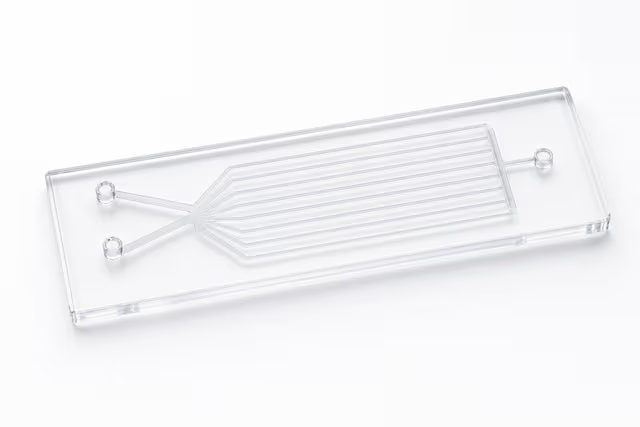
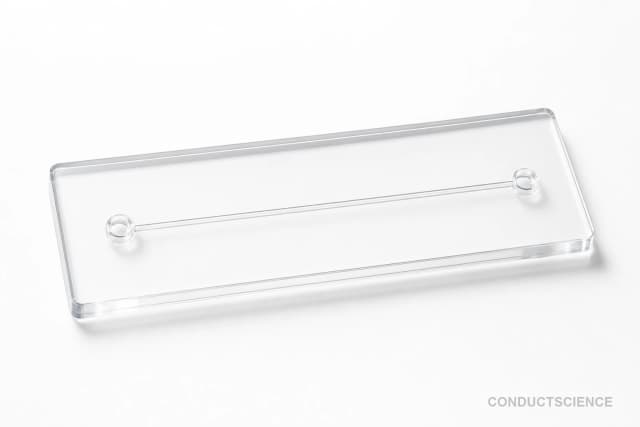
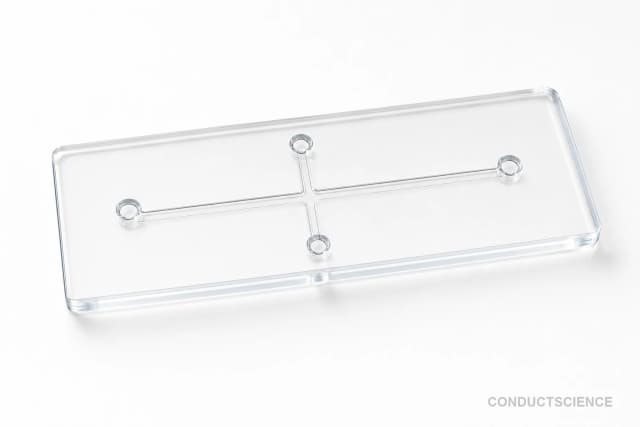
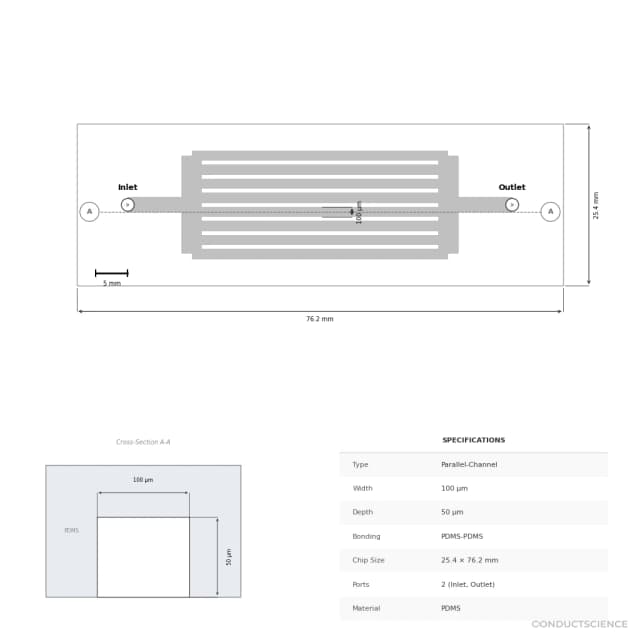
Microfluidic analysis chip with 100 x 100 μm channels for small molecule detection and quantification in pharmaceutical and environmental applications.
Reusable chip — designed for multiple experimental runs. Compatible with standard microfluidic tubing: steel pins (0.7 mm ID / 1.0 mm OD) and silicone tubing (0.8 mm ID / 1.9 mm OD). Available in bulk packs (5‑, 10‑, and 25‑unit) for lab-scale and consumable workflows.

Louise Corscadden, PhD
Director of Science · ConductScience
Ask Louise about Small Molecule Analysis Chip (100 um) fit, setup, configuration, or quote prep.
Already working with us? Sign in to connect this with My Scientist.
Key Specifications
Full details →- Model fit
- 3 selectable configurations
- SKU family
- WHM-0140
- Shipping box
- 181.8 x 136.3 x 90.9 cm
- Ordering
- Online checkout and quote request available
- Category
- Environmental Detection Chips
- Build notes
- Confirm accessories, station layout, and support needs before purchase
The Small Molecule Analysis Chip (100 μm) is a precision microfluidic device designed for chemical detection and quantification applications. Featuring 100 x 100 μm channel dimensions, this lab-on-chip platform enables controlled manipulation and analysis of small molecules in pharmaceutical, environmental, and analytical chemistry workflows.
The chip architecture supports molecular detection assays, chemical sensor integration, and microfluidic mixing protocols. Researchers utilize this platform for drug screening applications, environmental contaminant analysis, and small molecule quantification studies where precise fluidic control and miniaturized reaction volumes are essential for accurate measurements.
How It Works
The chip utilizes microfluidic channel geometry to control fluid flow and molecular transport at the microscale. The 100 x 100 μm channel dimensions create predictable laminar flow conditions where molecular diffusion and convective transport can be precisely controlled for analytical applications.
Small molecules are introduced into the channel network through inlet ports and undergo controlled mixing, reaction, or separation processes. The confined geometry enables efficient mass transfer and reaction kinetics while minimizing sample volumes and reagent consumption. Detection methods can be integrated directly on-chip or coupled to external analytical instruments.
The platform supports various detection modalities including optical absorbance, fluorescence, and electrochemical sensing depending on the specific analytical requirements and molecular targets of interest.
Features & Benefits
Shipping weight
- 3.3 lb
Shipping box
- L: 181.8 cm
- W: 136.3 cm
- H: 90.9 cm
| Feature | This Product | Typical Alternative | Advantage |
|---|---|---|---|
| Channel Dimensions | 100 x 100 μm channels | Entry-level chips often feature 200-500 μm channels | Smaller channels provide better mixing efficiency and reduced sample volumes for cost-effective analysis. |
| Application Range | Small molecule analysis, pharmaceutical, and environmental applications | Many chips are designed for single-application use | Multi-application compatibility reduces equipment costs and simplifies laboratory workflows. |
| Detection Integration | Compatible with optical, electrochemical, and MS coupling | Basic chips may support limited detection methods | Flexible detection options allow researchers to optimize sensitivity for specific molecular targets. |
| Channel Geometry | Precision microfluidic architecture for controlled transport | Standard designs may lack optimized flow characteristics | Predictable flow conditions improve reproducibility and reduce optimization time for new protocols. |
The chip offers optimized 100 μm channel dimensions that balance mixing efficiency with practical flow rates for diverse small molecule applications. The multi-application design supports pharmaceutical, environmental, and analytical chemistry workflows with a single platform.
| Model | SKU | Listed price | Status | Shipping box |
|---|---|---|---|---|
| 25-Pack | WHM-0140-25PK | Quote | Available | 181.8 x 136.3 x 90.9 cm |
| 10-Pack | WHM-0140-10PK | $1,490.00 | Available | 181.8 x 136.3 x 90.9 cm |
| 5-Pack | WHM-0140-5PK | Quote | Available | 181.8 x 136.3 x 90.9 cm |
Practical Tips
Calibrate flow rates using precision syringe pumps and verify with tracer studies before experimental runs.
Why: Accurate flow control is essential for reproducible residence times and mixing ratios in microfluidic assays.
Flush channels immediately after experiments with appropriate solvents to prevent sample carryover and channel fouling.
Why: Prompt cleaning prevents residue buildup that can alter channel geometry and affect subsequent measurements.
Filter all samples and reagents through 0.2 μm filters before introduction to microchannels.
Why: Particle removal prevents channel blockages and maintains consistent flow patterns throughout experiments.
If bubbles form in channels, increase back pressure slightly or use degassed solutions to maintain bubble-free operation.
Why: Air bubbles disrupt flow patterns and interfere with detection signals, compromising data quality.
Allow sufficient equilibration time after changing flow conditions before collecting analytical data.
Why: Steady-state conditions are required for reproducible measurements and accurate quantification results.
Use appropriate chemical-resistant tubing and fittings when working with organic solvents or aggressive reagents.
Why: Chemical compatibility prevents system failures and ensures safe operation with diverse analytical protocols.
Maintain consistent temperature during experiments to ensure stable viscosity and flow characteristics.
Why: Temperature variations affect fluid properties and can introduce systematic errors in microfluidic measurements.
Setup Guide
What’s in the Box
- Small Molecule Analysis Chip (100 μm)
- Product documentation and specifications
- Storage container (typical)
- Connection guide (typical)
Warranty
ConductScience provides a one-year manufacturer warranty covering materials and workmanship defects. Technical support is available for setup guidance and application protocols.
Compliance
What flow rates are optimal for the 100 μm channel dimensions?
Flow rates typically range from 1-100 μL/min depending on application requirements. Lower rates favor mixing and reaction completion while higher rates reduce analysis time. Consult product datasheet for pressure drop calculations.
What detection methods are compatible with this chip design?
The chip supports optical detection (absorbance, fluorescence), electrochemical sensing, and mass spectrometry coupling. Channel geometry accommodates various detection window configurations.
How do I prevent channel clogging during operation?
Use appropriate filtration of samples and reagents, maintain steady flow rates, and perform regular cleaning protocols between samples. Avoid particulates larger than 10 μm.
What is the typical sample volume required per analysis?
Sample volumes range from 1-50 μL depending on the analysis protocol and detection method. The microfluidic design minimizes sample consumption compared to conventional methods.
Can this chip handle organic solvents?
Solvent compatibility depends on chip material composition. Consult product specifications for chemical compatibility data with specific solvents used in your application.
How do I achieve reproducible mixing in the microchannels?
Control flow rate ratios between inlet streams, ensure steady-state conditions, and account for molecular diffusion times. Residence time in mixing regions should be optimized for complete mixing.
What maintenance is required between experiments?
Flush channels with appropriate cleaning solutions, inspect for residue or damage, and store in clean conditions. Replace chips if channel integrity is compromised.
Have a question about this product?
Have a question? Just ask.
Send it over and we'll email you a personalized answer — no call, no scheduling.
Prefer to talk it through?