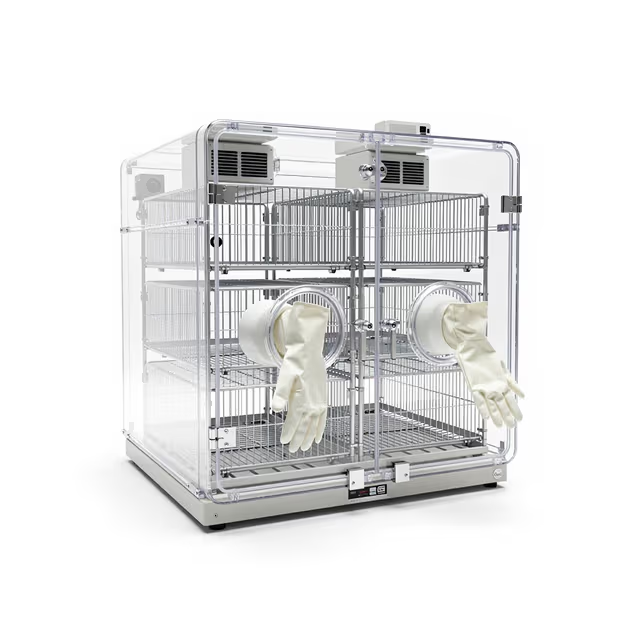
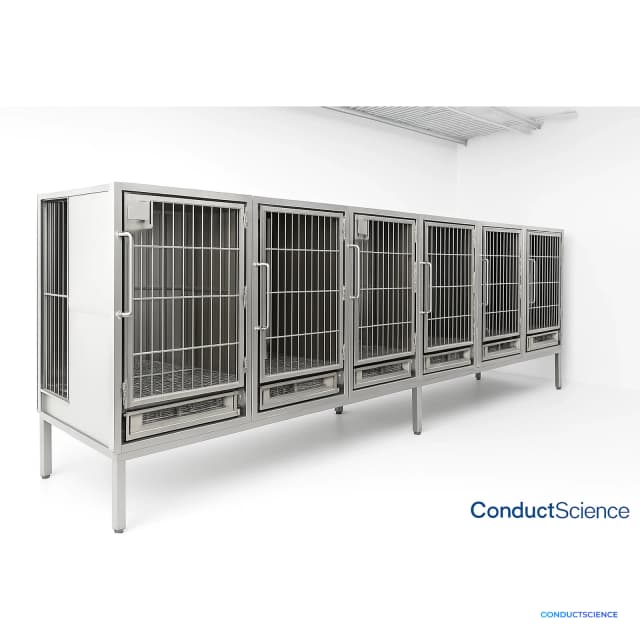
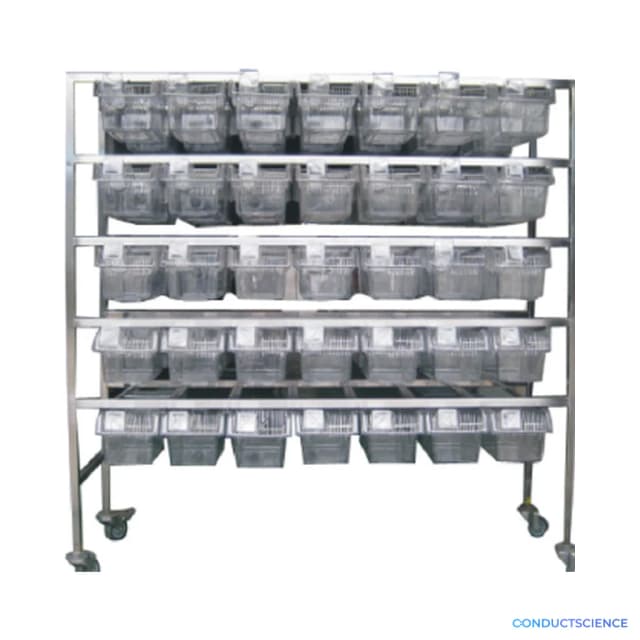
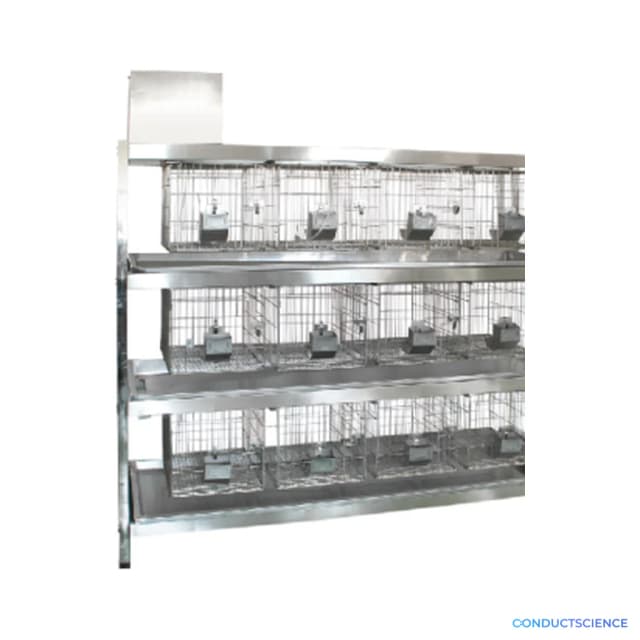
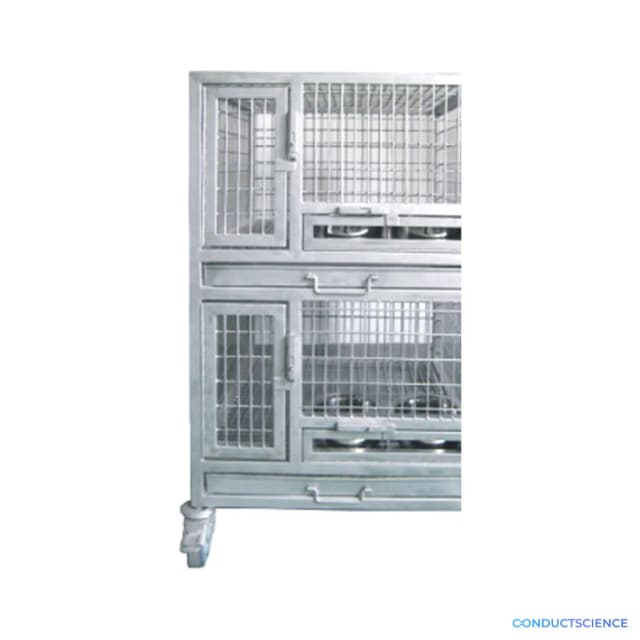
Stainless Steel 4-Layer Laboratory Monkey Cage
Four-tier stainless steel housing system for non-human primates featuring reinforced locking mechanisms and removable waste collection trays for secure laboratory containment.

Louise Corscadden, PhD
Director of Science · ConductScience
Ask Louise about Stainless Steel 4-Layer Laboratory Monkey Cage fit, setup, configuration, or quote prep.
Already working with us? Sign in to connect this with My Scientist.
Key Specifications
Full details →- Model fit
- Non-human Primate
- SKU family
- PTY-0017
- Shipping box
- 65.0 x 32.0 x 82.0 cm
- Ordering
- Online checkout and quote request available
- Category
- Large Animal Housing
- Build notes
- Stainless Steel SS304
The Stainless Steel 4-Layer Laboratory Monkey Cage (PTY-0017) provides secure, space-efficient housing for non-human primates in research environments. Constructed from SS304 stainless steel with reinforced locking mechanisms, this four-tier system maximizes vertical space utilization while maintaining individual animal containment and direct observation access for research protocols.
Each tier incorporates removable waste collection trays for efficient cleaning protocols and maintaining sanitary conditions. The robust stainless steel construction supports long-term use in laboratory settings requiring durable primate housing solutions with reliable containment security. The system accommodates individual housing requirements for behavioral, pharmacological, and toxicological research protocols requiring isolated subject observation.
How It Works
The four-tier design utilizes vertical stacking to maximize housing capacity within limited laboratory floor space while maintaining individual animal containment. Each tier functions as an independent housing unit with secure access points and reinforced locking mechanisms that prevent escape while enabling routine husbandry and research access.
The SS304 stainless steel construction provides chemical resistance and durability under repeated sanitation protocols. Removable waste collection trays at each tier facilitate efficient cleaning and waste management without disturbing adjacent animals. The open cage design maintains visual observation access for behavioral monitoring while providing adequate ventilation for animal welfare.
The reinforced locking mechanisms incorporate fail-safe design principles to prevent accidental opening during routine laboratory operations while remaining accessible for authorized research and husbandry personnel.
Features & Benefits
Tiers
- 4 layers
Security
- Reinforced locking mechanisms
Waste Collection
- Removable trays per tier
Automation Level
- manual
Brand
- ConductScience
Material
- Stainless Steel SS304
Species
- Non-human Primate
Research Domain
- Addiction Research
- Aging Research
- Behavioral Pharmacology
- Developmental Biology
- Neuroscience
- Toxicology
Shipping weight
- 85.0 lb
Shipping box
- L: 65.0 cm
- W: 32.0 cm
- H: 82.0 cm
| Feature | This Product | Typical Alternative | Advantage |
|---|---|---|---|
| Construction Material | SS304 stainless steel throughout | Entry-level systems often use mixed materials with polymer components | Provides superior chemical resistance and durability under repeated laboratory sanitation protocols |
| Tier Configuration | Four independent tiers with individual access | Most systems offer 2-3 tiers with shared access points | Maximizes housing density while maintaining complete individual containment isolation |
| Locking Security | Reinforced locking mechanisms on all access points | Standard systems often have basic latching mechanisms | Ensures secure containment for long-term studies with minimal escape risk |
| Waste Management | Removable collection trays per individual tier | Some systems use shared waste collection or fixed drainage | Enables efficient sanitation protocols without cross-contamination between subjects |
This system provides SS304 stainless steel construction across four independent tiers with reinforced locking mechanisms and individual waste collection trays. The design prioritizes long-term durability, containment security, and efficient sanitation protocols for laboratory primate housing applications.
Practical Tips
Establish staggered cleaning schedules for each tier to maintain continuous housing availability while ensuring thorough sanitation.
Why: Prevents facility downtime and maintains research continuity during routine maintenance cycles.
Inspect locking mechanisms weekly for proper engagement and lubricate moving parts with laboratory-safe lubricants as needed.
Why: Prevents mechanism failure that could compromise containment security during long-term studies.
Always engage backup containment protocols when accessing individual tiers for routine procedures or cleaning.
Why: Provides redundant security to prevent accidental escape during authorized access procedures.
Document tier assignments and rotation schedules to prevent location bias in behavioral observations.
Why: Environmental factors like height and position can influence primate behavior and confound research results.
Position the system away from high-traffic laboratory areas to minimize stress-inducing stimuli for housed animals.
Why: Reduces environmental confounding factors that could influence physiological and behavioral measurements.
Replace waste collection trays showing signs of wear or staining to maintain sanitation standards.
Why: Compromised waste collection surfaces can harbor contaminants and affect animal health outcomes.
If locking mechanisms become difficult to operate, check for debris accumulation in pivot points and clean thoroughly.
Why: Contamination in moving parts can cause binding and compromise both security and accessibility.
Setup Guide
What’s in the Box
- Four-tier stainless steel cage assembly
- Reinforced locking hardware set
- Removable waste collection trays (4 units)
- Assembly hardware and fasteners
- Installation and operation manual (typical)
- Cleaning and maintenance guidelines (typical)
Warranty
ConductScience provides standard one-year manufacturer warranty covering defects in materials and workmanship with technical support for proper installation and operation procedures.
Compliance
What are the dimensional specifications for each housing tier?
Consult product datasheet for specific tier dimensions, clearance heights, and total system footprint requirements for laboratory space planning.
How does the waste collection system facilitate sanitation protocols?
Each tier includes removable waste collection trays that can be cleaned independently without disturbing animals in other tiers, supporting efficient husbandry schedules.
What is the weight capacity for each tier?
Consult product datasheet for specific load capacities and weight limitations for safe operation with adult non-human primate subjects.
Are the locking mechanisms compatible with standard laboratory protocols?
The reinforced locking mechanisms are designed for authorized personnel access while preventing animal escape, supporting routine husbandry and research procedures.
How does SS304 stainless steel perform under laboratory disinfection protocols?
SS304 provides chemical resistance to standard laboratory disinfectants and maintains structural integrity under repeated sanitation cycles required for primate housing.
Can individual tiers be accessed independently during research protocols?
Yes, each tier functions independently with separate access points, enabling individual animal handling without disturbing subjects in adjacent tiers.
What maintenance requirements are needed for long-term operation?
Regular inspection of locking mechanisms, waste tray condition, and stainless steel surfaces for wear, with periodic deep sanitation according to institutional protocols.
How does this system compare to single-tier housing units?
The four-tier design provides equivalent individual containment with significantly reduced floor space requirements compared to four separate single-tier units.
Have a question about this product?
Have a question? Just ask.
Send it over and we'll email you a personalized answer — no call, no scheduling.
Prefer to talk it through?
Accessories
Enhance your setup with compatible accessories