Standard Droplet Formation Chip
PDMS microfluidic chip with 100 × 100 μm channels and T-junction geometry for controlled droplet generation in research and educational applications.
Reusable chip — designed for multiple experimental runs. Compatible with standard microfluidic tubing: steel pins (0.7 mm ID / 1.0 mm OD) and silicone tubing (0.8 mm ID / 1.9 mm OD). Available in bulk packs (5‑, 10‑, and 25‑unit) for lab-scale and consumable workflows.

Louise Corscadden, PhD
Director of Science · ConductScience
Ask Louise about Standard Droplet Formation Chip fit, setup, configuration, or quote prep.
Already working with us? Sign in to connect this with My Scientist.
Key Specifications
Full details →- Model fit
- 2 selectable configurations
- SKU family
- WHM-0092
- Shipping box
- 181.8 x 136.3 x 90.9 cm
- Ordering
- Online checkout and quote request available
- Category
- Droplet Generator Chips
- Build notes
- Confirm accessories, station layout, and support needs before purchase
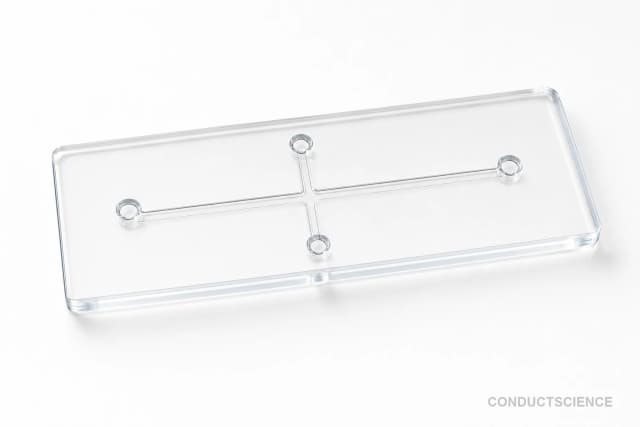
The Standard Droplet Formation Chip (WHM-0092) is a PDMS-based microfluidic device designed for controlled droplet generation using T-junction geometry. Featuring 100 × 100 μm channel dimensions, this chip provides researchers with a standardized platform for creating monodisperse droplets in aqueous-oil or oil-aqueous systems. The chip serves as an essential tool for both research applications and educational demonstrations of microfluidic principles.
The T-junction design enables precise control over droplet size and formation frequency through manipulation of flow rates and fluid properties. This chip is particularly valuable for researchers investigating emulsion formation, single-cell encapsulation, and micro-reaction systems where uniform droplet characteristics are critical for experimental reproducibility.
How It Works
The Standard Droplet Formation Chip operates on the principle of flow-focusing at a T-junction geometry. Two immiscible fluids are introduced through separate inlet channels: a dispersed phase (typically aqueous) and a continuous phase (typically oil with surfactant). At the T-junction intersection, the dispersed phase stream is periodically pinched off by the continuous phase flow, forming discrete droplets.
Droplet formation occurs through a shear-driven mechanism where the viscous stress from the continuous phase overcomes the surface tension of the dispersed phase interface. The 100 × 100 μm channel dimensions provide optimal conditions for stable droplet formation in the dripping regime, where droplets form regularly at the junction exit. Flow rate ratios between the continuous and dispersed phases determine final droplet size, while the channel geometry ensures consistent droplet spacing and uniformity.
The PDMS material enables optical transparency for real-time observation and provides chemical compatibility with most aqueous and organic solvent systems used in microfluidic applications.
Features & Benefits
Shipping weight
- 3.3 lb
Shipping box
- L: 181.8 cm
- W: 136.3 cm
- H: 90.9 cm
| Feature | This Product | Typical Alternative | Advantage |
|---|---|---|---|
| Channel Material | PDMS polymer construction | Glass or other rigid materials in higher-end systems | Provides optical transparency and flexibility while maintaining lower cost for educational and research applications. |
| Channel Cross-Section | 100 × 100 μm square channels | Variable dimensions from 50-500 μm in different models | Standardized dimensions ensure reproducible droplet formation characteristics across experiments. |
| Junction Design | T-junction geometry | Flow-focusing or multi-channel designs in advanced systems | Simplified geometry reduces complexity while maintaining reliable droplet formation for teaching and basic research. |
| Application Focus | Droplet generation and teaching applications | Specialized applications like sorting or analysis in research-grade systems | Versatile platform suitable for both educational demonstrations and fundamental droplet formation research. |
This standard chip provides reliable T-junction droplet formation in PDMS construction with 100 × 100 μm channels. The design emphasizes simplicity and reproducibility for educational use while maintaining research-grade performance for basic microfluidic studies.
| Model | SKU | Listed price | Status | Shipping box |
|---|---|---|---|---|
| 25-Pack | WHM-0092-25PK | Quote | Available | 181.8 x 136.3 x 90.9 cm |
| 10-Pack | WHM-0092-10PK | $1,490.00 | Available | 181.8 x 136.3 x 90.9 cm |
Practical Tips
Measure actual droplet sizes under your specific conditions using microscopy and image analysis to establish size-flow rate relationships.
Why: Droplet size varies with fluid properties and flow conditions beyond theoretical predictions.
Flush channels immediately after use with appropriate cleaning solvents and store chips in sealed containers to prevent contamination.
Why: Dried residues in microchannels are difficult to remove and may affect subsequent droplet formation.
Start droplet formation at low flow rates and gradually increase to optimize stability before collecting experimental samples.
Why: Initial flow transients can produce irregular droplets that may interfere with downstream analysis.
If droplets become irregular, check for air bubbles in inlet lines and verify that flow rate ratios remain in the dripping regime.
Why: Air bubbles or improper flow ratios can cause jetting instead of controlled droplet formation.
Allow system to reach steady state for at least 10 minutes before collecting droplets for size analysis or downstream applications.
Why: Thermal equilibration and flow stabilization ensure consistent droplet characteristics.
Verify chemical compatibility of all fluids with PDMS before use and work in appropriate fume hood when using organic solvents.
Why: Some solvents can cause PDMS swelling or dissolution, and organic vapors require proper ventilation.
Setup Guide
What’s in the Box
- Standard Droplet Formation Chip
- Chip protective case (typical)
- Product specification sheet (typical)
- User manual with setup instructions (typical)
Warranty
ConductScience provides a 1-year manufacturer warranty covering defects in materials and workmanship, with technical support for setup and operation guidance.
Compliance
What droplet size range can be achieved with this chip?
Droplet sizes typically range from 50-200 μm diameter depending on flow rate ratios, fluid properties, and surface treatment. Higher continuous-to-dispersed phase ratios produce smaller droplets.
What surface treatments are recommended for different fluid systems?
For water-in-oil droplets, use hydrophobic treatment (silanization). For oil-in-water systems, maintain native hydrophilic PDMS surface or apply plasma oxidation. Treatment duration affects wetting characteristics.
How do I prevent channel clogging during operation?
Filter all fluids before use, avoid high particle concentrations, maintain stable flow rates, and flush channels with appropriate solvents between experiments. Monitor pressure buildup as early clogging indicator.
What flow rate ranges work best with this chip geometry?
Optimal flow rates typically range from 1-50 μL/min for each phase, with continuous-to-dispersed ratios of 2:1 to 10:1 for stable dripping regime. Consult product datasheet for specific recommendations.
Can this chip be reused and cleaned?
Yes, PDMS chips can be cleaned with appropriate solvents and reused multiple times. Avoid harsh chemicals that may swell PDMS, and store in clean, dry conditions between uses.
What surfactants are compatible with PDMS channels?
Common surfactants include Span 80 for w/o systems and Tween 20 for o/w systems. Avoid surfactants that may absorb into PDMS or cause channel swelling. Test compatibility before extended use.
How does this compare to flow-focusing geometries?
T-junction design offers simpler fabrication and operation compared to flow-focusing devices, though flow-focusing may provide better size control and higher throughput for specific applications.
Have a question about this product?
Have a question? Just ask.
Send it over and we'll email you a personalized answer — no call, no scheduling.
Prefer to talk it through?