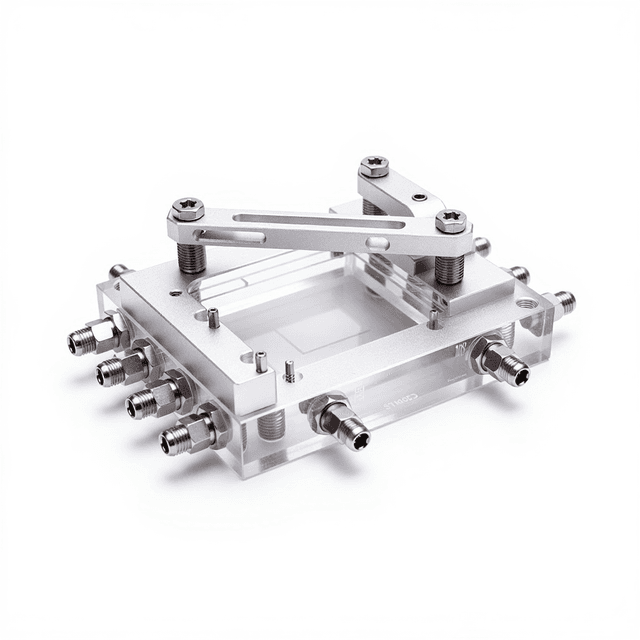
Vacuum Hot Press Bonding Machine
Vacuum hot press bonding machine for thermoplastic chip bonding in microfluidic device fabrication and microfabrication applications.

Louise Corscadden, PhD
Director of Science · ConductScience
Ask Louise about Vacuum Hot Press Bonding Machine fit, setup, configuration, or quote prep.
Already working with us? Sign in to connect this with My Scientist.
Key Specifications
Full details →- Model fit
- Configured during quote
- SKU family
- WHM-0040
- Shipping box
- 500.0 x 400.0 x 600.0 cm
- Ordering
- Online checkout and quote request available
- Category
- Lab Equipment
- Build notes
- Confirm accessories, station layout, and support needs before purchase
Product: WH-2000A Vacuum Hot Press Bonding Machine
Model: WH-2000A
Operating mode: Vacuum hot pressing
Description
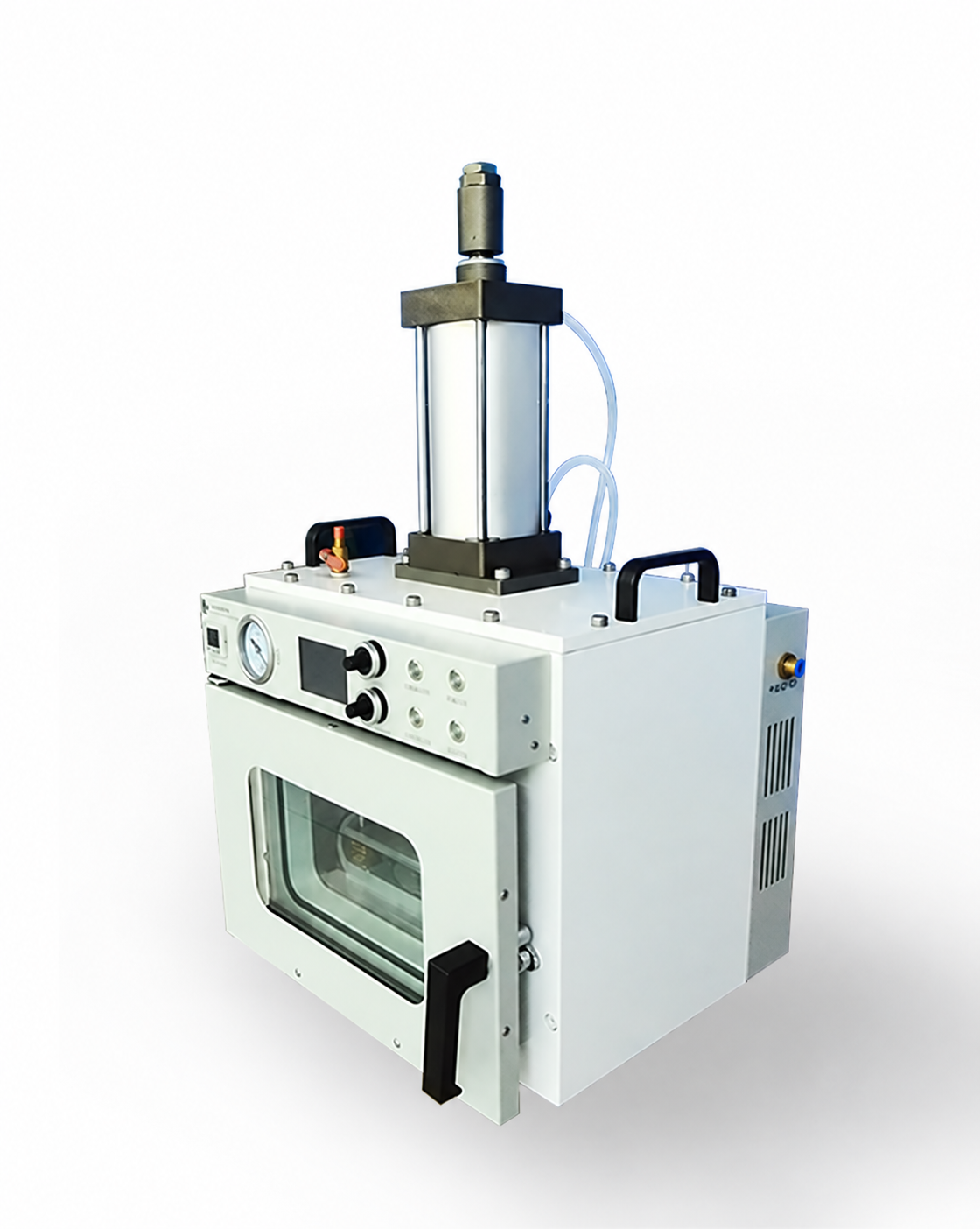
The WH-2000A is designed for bonding rigid plastic microfluidic chips made from PMMA, PC, COC, and similar materials. It combines controlled heating, pressure, and vacuum to improve bonding while minimizing damage to chip structures.
Features
- Precise constant-temperature heating
- Flat aluminum-alloy upper and lower work platforms
- Fast and uniform heat transfer
- Large heating area suitable for commonly used chip sizes
- Uniform forced-air cooling
- Precisely adjustable pressure
- Vacuum hot-press system designed to improve bonding without damaging chips
Technical Specifications
| Specification | Value |
|---|---|
| External dimensions | 470 × 415 × 876 mm |
| Weight | 80 kg |
| Working surface | 230 × 200 mm |
| Supported chip thickness | 0–140 mm |
| Rated voltage | AC 220 V, 50 Hz |
| Pressure range | 0–3 kN |
| Rated power | 1.4 kW |
| Maximum temperature | 200°C |
Component Identification
- Pneumatic cylinder
- Precision pressure regulator
- Display screen
- Glass observation window
- Power connection
- Upper-plate temperature adjustment knob
- Upper-plate temperature switch
- Cooling-fan switch
- Cylinder-control switch
- Lower-plate temperature switch
- Lower-plate temperature adjustment knob
- Digital air-pressure gauge
- Vacuum gauge
- Sealing ring
- Air inlet
- Compressed-air supply inlet
- Vacuum extraction port
Pressure-Accuracy Test
The supplier tested the machine between 0.06 and 0.50 MPa at three pressure settings. The reported pressure deviation remained within ±3%, and the unit passed the pressure-accuracy test.
General Operating Principle
Under vacuum or another controlled atmosphere, the material is heated and compressed between upper and lower press plates. At elevated temperature, particle bonding and material densification occur, reducing pores and increasing density. The combined effects of heat, pressure, and vacuum can improve density, hardness, and certain mechanical, electrical, and thermal properties.
How It Works
The vacuum hot press bonding process relies on the thermoplastic flow behavior of polymer substrates above their glass transition temperature. When heated under controlled conditions, thermoplastic materials become deformable, allowing molecular interdiffusion across bonding interfaces. The vacuum environment removes trapped air and surface contaminants that could compromise bond integrity.
During operation, the bonding chamber is evacuated to eliminate atmospheric pressure, while heated platens apply uniform pressure and temperature to the substrate assembly. The combination of vacuum, heat, and pressure promotes intimate contact between bonding surfaces and facilitates polymer chain entanglement across the interface. Temperature and pressure profiles are precisely controlled to optimize bonding without causing thermal degradation or dimensional distortion of microstructures.
The process parameters must be optimized for specific thermoplastic materials, with consideration for glass transition temperatures, melt viscosities, and thermal expansion coefficients. Proper parameter selection ensures strong, hermetic seals while preserving the dimensional accuracy of microfluidic features.
Features & Benefits
Environment
- Vacuum
Automation Level
- semi-automated
Brand
- ConductScience
Research Domain
- Analytical Chemistry
- Cell Biology
- Clinical Diagnostics
- Materials Science
- Microbiology
- Pharmaceutical QC
Shipping weight
- 50.0 lb
Shipping box
- L: 500.0 cm
- W: 400.0 cm
- H: 600.0 cm
| Feature | This Product | Typical Alternative | Advantage |
|---|---|---|---|
| Bonding Environment | Vacuum environment for bubble-free bonding | Atmospheric pressure bonding often results in trapped air bubbles | Vacuum environment ensures consistent, void-free bonds critical for microfluidic device integrity and performance. |
| Application Focus | Specifically designed for thermoplastic chip bonding | General-purpose presses may lack microfluidic-specific features | Specialized design optimizes parameters for microfluidic device fabrication rather than general material joining. |
| Process Control | Programmable temperature and pressure profiles | Manual systems require constant operator attention | Automated control ensures reproducible bonding conditions essential for device consistency across batches. |
| Laboratory Integration | Compact 500 × 400 × 600 mm footprint | Industrial systems often require dedicated floor space | Laboratory-scale design fits within research environments while providing full bonding capabilities. |
This vacuum hot press bonding machine provides specialized capabilities for thermoplastic microfluidic device fabrication with programmable process control in a laboratory-compatible form factor. The vacuum environment and optimized parameter control distinguish it from general-purpose bonding equipment.
Practical Tips
Verify temperature uniformity across the bonding area using thermal mapping before processing critical devices.
Why: Temperature variations can cause uneven bonding and dimensional distortions in microstructures.
Clean bonding platens with appropriate solvents after each use to prevent contamination buildup.
Why: Surface contamination can create weak spots in bonds and affect device hermeticity.
Pre-heat substrates gradually to prevent thermal shock and ensure uniform temperature distribution.
Why: Rapid heating can cause thermal stress and uneven expansion that compromises bond quality.
If bonds appear weak, check vacuum level and verify no air leaks in the chamber sealing system.
Why: Inadequate vacuum allows air entrapment that weakens the bonding interface.
Record complete process parameters for each bonding run to enable reproducibility and troubleshooting.
Why: Parameter documentation supports quality control and process optimization across device batches.
Allow complete cooling under pressure before venting the chamber to prevent thermal shock to bonded devices.
Why: Rapid cooling or pressure release can cause stress fractures in the thermoplastic bond interface.
Optimize bonding parameters using test substrates before processing final devices to avoid material waste.
Why: Parameter optimization ensures reliable bonding without risking expensive or time-consuming device fabrication.
Setup Guide
What’s in the Box
- Vacuum hot press bonding machine (main unit)
- Heated bonding platens (typical)
- Vacuum chamber assembly (typical)
- Temperature controller interface (typical)
- Pressure application system (typical)
- Vacuum gauge and controls (typical)
- User manual and operation guide (typical)
- Basic tooling set (typical)
Warranty
ConductScience provides a standard 1-year manufacturer warranty covering defects in materials and workmanship, with technical support for process optimization and troubleshooting assistance.
Compliance
What thermoplastic materials are compatible with this bonding system?
The system is designed for common microfluidic thermoplastics including PMMA, polycarbonate, COC, and COP. Bonding parameters must be optimized for each material based on glass transition temperature and thermal expansion properties.
What vacuum level is achievable and how does it affect bond quality?
Consult product datasheet for specific vacuum specifications. Lower vacuum levels improve bond quality by removing trapped air and surface moisture that can create weak spots or bubbles in the bonded interface.
How is temperature uniformity maintained across the bonding area?
The system uses heated platens designed for uniform heat distribution. Temperature uniformity depends on platen design and thermal mass. Verify temperature mapping across the bonding area for critical applications.
What is the maximum substrate size that can be processed?
Consult product datasheet for specific chamber dimensions and substrate capacity. The 500 × 400 mm external dimensions suggest accommodation of typical research-scale microfluidic substrates.
How do I optimize bonding parameters for new thermoplastic combinations?
Start with material supplier recommendations for bonding temperature and pressure. Perform systematic parameter optimization studies varying temperature, pressure, and time while monitoring bond strength and dimensional accuracy.
What maintenance is required for consistent bonding performance?
Regular cleaning of bonding surfaces, vacuum system maintenance, and temperature calibration verification are essential. Replace seals and filters according to usage frequency and contamination levels.
Can the system handle substrates with pre-existing microstructures?
Yes, vacuum bonding is specifically designed to preserve microstructure integrity during bonding. Pressure and temperature must be controlled to prevent feature collapse or deformation.
How does this compare to solvent bonding or adhesive methods?
Vacuum hot press bonding creates stronger, more chemically resistant joints without introducing foreign materials. It eliminates solvent compatibility issues and provides better long-term stability for biological and chemical applications.
Have a question about this product?
Have a question? Just ask.
Send it over and we'll email you a personalized answer — no call, no scheduling.
Prefer to talk it through?