Y-Type Turbulent Mixing Chip
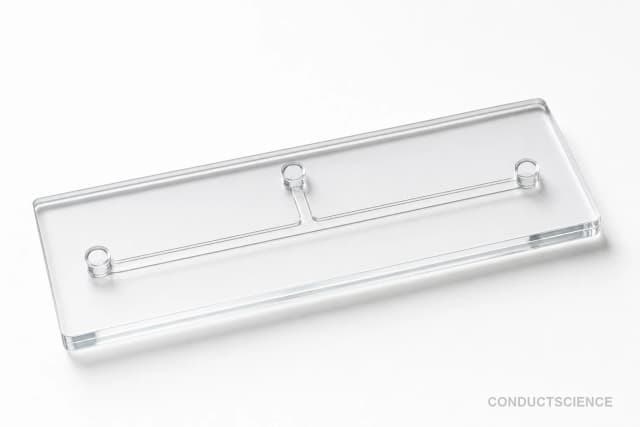
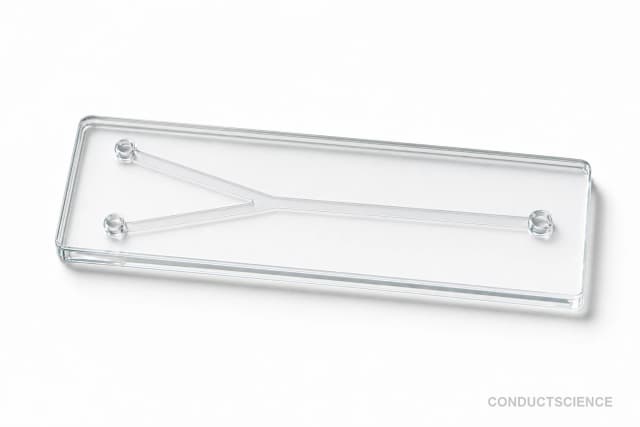
Microfluidic mixing chip featuring embedded microbeads in a Y-junction design for turbulent flow generation and rapid reagent blending in standard slide format.
Reusable chip — designed for multiple experimental runs. Compatible with standard microfluidic tubing: steel pins (0.7 mm ID / 1.0 mm OD) and silicone tubing (0.8 mm ID / 1.9 mm OD). Available in bulk packs (5‑, 10‑, and 25‑unit) for lab-scale and consumable workflows.

Louise Corscadden, PhD
Director of Science · ConductScience
Ask Louise about Y-Type Turbulent Mixing Chip fit, setup, configuration, or quote prep.
Already working with us? Sign in to connect this with My Scientist.
Key Specifications
Full details →- Model fit
- 3 selectable configurations
- SKU family
- WHM-0116
- Shipping box
- 181.8 x 136.3 x 90.9 cm
- Ordering
- Online checkout and quote request available
- Category
- Microfluidic Chips
- Build notes
- Confirm accessories, station layout, and support needs before purchase
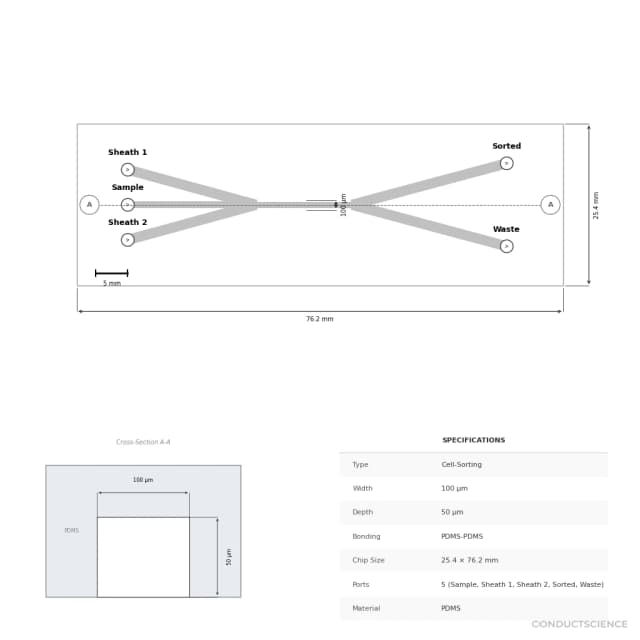
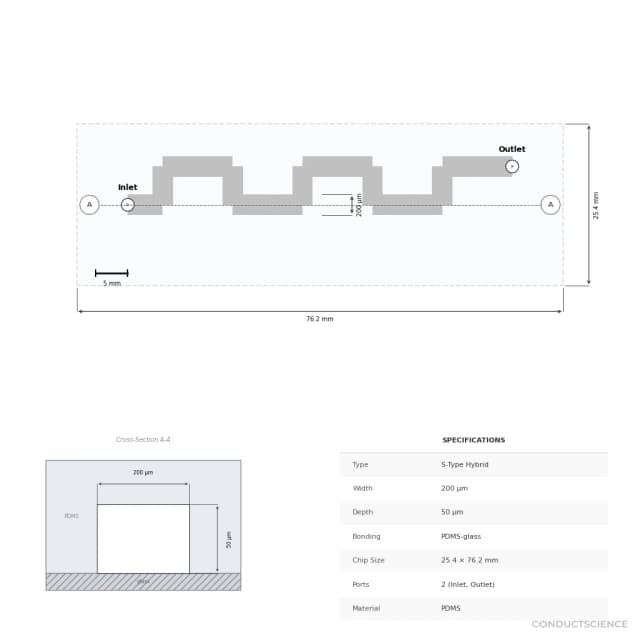
The Y-Type Turbulent Mixing Chip is a specialized microfluidic device designed for rapid and efficient mixing of reagents in microscale fluid handling applications. The chip incorporates embedded microbeads within its Y-junction architecture to generate turbulent flow patterns that enhance mixing efficiency through chaotic advection. Manufactured in the standard 25 x 76 mm slide format, this chip enables seamless integration with existing microscopy and microfluidic instrumentation.
The turbulent mixing mechanism provides superior mixing performance compared to conventional laminar flow devices, making it particularly suitable for applications requiring rapid homogenization of reagents, chemical reactions at microscale, or preparation of uniform sample distributions. The chip's geometry and microbead integration create controlled turbulence that accelerates diffusion-limited mixing processes while maintaining precise flow control.
How It Works
The Y-Type Turbulent Mixing Chip operates on the principle of chaotic advection enhanced by embedded microbeads. When two fluid streams enter the Y-junction, they initially flow in parallel laminar streams with mixing limited to molecular diffusion at the interface. The embedded microbeads within the channel create flow disturbances that generate localized turbulence and secondary flow patterns.
The microbeads act as passive mixing elements that induce chaotic streamlines, repeatedly stretching and folding the fluid interface to exponentially increase the contact area between the mixing fluids. This chaotic advection mechanism significantly reduces mixing time from the diffusion-limited timescale to the convection timescale, achieving homogeneous mixing over distances much shorter than conventional laminar mixing devices.
The 25 x 76 mm slide format dimensions provide optimal channel length for complete mixing while maintaining compatibility with standard microscopy stages and flow control systems. The turbulent flow regime created by the microbead array ensures efficient mixing even at low Reynolds numbers typical of microfluidic applications.
Features & Benefits
Shipping weight
- 3.3 lb
Shipping box
- L: 181.8 cm
- W: 136.3 cm
- H: 90.9 cm
| Feature | This Product | Typical Alternative | Advantage |
|---|---|---|---|
| Mixing Method | Embedded microbeads generating turbulent flow | Simple laminar flow or basic geometric features | Turbulent mixing achieves homogenization in shorter channel lengths and faster time scales |
| Chip Format | 25 x 76 mm standard slide dimensions | Custom dimensions requiring specialized holders | Direct compatibility with existing microscopy and instrumentation setups |
| Flow Configuration | Y-junction with two controllable inlets | Single inlet or complex multi-inlet designs | Optimal balance between mixing control and system simplicity |
| Mixing Enhancement | Chaotic advection through microbead placement | Relies primarily on molecular diffusion | Orders of magnitude faster mixing for time-sensitive applications |
This chip combines the convenience of standard slide format with advanced turbulent mixing technology. The embedded microbead design provides superior mixing performance while maintaining the simplicity of a two-inlet Y-junction configuration.
| Model | SKU | Listed price | Status | Shipping box |
|---|---|---|---|---|
| 25-Pack | WHM-0116-25PK | Quote | Available | 181.8 x 136.3 x 90.9 cm |
| 10-Pack | WHM-0116-10PK | $1,490.00 | Available | 181.8 x 136.3 x 90.9 cm |
| 5-Pack | WHM-0116-5PK | Quote | Available | 181.8 x 136.3 x 90.9 cm |
Practical Tips
Establish baseline mixing efficiency using fluorescent tracers before each experimental series.
Why: Ensures reproducible mixing performance and helps identify any channel degradation or clogging.
Flush channels immediately after use and store filled with appropriate solvent to prevent sample crystallization.
Why: Prevents blockages around microbead sites that are difficult to clear once established.
Match flow rates to achieve desired mixing ratios, starting with equal rates for 1:1 mixing.
Why: Flow rate ratio directly controls the final concentration ratio in the mixed stream.
If mixing appears incomplete, increase flow rates slightly to enhance turbulent effects around microbeads.
Why: Higher Reynolds numbers improve chaotic advection patterns for better mixing efficiency.
Allow several channel volumes to flush through before collecting mixed samples for analysis.
Why: Eliminates transitional mixing artifacts and ensures steady-state mixing conditions.
Use appropriate chemical-resistant tubing and connections for corrosive reagents.
Why: Chemical compatibility prevents system failure and potential exposure to hazardous materials.
Monitor mixing quality optically when possible rather than relying solely on downstream analysis.
Why: Real-time visual feedback allows immediate optimization of flow conditions.
Setup Guide
What’s in the Box
- Y-Type Turbulent Mixing Chip (25 x 76 mm)
- User manual with setup instructions (typical)
- Certificate of manufacturing quality (typical)
Warranty
ConductScience provides a standard one-year manufacturer warranty covering defects in materials and workmanship. Technical support is available for setup guidance and troubleshooting assistance.
Compliance
What flow rate ranges work best with this mixing chip?
Optimal flow rates depend on your specific application and fluid properties. Start with equal flow rates of 1-10 μL/min per inlet and adjust based on mixing efficiency observed. Consult product datasheet for recommended ranges based on fluid viscosity.
How does mixing efficiency compare to T-junction mixers?
The embedded microbead design generates turbulent flow that typically provides 5-10 fold improvement in mixing efficiency over simple T-junction devices by creating chaotic advection patterns.
What cleaning protocols are recommended between experiments?
Flush with appropriate solvent (ethanol, acetone, or DI water) at 2-3x your experimental flow rate for 5-10 minutes. For biological samples, use 10% bleach solution followed by extensive water rinse.
Can this chip handle viscous solutions or suspensions?
Yes, the turbulent mixing mechanism works well with moderately viscous fluids. For high viscosity solutions, reduce flow rates and increase mixing channel length residence time. Avoid particle-laden suspensions that might clog around microbeads.
What tubing connections are compatible?
The chip accepts standard microfluidic tubing connectors. Common options include 1/16" OD tubing with appropriate fittings or direct PDMS-to-tubing connections. Consult product datasheet for specific port dimensions.
How do I verify complete mixing has occurred?
Use fluorescent tracers or dyed solutions to visually assess mixing under microscopy. Complete mixing is indicated by uniform intensity distribution across the channel width downstream of the mixing region.
What is the typical lifespan of the chip with regular use?
With proper cleaning protocols, the chip can withstand hundreds of experiments. Avoid harsh chemicals that might damage the chip material, and inspect channels regularly for wear or clogging around microbead sites.
Have a question about this product?
Have a question? Just ask.
Send it over and we'll email you a personalized answer — no call, no scheduling.
Prefer to talk it through?