Primary Assay — Mexican Cavefish
Vibration Attraction Behavior (VAB)
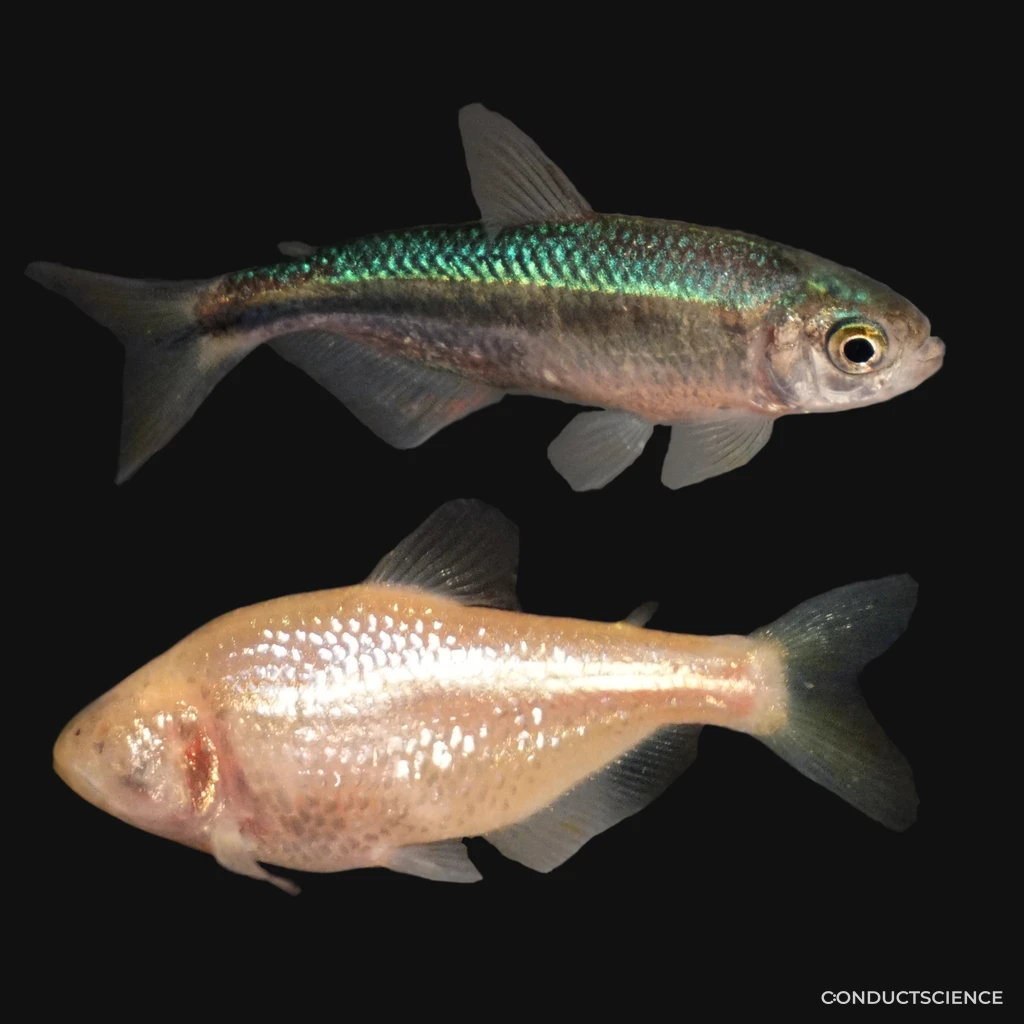
Astyanax mexicanus
Cavefish are attracted to mechanical vibrations via enhanced lateral-line input. Approach latency to a vibrating rod indexes the VAB phenotype.
Quantitative Output
Measured Parameters
Every parameter is automatically tracked frame-by-frame in the ConductVision pipeline for Astyanax mexicanus.
| Parameter | Unit | Description |
|---|---|---|
| Approach latency | s | Time to contact rod |
| Approaches per 90s | count | Engagement frequency |
| VAB index | fold change | Cave vs surface ratio |
| Distance to rod | BL | Mean approach distance |
References
Citations for Vibration Attraction Behavior (VAB)
- Yoshizawa M, et al. (2010). Evolution of a behavioral shift mediated by superficial neuromasts helps cavefish find food in darkness. Curr Biol, 20(18), 1631-1636. PMID: 20705469
Compatible Equipment
Hardware for Mexican Cavefish Research
Aquatic Activity Tracker (24h)
Sleep/wake monitoring
Vibration Generator with Rod Probe
VAB assay
Schooling / Shoaling Arena
Social behavior quantification
Lateral-Line Stim System
Neuromast-based sensory testing
Multi-Tank Sleep Imaging Rig
Long-term rest assays
Related Assays
Other Mexican Cavefish Primary Assays
15
Sleep / Activity
Astyanax mexicanus
Cave morphs of Astyanax show dramatically reduced sleep relative to surface morphs. Total rest time, bout structure, and…
15
Schooling
Astyanax mexicanus
Surface fish school strongly while cavefish do not. Polarization, nearest-neighbor distance, and shoaling cohesion bench…
15
Feeding Posture
Astyanax mexicanus
Cavefish forage at a steeper angle than surface fish, an adaptation to substrate feeding in darkness. Feeding-angle dist…
Run Vibration Attraction Behavior (VAB) on ConductVision
Our team will configure the protocol, camera rig, and analysis pipeline for your mexican cavefish facility.