Primary Assay — Planarian
Phototaxis (Light Avoidance)
Schmidtea mediterranea
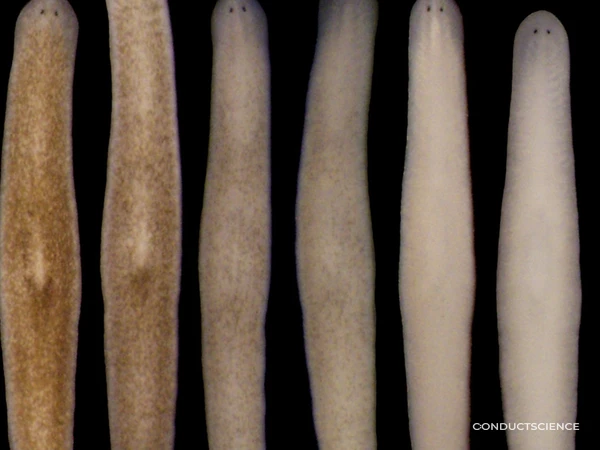
Scototaxis assay measuring innate light avoidance behavior. Planarians exhibit robust negative phototaxis mediated by both ocular and extraocular photoreceptors, providing a key endpoint for visual system regeneration studies.

Quantitative Output
Measured Parameters
Every parameter is automatically tracked frame-by-frame in the ConductVision pipeline for Schmidtea mediterranea.
| Parameter | Unit | Description |
|---|---|---|
| Light-avoidance score | % time in dark | Scototaxis strength |
| Latency to reach dark zone | s | Avoidance speed |
| Light-zone entries | count | Exploration vs avoidance balance |
References
Citations for Phototaxis (Light Avoidance)
- Birkholz TR, et al. (2017). The planarian TRPA1 homolog mediates extraocular behavioral responses to near-ultraviolet light. J Exp Biol, 220(14), 2616-2625. PMID: 28495872
- Inoue T, et al. (2004). Morphological and functional recovery of the planarian photosensing system during head regeneration. Zoolog Sci, 21(3), 275-283. PMID: 15056922
Compatible Equipment
Hardware for Planarian Research
Planarian Tracking Camera System
Automated phototaxis and locomotion
Chemotaxis Assay Plate
Gradient-based attraction testing
Dark/Light Choice Arena
Phototaxis preference
Thermal Gradient Plate
Thermotaxis assays
Regeneration Monitoring System
Post-decapitation behavioral recovery
Related Assays
Other Planarian Primary Assays
07
Chemotaxis
Schmidtea mediterranea
Gradient-based attraction assay measuring directional movement toward chemical cues. Chemotaxis index and approach laten…
07
Gliding Locomotion + Scrunching
Schmidtea mediterranea
Dual-gait analysis of normal ciliary gliding and the escape-specific scrunching gait. Scrunching — a recently discovered…
07
Behavioral Regeneration After Decapitation
Schmidtea mediterranea
Longitudinal tracking of behavioral recovery following head amputation. Measures the return of phototaxis, conditioned r…
Run Phototaxis (Light Avoidance) on ConductVision
Our team will configure the protocol, camera rig, and analysis pipeline for your planarian facility.