Primary Assay — Zebra Finch
Neophobia
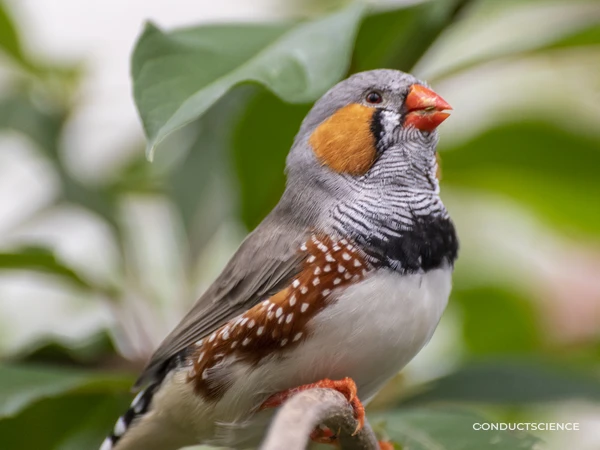
Taeniopygia guttata
Latency and avoidance measures in response to novel objects placed near a food source. Neophobia is sensitive to early-life stress and corticosterone exposure.

Quantitative Output
Measured Parameters
Every parameter is automatically tracked frame-by-frame in the ConductVision pipeline for Taeniopygia guttata.
| Parameter | Unit | Description |
|---|---|---|
| Latency to approach novel object | s | Fear of novelty |
| Time near novel vs familiar | s | Neophobic avoidance |
| Feeding suppression | % | Reduced eating near novel stimulus |
References
Citations for Neophobia
- Spencer KA, et al. (2007). Delayed behavioral effects of postnatal exposure to corticosterone in the zebra finch. Horm Behav, 51(2), 273-282. PMID: 17196201
Compatible Equipment
Hardware for Zebra Finch Research
Sound-Attenuated Recording Chamber
Song recording and analysis
Acoustic Microphone Array
Multi-channel song capture
Two-Choice Preference Chamber
Mate choice and social preference
Video Tracking System
Social proximity and neophobia
Song Analysis Software Module
Spectrogram and syntax tools
Related Assays
Other Zebra Finch Primary Assays
04
Song Learning / Crystallization
Taeniopygia guttata
Longitudinal analysis of song development from subsong through crystallization. Spectral cross-correlation with tutor so…
04
Mate Preference / Choice
Taeniopygia guttata
Two-choice preference assay measuring female attraction to male song and plumage. Time allocation, approach frequency, a…
04
Vocal Syntax Analysis
Taeniopygia guttata
Information-theoretic analysis of syllable sequencing and transition probabilities. Entropy measures capture the combina…
Run Neophobia on ConductVision
Our team will configure the protocol, camera rig, and analysis pipeline for your zebra finch facility.