Individual trajectories per animal per frame
X/Y coordinates, velocity, and heading for each identified animal at every frame. Identity labels are consistent across the entire session.
CSVJSONMP4
Markerless identification of individual animals in group-housed paradigms
Track up to four animals simultaneously with persistent identity assignment — no ear tags, paint marks, or RFID implants.
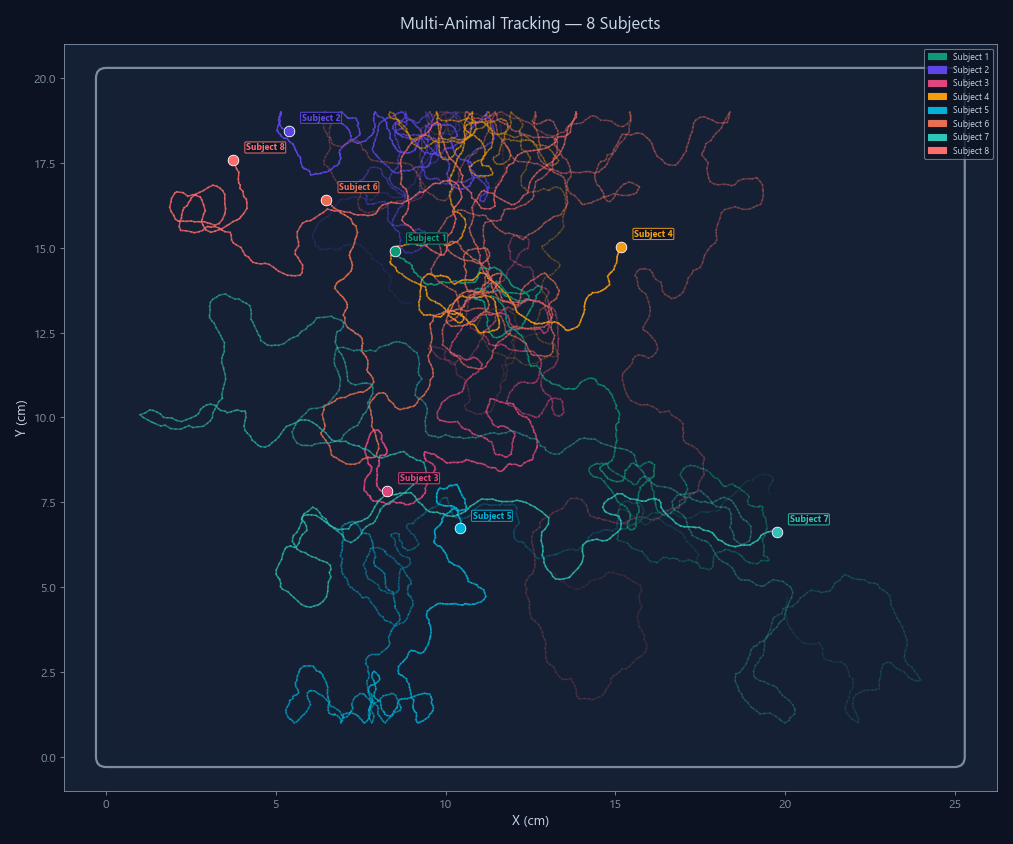
Group-housed behavioral experiments require individual identification. Current methods — paint marks, ear tags, RFID implants — each introduce their own confounds. Paint degrades within sessions, ear tags cause grooming artifacts, and implants require surgery. Manual scoring of social interactions is subjective and prohibitively slow for large cohorts.
ConductVision assigns and maintains individual identities using appearance-based features extracted directly from video. Identity persists through occlusions, crossings, and huddling. All pairwise interactions are scored automatically and continuously.
X/Y coordinates, velocity, and heading for each identified animal at every frame. Identity labels are consistent across the entire session.

Inter-animal distances, contact durations, approach/withdrawal counts, and following behavior scored for every dyad continuously.

Time in each defined zone reported per animal. Enables individual preference indices in social choice paradigms.
Track the test animal and stimulus animals independently. Compute social preference index, investigation time, and approach frequency without manual scoring.
Identify resident and intruder throughout the session. Score attack latency, bout duration, and inter-animal distance without observer bias.
Track observer and demonstrator separately to quantify observation time, proximity during demonstration, and subsequent behavioral mimicry.
Simultaneously phenotype multiple animals in the same arena. Individual locomotor profiles, thigmotaxis, and social clustering are computed in a single session.
| Feature | ConductVision | Typical systems |
|---|---|---|
| Subjects tracked simultaneously | 4 — markerless | 2 with physical markers |
| Temporal resolution | 30 fps per animal | 8-11 fps |
| Identity through occlusion | Yes — 98.7% accuracy | Frequent identity swaps |
| Data granularity | Per-animal per-frame coordinates | Aggregate or manual annotation |
| Scoring method | Fully automated, all dyads | Manual or semi-automated |
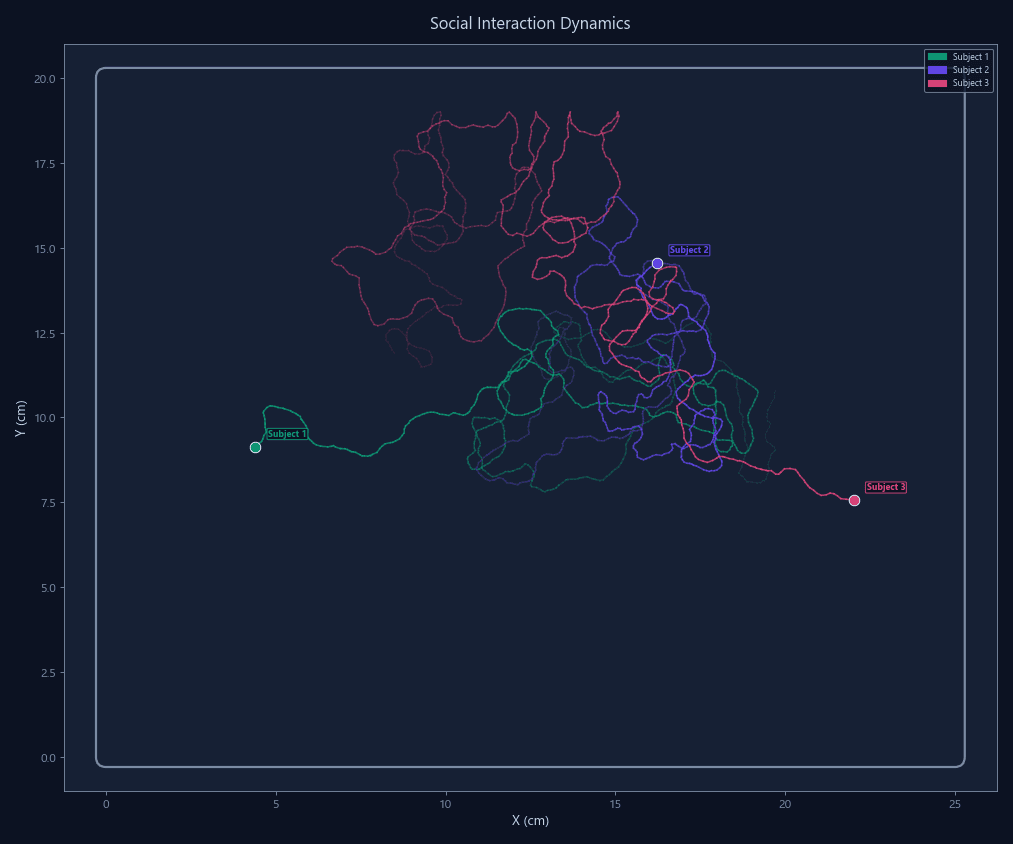
Continuous automated scoring of all pairwise social interactions — approach, contact, following, avoidance — for up to 4 animals.
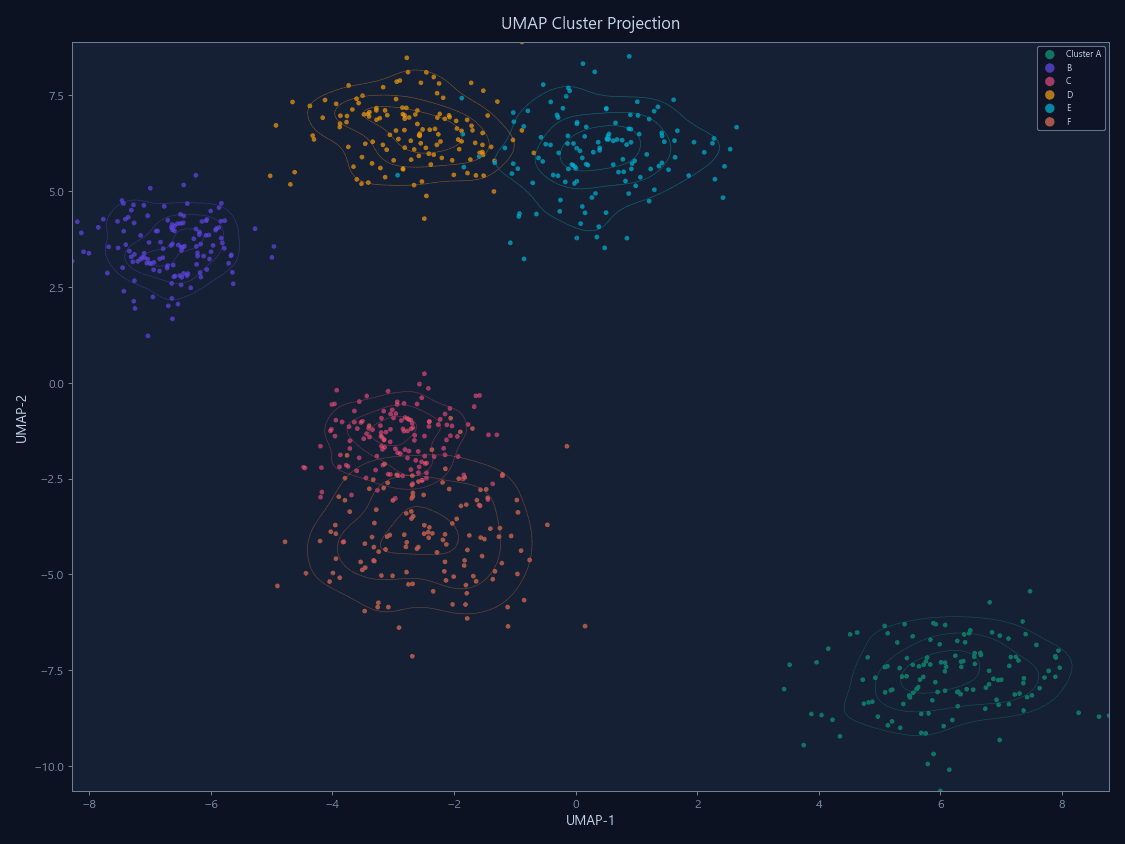
Unsupervised behavioral clustering reveals structure without predefined ethograms — UMAP visualization and novel behavior flagging.
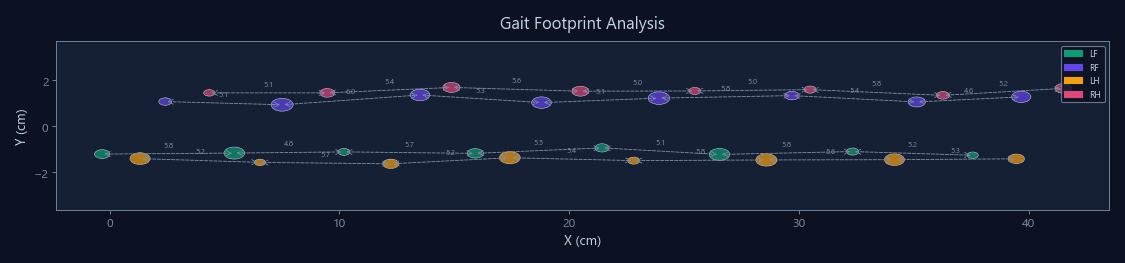
HMM-based stride detection from standard video with per-paw metrics — no treadmill or pressure plate required.
Upload a multi-animal recording and see individual trajectories extracted without markers.