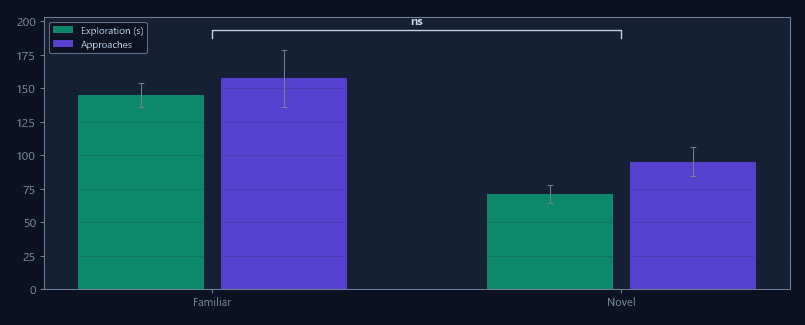
Exploration time per object
Cumulative exploration time for each object across the full session and per time bin. Includes bout count and mean bout duration.
CSVJSON
Automated recognition memory scoring with configurable object zones
Quantify exploration time, discrimination index, and preference ratio for 2-object and 4-object NOR paradigms — no manual stopwatch scoring.
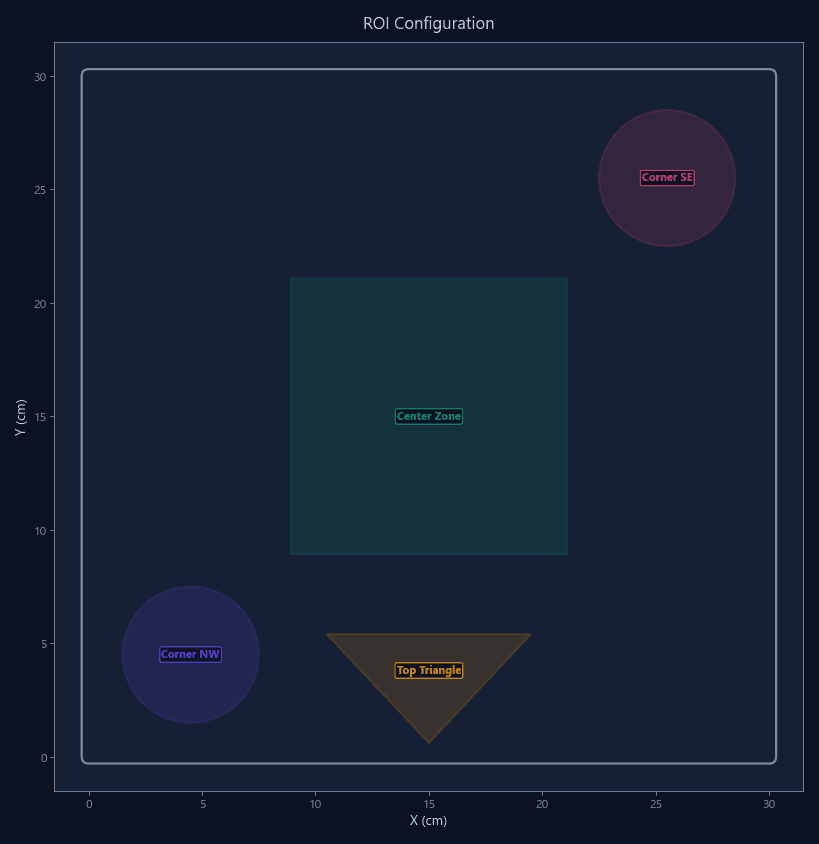
NOR requires timing how long an animal explores each object. "Exploration" is defined as nose within 2 cm and oriented toward the object — a judgment call that varies across scorers and fatigues over long sessions.
ConductVision defines configurable proximity zones around each object. Exploration is scored when the animal nose point enters the zone and head direction is oriented toward the object — matching the standard criterion, applied consistently.
Cumulative exploration time for each object across the full session and per time bin. Includes bout count and mean bout duration.
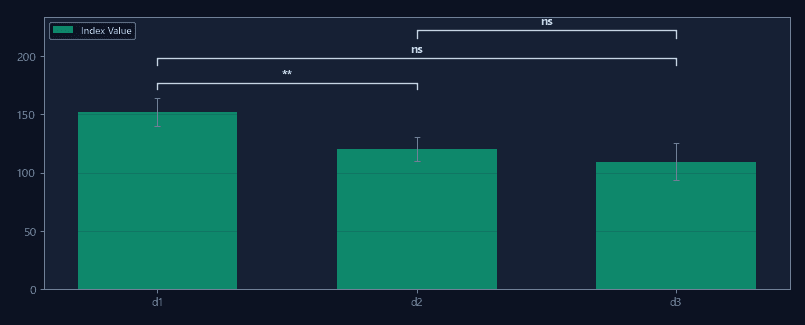
Standard d1 (difference), d2 (difference/total), and d3 (ratio) discrimination indices computed automatically.
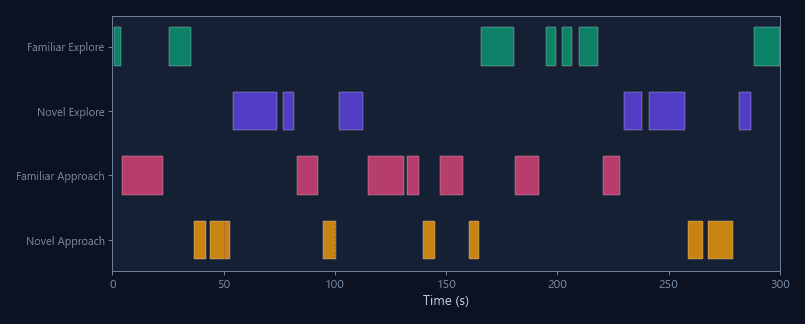
Every exploration bout with onset, offset, object identity, and proximity distance for detailed behavioral microstructure analysis.
The classic NOR paradigm with familiarization and test phases. Automated discrimination index replaces manual scoring.
Object displacement variant where one familiar object is moved to a new location. Automated scoring detects spatial preference.
Which of two familiar objects was presented more recently? Automated scoring of recency preference across varying inter-trial intervals.
NOR discrimination index declines with age in AD models. Automated scoring enables longitudinal tracking across large cohorts.
| Feature | ConductVision | Typical systems |
|---|---|---|
| Exploration criterion | Proximity + head direction | Proximity only or manual judgment |
| Multi-object support | 2-object and 4-object variants | 2-object only in most systems |
| Discrimination index calculation | d1, d2, d3 — all three standard | Usually one index, varies by system |
| Object zone configuration | Adjustable radius per object | Fixed zones |
| Bout-level data | Every interaction event logged | Cumulative totals only |
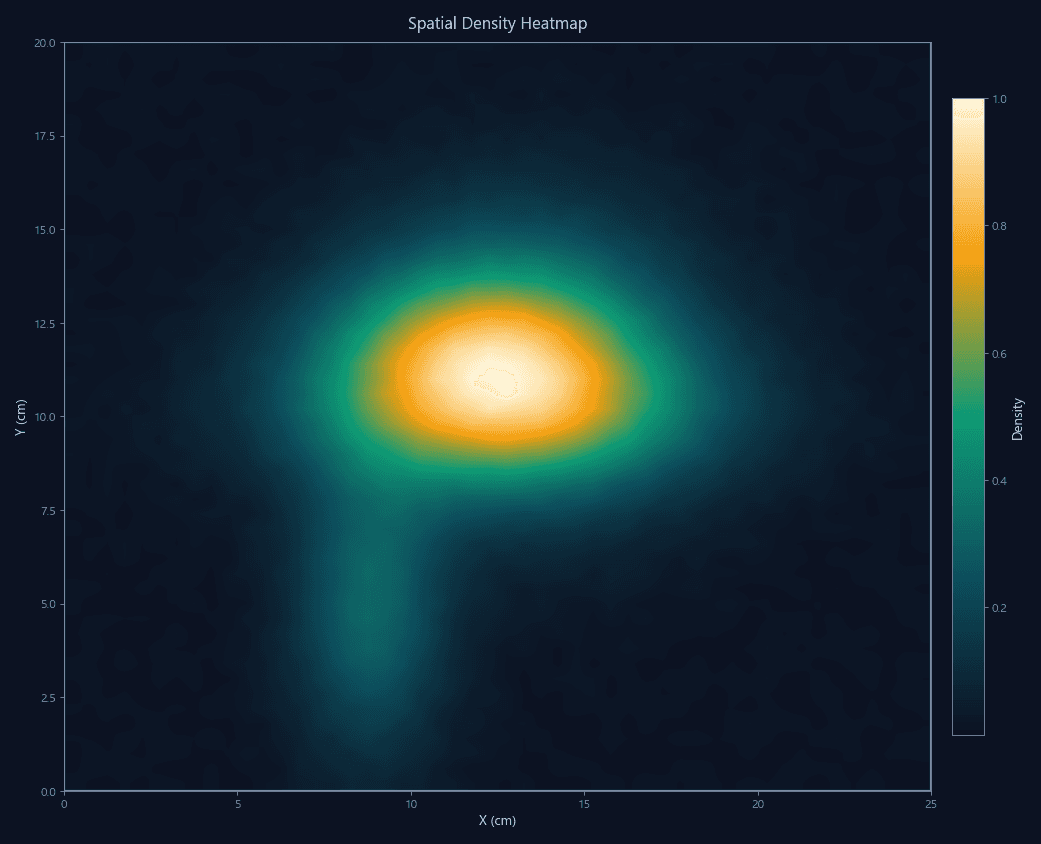
Configurable spatial zones with automated dwell time, entry count, and heatmap analysis for any arena.
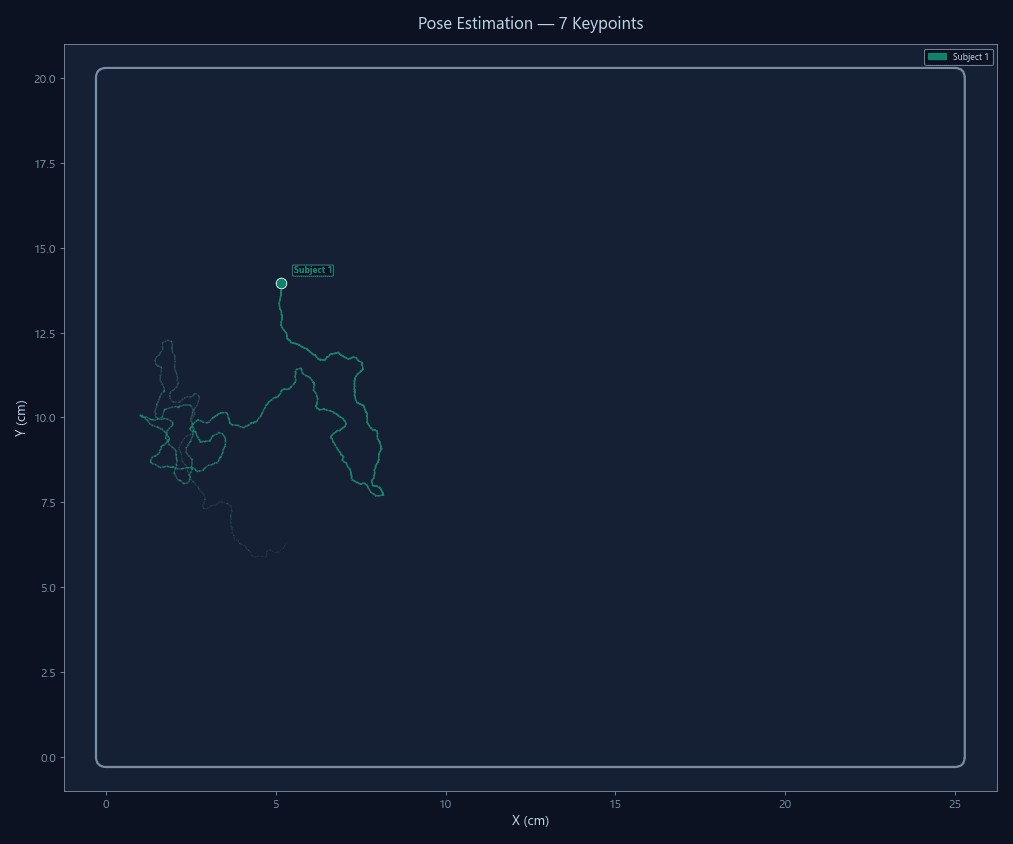
Multi-keypoint body part tracking — head, paws, tail, body center — with pretrained and custom model support.
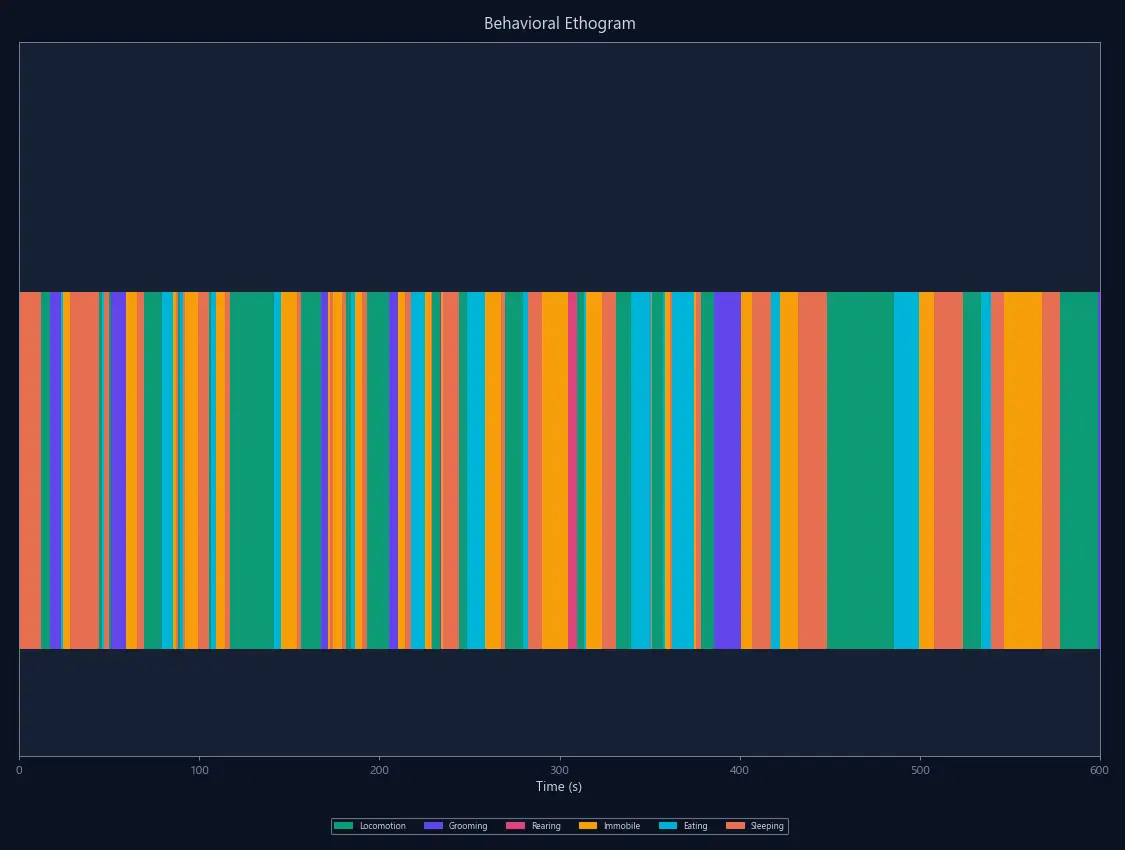
ML-powered frame-level behavioral classification with temporal smoothing and custom classifier training.
Upload NOR recordings and compare automated discrimination indices to manual scores.