Mineral & granular analysis
Particle size, shape, and mineral-class proxies for mineral processing streams.
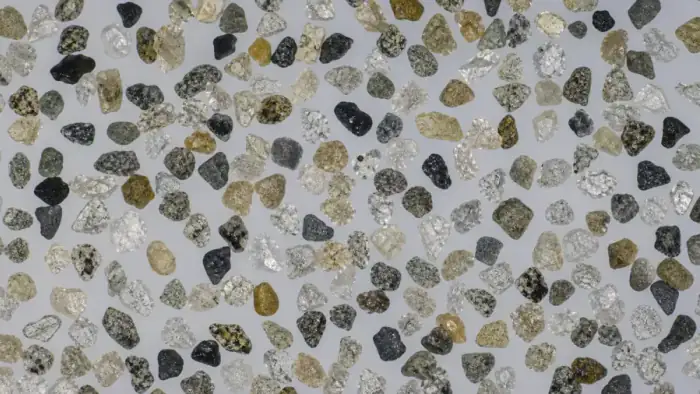
Example outputs shown for illustration. Numbers depend on your samples and protocol.
Results
Each measurement below comes from your own images, tied back to the annotated frame it came from, so results stay comparable across samples, locations, and conditions.
µm or count
Size & shape
Size and shape measured for every detected object, then summarized across the population.
In your report: Per-object table, size distribution, and summary percentiles.
class
Mineral class
Each detected feature assigned to a class using the agreed rule set, shown on the image.
In your report: Per-feature class, counts by class, and annotated overlays.
µm or count
Liberation
Size and shape measured for every detected object, then summarized across the population.
In your report: Per-object table, size distribution, and summary percentiles.
µm or count
Association
Size and shape measured for every detected object, then summarized across the population.
In your report: Per-object table, size distribution, and summary percentiles.
Built around your image set
Use the calibrated images your team already collects, together with the locations you need to compare.
Each report includes
The artifacts your team receives, ready for review and archive.
Annotated image set
Original images with regions of interest, measurement points, masks, and finding overlays.
Measurement table
Location-indexed values, units, distributions, and QC flags in a structured export.
Method record
Calibration evidence, analysis settings, version history, and validation summary.
Confidence in every resultTraceable measurements, reviewed against your agreed reference method.
- Traceable scale
- The report records the image scale, calibration evidence, and a method-specific expanded measurement uncertainty. It does not use one product-wide accuracy number.
- Reference comparison
- The configured method is compared with your accepted reference method or reviewed annotations, and reports bias by measurement range and image condition.
- Detection performance
- Detections are evaluated against reviewed reference regions with precision, recall, and segmentation overlap, separated by the conditions that affect performance.
- Repeatability
- The locked protocol is rerun on the same inputs and on a defined repeat set. The review records variation from image acquisition, sampling, and analysis separately where possible.
The measurement, today
Process streams need size and liberation estimates fast, but manual point counting cannot keep up with throughput.
From image to reviewed result
- 1
Calibrate the scale
Set spatial scale from a bar or known dimension. Every downstream number inherits real units.
- 2
Detect & segment
Segmentation models find the objects and regions of interest: grains, particles, pores, fibers, cells.
- 3
Measure
Quantify size, count, area fraction, density, and orientation. The metrics your method already defines.
- 4
Review the overlay
Inspect the result on every field. Adjust thresholds by hand; the change is logged with the output.
- 5
Export & compare
Publication-ready statistics, plus batch comparison across lots, conditions, and time points.
Not sure this is the right measurement?
Send a representative image and your measurement goal. A ConductVision scientist will confirm whether this is the right fit, or point you to the closer workflow, before you commit to a quote.
Related applications
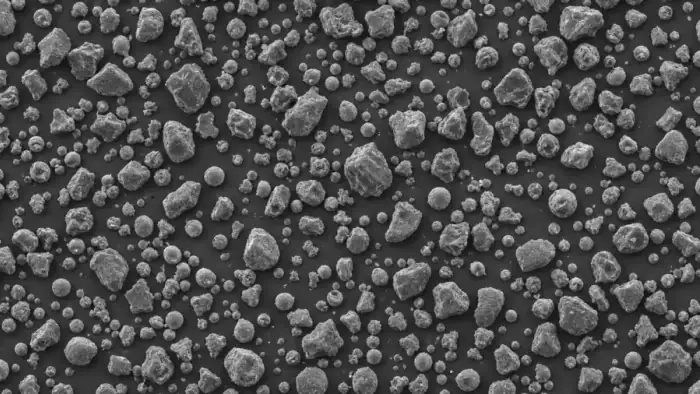
Particle size analysis
Static image-analysis particle sizing with shape descriptors across full fields.
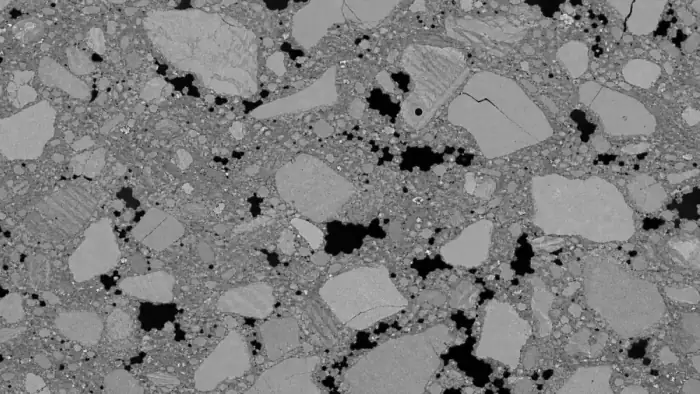
Digital rock & porosity
Pore fraction, throat proxies, and fracture density from micro-CT slices and SEM.
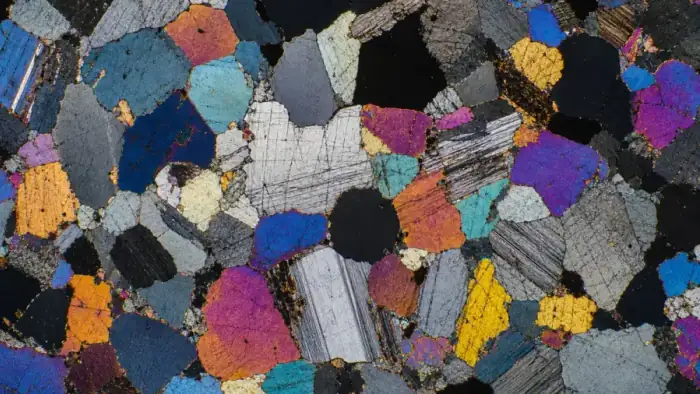
Petrographic thin section
Mineral phase maps, grain size, and sorting from thin-section microscopy.
Send a sample image and a measurement goal
We will show the closest ConductVision workflow and flag what needs custom validation for your images.