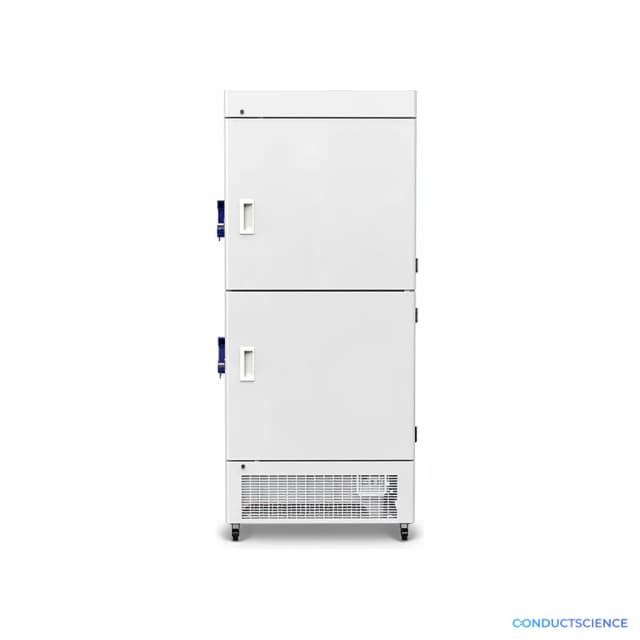
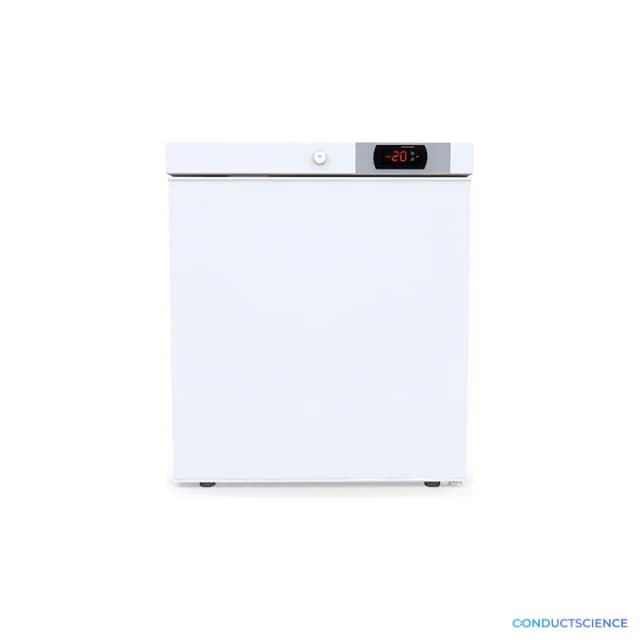
25℃ freezer 100L 270L 350L 936L
Laboratory freezers providing controlled storage at -10°C to -25°C with microprocessor control, LED display, and comprehensive alarm systems in capacities from 100L to 936L.

Louise Corscadden, PhD
Director of Science · ConductScience
Ask Louise about 25℃ freezer 100L 270L 350L 936L fit, setup, configuration, or quote prep.
Already working with us? Sign in to connect this with My Scientist.
Key Specifications
Full details →- Model fit
- 4 selectable configurations
- SKU family
- BIO-0081
- Shipping box
- 63.0 x 41.0 x 44.0 cm
- Ordering
- Online checkout and quote request available
- Category
- Cold Storage
- Build notes
- Confirm accessories, station layout, and support needs before purchase
The ConductScience 25°C freezer series provides controlled low-temperature storage for laboratory samples requiring temperatures between -10°C and -25°C. Available in 100L, 270L, 350L, and 936L capacities, these direct-cooling freezers feature microprocessor control with LED display and comprehensive alarm systems. The units maintain temperature accuracy to ±0.1°C with uniformity and stability within ±3°C, making them suitable for preserving biological samples, reagents, and other temperature-sensitive materials that do not require ultra-low temperatures.
The freezers incorporate R600a refrigerant and achieve rapid temperature recovery (≤15 minutes to reach -22°C) and cooling performance (≤1.5 hours to reach -25°C from ambient temperature). Multiple alarm functions monitor temperature deviations, sensor faults, thermostat malfunctions, power failures, and door opening events to protect valuable samples from temperature excursions.
How It Works
The freezer operates using direct-cooling refrigeration technology with R600a refrigerant (32g capacity). The system employs a microprocessor-controlled compressor and evaporator configuration that circulates refrigerant through cooling coils to extract heat from the storage compartment. Direct cooling provides efficient heat transfer and uniform temperature distribution throughout the storage volume.
Temperature control is managed by a microprocessor system that monitors internal conditions via temperature sensors and adjusts compressor operation to maintain the setpoint within ±0.1°C accuracy. The LED display shows real-time temperature readings while the control system continuously compares actual temperature against the programmed setpoint. When deviations exceed acceptable limits, the integrated alarm system activates to alert users of potential temperature excursions.
The alarm system monitors multiple parameters including high/low temperature thresholds, sensor functionality, thermostat operation, power supply status, and door position. This comprehensive monitoring protects stored materials by providing early warning of conditions that could compromise sample integrity.
Features & Benefits
Automation Level
- semi-automated
BDF-25V270
- BDF-25V350
270L
- 350L
Temp. Range
- -10~-25℃
Temp. Accuracy
- 0.1℃
Temp. Uniformity
- ≤3℃
Temp. Stability
- ≤3℃
Recovery Time(Recover to -22℃ in an ambient temp.
- ≤15min
Cooling Time(Cool down to -25℃ in an ambient temp.
- ≤1.5h
Control System
- Microprocessor control
High and low temperature alarm, thermostat fault a
- High and low temperature alarm, sensor fault alarm, thermostat fault alarm, power off alarm, door op
Refrigeration Type
- Direct-cooling
Refrigerant
- R600a/32g
Brand
- ConductScience
Research Domain
- Analytical Chemistry
- Cell Biology
- Clinical Diagnostics
- Microbiology
- Pharmaceutical QC
Capacity
- 100L
Display Type
- LED
Shipping weight
- 37.5 lb
Shipping box
- L: 63.0 cm
- W: 41.0 cm
- H: 44.0 cm
| Feature | This Product | Typical Alternative | Advantage |
|---|---|---|---|
| Temperature Accuracy | ±0.1°C precision control | Entry-level models often provide ±0.5°C to ±1.0°C accuracy | Tighter temperature control ensures more consistent sample preservation and reduces variability in temperature-sensitive assays |
| Temperature Recovery Time | ≤15 minutes to reach -22°C | Basic units may require 30-60 minutes for temperature recovery | Faster recovery minimizes thermal stress on samples during routine laboratory access |
| Control System | Microprocessor control with LED display | Mechanical thermostats with analog temperature indicators | Digital control provides programmable setpoints and precise monitoring for improved sample protection |
| Alarm Functions | Comprehensive monitoring of temperature, sensor, power, and door status | Limited to basic high/low temperature alarms | Multiple alarm parameters provide early warning of various failure modes that could compromise sample integrity |
| Temperature Uniformity | ±3°C throughout storage compartment | Varies by model, often ±5°C or greater variation | Better spatial uniformity eliminates hot spots and ensures consistent preservation conditions for all stored samples |
The ConductScience freezer series offers precision temperature control with ±0.1°C accuracy, rapid temperature recovery, and comprehensive alarm monitoring. The microprocessor control system and multiple capacity options provide scalable solutions from individual research applications to institutional biobanking requirements.
| Model | SKU | Listed price | Status | Shipping box |
|---|---|---|---|---|
| BDF-25V936 | BDF-25V936 | $10,999.00 | Available | 63.0 x 41.0 x 44.0 cm |
| BDF-25V350 | BDF-25V350 | $2,489.00 | Available | 63.0 x 41.0 x 44.0 cm |
| BDF-25V270 | BDF-25V270 | $2,379.00 | Available | 63.0 x 41.0 x 44.0 cm |
| BDF-25V100 | BDF-25V100 | $1,479.00 | Available | 63.0 x 41.0 x 44.0 cm |
Practical Tips
Verify temperature accuracy monthly using a calibrated independent thermometer placed in the geometric center of the storage compartment.
Why: Maintains measurement traceability and ensures the LED display accurately reflects internal conditions.
Clean door seals regularly and inspect for wear or damage that could compromise temperature integrity.
Why: Damaged seals allow warm air infiltration and force the compressor to work harder, reducing efficiency and temperature stability.
Load samples gradually rather than placing large quantities of room-temperature materials simultaneously.
Why: Prevents overwhelming the cooling system and maintains stable conditions for previously stored samples.
If temperature alarms activate frequently, check that door seals are intact and ambient temperature is within specifications.
Why: Environmental factors and seal degradation are common causes of temperature instability before mechanical failures occur.
Record temperature readings and alarm events in a logbook to establish baseline performance patterns.
Why: Historical data helps identify gradual performance degradation and supports troubleshooting when issues arise.
Ensure adequate ventilation around the unit and never obstruct air intake or exhaust areas.
Why: Proper airflow prevents compressor overheating and maintains optimal cooling efficiency while extending equipment lifespan.
Organize samples to maintain air circulation pathways throughout the storage compartment.
Why: Adequate airflow ensures temperature uniformity and enables faster recovery after door openings.
Test all alarm functions monthly to verify proper operation of temperature, sensor, and power monitoring systems.
Why: Regular alarm testing ensures sample protection systems will function correctly when actual failures occur.
Setup Guide
What’s in the Box
- Freezer unit
- Power cord
- User manual and documentation
- Temperature monitoring accessories (typical)
- Shelving/storage accessories (typical)
Warranty
ConductScience provides a standard 1-year manufacturer warranty covering parts and technical support. Extended warranty options and service contracts are available for institutional applications requiring enhanced coverage.
Compliance
References
Background reading relevant to this product:
What temperature uniformity can be expected across different storage locations?
Temperature uniformity is maintained within ±3°C throughout the storage compartment, ensuring consistent preservation conditions regardless of sample placement within the unit.
How quickly does the unit recover temperature after door openings?
The system recovers to -22°C within 15 minutes after door closure, minimizing thermal excursions during routine sample access.
What alarm functions are included for sample protection?
The comprehensive alarm system monitors high/low temperature deviations, sensor faults, thermostat failures, power interruptions, and door opening events with audible and visual alerts.
Can the temperature setpoint be adjusted for different sample types?
Yes, the microprocessor control allows programming of temperature setpoints anywhere within the -10°C to -25°C operating range with ±0.1°C accuracy.
What capacity should be selected for a typical research laboratory?
Capacity selection depends on sample volume and growth projections; 100L-270L suits individual research groups while 350L-936L accommodates core facilities or biobanking operations.
How does direct cooling compare to fan-forced circulation systems?
Direct cooling provides efficient heat transfer through evaporator coils while eliminating fan-induced air movement that could cause temperature fluctuations, though spatial uniformity may vary slightly compared to forced-air systems.
What maintenance is required for optimal performance?
Consult product datasheet for specific maintenance schedules; typical requirements include periodic cleaning, door seal inspection, and temperature calibration verification.
Have a question about this product?
Have a question? Just ask.
Send it over and we'll email you a personalized answer — no call, no scheduling.
Prefer to talk it through?
Accessories
Enhance your setup with compatible accessories
Frequently Bought Together