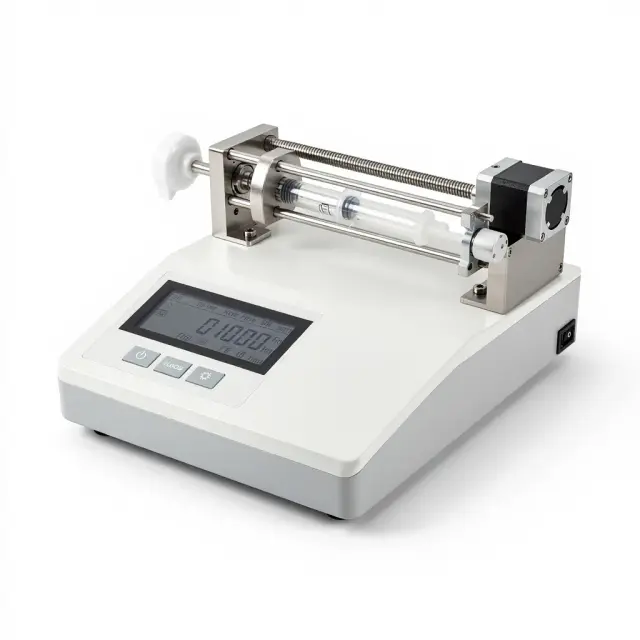
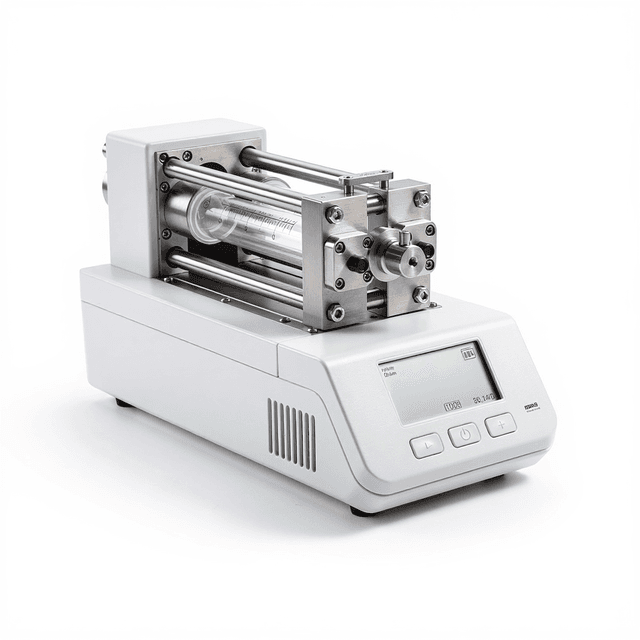
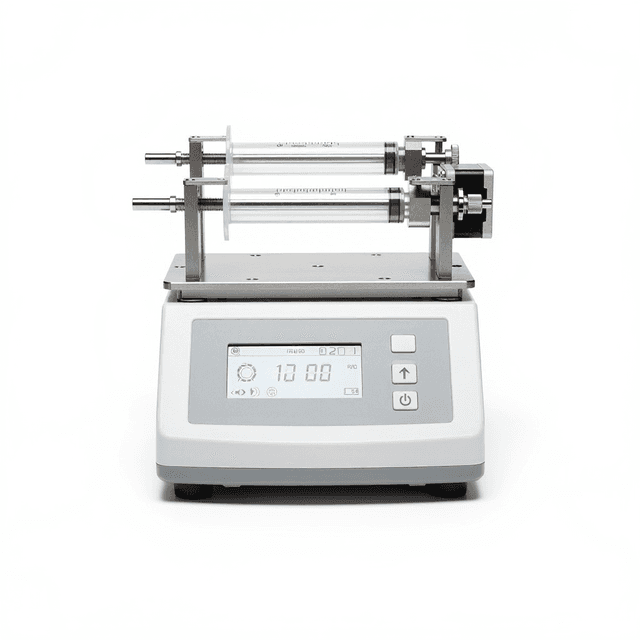
8-Channel Microfluidic Syringe Pump System
Eight-channel syringe pump system with 10 µL to 10 mL range, 0.078 µm resolution, and touchscreen control for precise microfluidic applications.
| Number of Channels | 8 |
| Syringe Range | 10 uL - 10 mL |
| Connectivity | USB, RS485 |
| Automation Level | semi-automated |
| Brand | ConductScience |
| Accuracy | 0.078 um |

The 8-Channel Microfluidic Syringe Pump System delivers precise fluid delivery across eight independent channels for microfluidic applications. Each channel accommodates syringes from 10 µL to 10 mL with 0.078 µm resolution and ≤0.5% accuracy, enabling simultaneous control of multiple reagent streams in complex microfluidic workflows.
The system features a 5-inch LCD touchscreen interface for parameter programming and real-time monitoring. USB and RS485 connectivity options support integration with laboratory automation systems and data logging protocols. The compact benchtop design (300 × 250 × 174 mm, 4.5 kg) provides multi-channel fluid control for droplet generation, perfusion studies, and gradient formation experiments.
How It Works
The system operates through precision stepper motor-driven syringe plungers that displace fluid volumes with micrometer-scale accuracy. Each of the eight channels functions independently, allowing simultaneous control of different syringe volumes and flow rates. The stepper motors provide 0.078 µm linear resolution, translating to precise volumetric control based on syringe diameter and programmed parameters.
Flow rate control is achieved through variable motor speed programming, with the system calculating the required plunger advancement rate to achieve target volumetric flow rates. The ≤0.5% accuracy specification applies across the full syringe range from 10 µL to 10 mL, maintained through closed-loop position feedback and motor control algorithms.
The touchscreen interface provides real-time display of flow parameters, allowing users to program infusion rates, volumes, and timing sequences for each channel. USB and RS485 connectivity enables computer control and data logging, supporting integration with automated experimental protocols and laboratory information management systems.
Features & Benefits
Number of Channels
- 8
Syringe Range
- 10 uL - 10 mL
Connectivity
- USB, RS485
Automation Level
- semi-automated
Brand
- ConductScience
Accuracy
- 0.078 um
Display Type
- 5-inch LCD touchscreen
Research Domain
- Analytical Chemistry
- Cell Biology
- Environmental Monitoring
- Materials Science
- Microbiology
- Pharmaceutical QC
Weight
- 4.5 kg
Dimensions
- L: 300.0 mm
- W: 250.0 mm
- H: 174.0 mm
Comparison Guide
| Feature | This Product | Typical Alternative | Advantage |
|---|---|---|---|
| Number of Channels | 8 independent channels | Entry-level models typically offer 1-4 channels | Enables complex microfluidic protocols requiring simultaneous delivery of multiple reagents or concentration gradient generation |
| Volume Range | 10 µL to 10 mL syringe compatibility | Many systems focus on either micro-scale or milli-scale volumes | Single system handles diverse experimental scales from single-cell studies to bulk sample preparation |
| Resolution | 0.078 µm linear positioning | Standard systems offer micrometer-scale resolution | Sub-micrometer precision enables accurate dose-response studies and precise concentration control for sensitive assays |
| User Interface | 5-inch LCD touchscreen | Basic models rely on button controls or external software only | Direct parameter programming and real-time monitoring reduces setup complexity and enables immediate operational verification |
| Connectivity Options | USB and RS485 interfaces | Limited interface options on basic models | Dual connectivity supports both simple computer control and industrial automation system integration |
| Accuracy Specification | ≤0.5% across full range | Accuracy varies by model and volume range | Consistent precision across all syringe sizes ensures reliable experimental results for quantitative applications |
This system combines 8-channel independent operation with precision control across a wide volume range, supported by both touchscreen interface and dual connectivity options. The sub-micrometer resolution and ≤0.5% accuracy specification provide the precision required for demanding microfluidic applications while maintaining operational flexibility through multiple control interfaces.
Practical Tips
Perform gravimetric calibration using analytical balance measurements of delivered volumes at different flow rates across the syringe range.
Why: Verifies accuracy across all channels and identifies any systematic errors in volumetric delivery.
Flush all channels with appropriate cleaning solutions between experiments and store with syringes filled with compatible preservation fluid.
Why: Prevents cross-contamination and maintains syringe seal integrity during storage periods.
Prime all fluidic lines thoroughly and use bubble traps where possible to eliminate air pockets that can affect flow stability.
Why: Air bubbles compress under pressure and cause flow rate variations that compromise experimental precision.
Match tubing inner diameter to syringe volume and required flow rates to minimize dead volume and pressure drop effects.
Why: Proper tubing selection reduces system response time and improves flow rate accuracy for time-sensitive applications.
If flow rates appear inconsistent, check syringe mounting alignment and verify that plunger movement is unrestricted.
Why: Mechanical binding or misalignment causes irregular fluid delivery and reduces volumetric accuracy.
Document syringe lot numbers and calibration dates when recording experimental data to maintain traceability.
Why: Syringe manufacturing tolerances can affect delivery precision, and documentation supports result reproducibility.
Use appropriate personal protective equipment and ensure proper ventilation when handling volatile or hazardous fluids.
Why: Microfluidic applications may involve concentrated reagents or solvents that require standard laboratory safety precautions.
Setup Guide
What’s in the Box
- 8-Channel Microfluidic Syringe Pump main unit
- Power adapter and cord
- USB communication cable
- RS485 interface cable
- Syringe mounting hardware set (typical)
- User manual and software CD (typical)
- Quick start guide (typical)
Warranty
ConductScience provides a standard one-year manufacturer warranty covering parts and labor, with technical support for installation, operation, and maintenance procedures. Extended warranty options and calibration services are available for regulated laboratory environments.
Compliance
References
Background reading relevant to this product:
What is the minimum achievable flow rate with 10 µL syringes?
Minimum flow rates depend on syringe diameter and motor step resolution. With 0.078 µm linear resolution, consult the product datasheet for specific flow rate calculations based on syringe specifications and required experimental precision.
Can different syringe volumes be used simultaneously across channels?
Yes, each channel operates independently and can accommodate different syringe volumes within the 10 µL to 10 mL range, allowing mixed-volume experimental protocols with simultaneous operation.
What pressure limits apply to the fluidic system?
Pressure limits are determined by syringe specifications and tubing connections. Consult product datasheet for maximum back-pressure ratings and recommended tubing specifications for high-pressure applications.
How is flow rate accuracy maintained across the volume range?
The ≤0.5% accuracy specification applies across the full 10 µL to 10 mL range through precision stepper motor control and position feedback systems that compensate for mechanical variations.
What software protocols are supported for automated control?
USB and RS485 connectivity supports standard communication protocols. Consult documentation for specific command sets, programming languages, and integration options with laboratory automation systems.
How frequently does the system require calibration?
Calibration frequency depends on accuracy requirements and usage patterns. Regular verification using gravimetric methods is recommended for quantitative applications, with annual professional calibration for regulated environments.
Can the system handle viscous or biological fluids?
Viscosity tolerance depends on syringe specifications and tubing diameter. The system can accommodate moderately viscous solutions, but consult datasheet for specific viscosity limits and pressure requirements.
Have a question about this product?
Accessories
Enhance your setup with compatible accessories
Frequently Bought Together
Upgrade Options