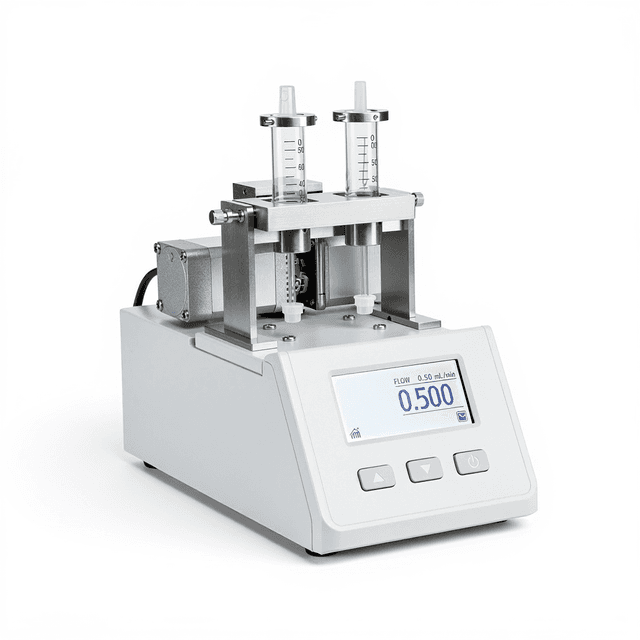
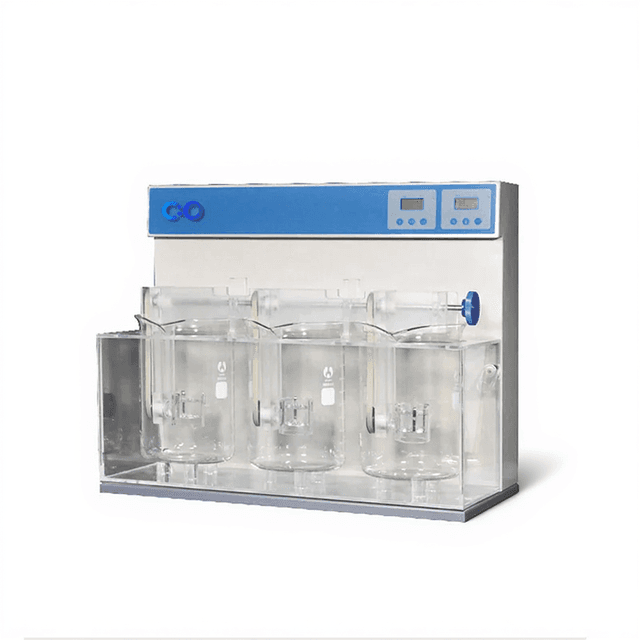
6-Channel Continuous Syringe Pump
Six-channel continuous syringe pump providing non-pulsatile fluid delivery for 1-10 mL syringes with 20 kgf thrust and 60 mm stroke capability.

Louise Corscadden, PhD
Director of Science · ConductScience
Ask Louise about 6-Channel Continuous Syringe Pump fit, setup, configuration, or quote prep.
Already working with us? Sign in to connect this with My Scientist.
Key Specifications
Full details →- Model fit
- Configured during quote
- SKU family
- WHM-0030
- Shipping box
- 410.0 x 270.0 x 365.0 cm
- Ordering
- Online checkout and quote request available
- Category
- Lab Equipment
- Build notes
- Confirm accessories, station layout, and support needs before purchase
The 6-Channel Continuous Syringe Pump delivers precise, non-pulsatile fluid administration for laboratory applications requiring controlled reagent delivery. The system accommodates 1-10 mL syringes across six independent channels, each driven by a 60 mm stroke mechanism with 20 kgf thrust capability. The continuous flow design eliminates pressure fluctuations inherent to pulsatile delivery systems.
This multi-channel architecture enables parallel processing of multiple samples or simultaneous delivery of different reagents, supporting complex experimental protocols in materials synthesis, drug delivery research, and analytical chemistry workflows. The robust mechanical design ensures consistent flow rates over extended operation periods, critical for applications requiring precise stoichiometric control or steady-state delivery conditions.
How It Works
The continuous syringe pump operates on a mechanically driven piston displacement principle, where a stepper motor advances a lead screw mechanism to provide linear translation of syringe plungers. Unlike peristaltic or diaphragm pumps that create pulsatile flow, this direct displacement design generates smooth, continuous fluid delivery with minimal flow rate variation.
Each of the six channels operates independently, allowing simultaneous control of different flow rates and volumes. The 20 kgf thrust capability overcomes back-pressure from restrictive tubing, filters, or reaction vessels, while the 60 mm stroke provides sufficient displacement volume for extended operation periods without refilling.
Flow rate control is achieved through precise motor speed regulation, with the continuous delivery mechanism eliminating the pressure spikes and flow irregularities associated with valve-based pumping systems. This design is particularly beneficial for applications requiring laminar flow conditions or pressure-sensitive reactions.
Features & Benefits
Number of Channels
- 6
Syringe Range
- 1-10 mL
Stroke
- 60 mm
Thrust
- 20 kgf
Flow Mode
- Continuous (non-pulsatile)
Automation Level
- semi-automated
Brand
- ConductScience
Power/Voltage
- 220V/50Hz
Research Domain
- Analytical Chemistry
- Cell Biology
- Environmental Monitoring
- Materials Science
- Microbiology
- Pharmaceutical QC
Shipping weight
- 15.0 lb
Shipping box
- L: 410.0 cm
- W: 270.0 cm
- H: 365.0 cm
| Feature | This Product | Typical Alternative | Advantage |
|---|---|---|---|
| Number of Channels | 6 independent channels | Entry-level models often offer 2-4 channels | Enables parallel processing of more samples or simultaneous delivery of multiple reagents in complex protocols. |
| Thrust Capability | 20 kgf thrust per channel | Lower-cost units may provide 5-10 kgf thrust | Maintains consistent flow rates against higher back-pressure from restrictive tubing or packed columns. |
| Flow Characteristics | Continuous non-pulsatile delivery | Some pump designs exhibit pulsatile flow patterns | Critical for applications requiring steady-state conditions or pressure-sensitive reactions. |
| Syringe Compatibility | 1-10 mL syringe range | Fixed syringe sizes or narrower volume ranges | Accommodates diverse experimental volume requirements using standard laboratory consumables. |
| Stroke Length | 60 mm stroke capability | Shorter stroke lengths in compact designs | Extends operation time between refills, reducing experimental interruptions during long-duration studies. |
This pump offers high-thrust, multi-channel capability with continuous flow characteristics suitable for demanding laboratory applications. The 6-channel configuration and 20 kgf thrust capacity provide operational flexibility and reliability for complex experimental protocols requiring precise fluid delivery.
Practical Tips
Verify flow rate accuracy gravimetrically using analytical balance measurements over extended time periods.
Why: Ensures delivery precision matches experimental requirements and compensates for mechanical variations.
Inspect syringe seals and plunger alignment regularly, replacing worn components before accuracy degradation occurs.
Why: Prevents fluid leakage and maintains consistent displacement volumes across all channels.
Prime all tubing lines thoroughly and verify bubble-free operation before starting critical experiments.
Why: Air bubbles create flow irregularities and affect delivery accuracy in precision applications.
Monitor for irregular flow patterns that may indicate mechanical binding or excessive back-pressure conditions.
Why: Early detection prevents experimental failures and identifies when system adjustments are needed.
Document syringe volumes, flow rates, and total delivery times for each channel during critical experiments.
Why: Provides traceability for method validation and enables accurate experimental replication.
Ensure proper ventilation when handling volatile solvents and use appropriate chemical-resistant tubing materials.
Why: Prevents exposure hazards and maintains system integrity with aggressive chemical solutions.
Allow thermal equilibration time after moving the pump between different temperature environments.
Why: Temperature changes affect mechanical tolerances and fluid properties, impacting delivery accuracy.
Setup Guide
What’s in the Box
- 6-Channel Continuous Syringe Pump main unit
- Power cable (220V/50Hz)
- Syringe mounting hardware (typical)
- User manual and technical documentation (typical)
- Calibration certificate (typical)
Warranty
ConductScience provides a standard one-year manufacturer warranty covering defects in materials and workmanship, with technical support available for installation and operational guidance.
Compliance
References
Background reading relevant to this product:
What is the minimum achievable flow rate with 1 mL syringes?
Minimum flow rates depend on stepper motor resolution and gear ratios - consult product datasheet for specific flow rate ranges with different syringe volumes.
Can the pump handle viscous solutions or organic solvents?
The 20 kgf thrust accommodates moderately viscous solutions, but chemical compatibility depends on syringe and tubing materials used - verify solvent compatibility with chosen consumables.
How is flow rate accuracy maintained across different syringe sizes?
Flow rate accuracy depends on proper syringe volume calibration and mechanical backlash compensation - periodic gravimetric verification is recommended for critical applications.
What maintenance is required for continuous operation?
Regular inspection of drive mechanisms, syringe seal integrity, and tubing connections, with periodic lubrication of mechanical components per manufacturer specifications.
Can different flow rates be set for each channel simultaneously?
Yes, each of the six channels operates independently, allowing different flow rates, start/stop timing, and total volumes per channel.
What is the maximum back-pressure the pump can overcome?
The 20 kgf thrust specification indicates substantial back-pressure capability, but maximum operating pressure depends on syringe size and should be verified against system requirements.
How does temperature affect delivery accuracy?
Thermal expansion of mechanical components and fluid density changes can affect accuracy - maintain consistent operating temperature and calibrate under actual use conditions.
Have a question about this product?
Have a question? Just ask.
Send it over and we'll email you a personalized answer — no call, no scheduling.
Prefer to talk it through?
Accessories
Enhance your setup with compatible accessories
Frequently Bought Together
Upgrade Options