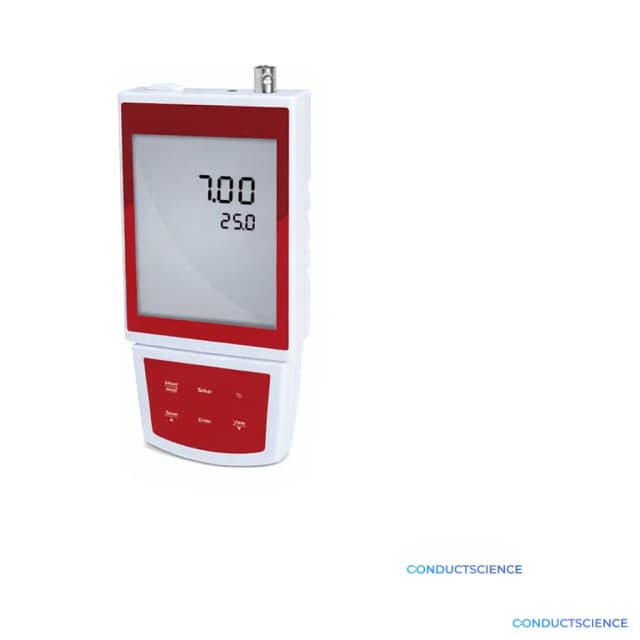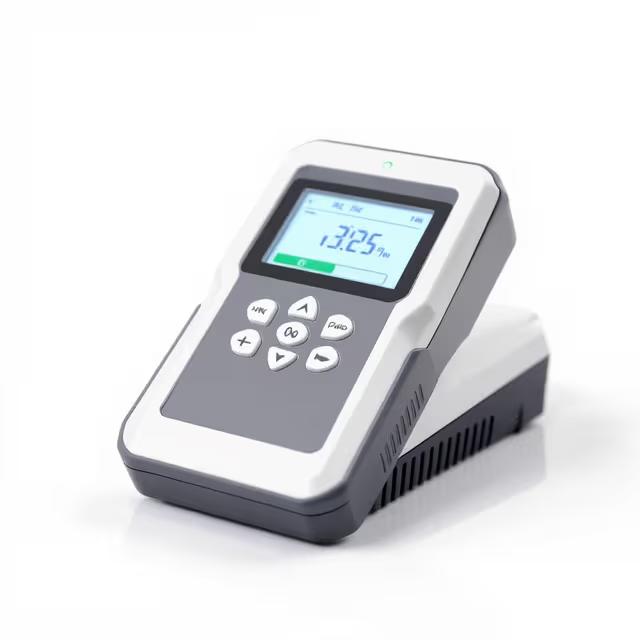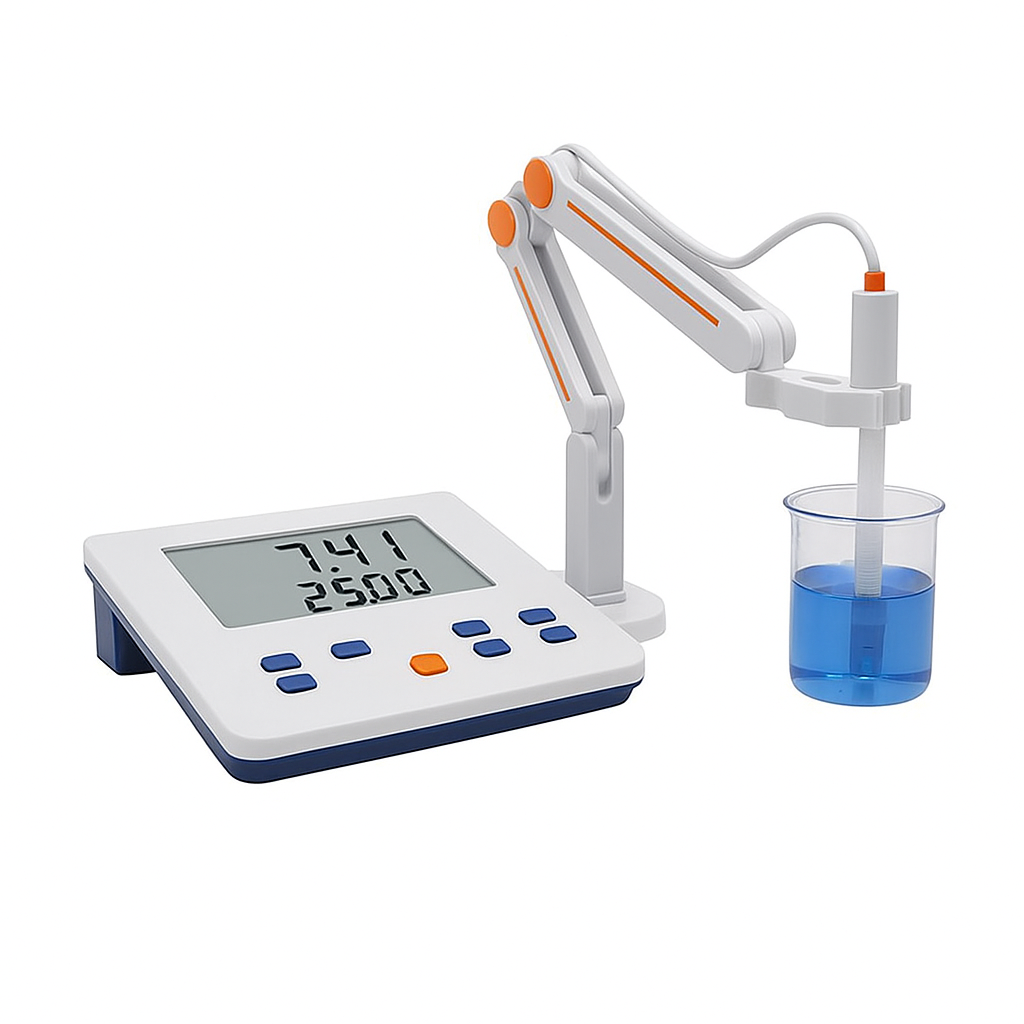
Benchtop pH Meter PH200 Series
Benchtop pH meter with 6.0-inch LCD display, NIST buffer recognition, and USB connectivity for precise pH, ORP, and temperature measurements in laboratory applications.

Louise Corscadden, PhD
Director of Science · ConductScience
Ask Louise about Benchtop pH Meter PH200 Series fit, setup, configuration, or quote prep.
Already working with us? Sign in to connect this with My Scientist.
Key Specifications
Full details →- Model fit
- 2 selectable configurations
- SKU family
- BIO-0393
- Shipping box
- 6.8 x 24.2 x 19.5 cm
- Ordering
- Online checkout and quote request available
- Category
- pH Meters
- Build notes
- Confirm accessories, station layout, and support needs before purchase
Benchtop pH Meter PH200 Series
High-precision laboratory pH value measuring instrument with dual functions of pH and mV. Features E201 composite electrode with fast response and good stability. Widely used in scientific research, teaching, agriculture and many other disciplines and fields.
Key Features
- High-resolution 6.0-inch LCD display screen
- Dual functions: pH and mV (ORP) measurements
- E201 composite electrode with fast response and good stability
- Automatic Temperature Compensation (ATC) or Manual Temperature Compensation (MTC)
- NIST buffer automatic recognition
- Memory storage: 50 results each
- USB communication interface
- Multiple temperature compensation modes
Model Comparison
| Feature | PH200E ($599) | PH200EM ($399) |
|---|---|---|
| pH Range | -2.00~18.00 pH | -2.00~18.00 pH |
| Temperature Compensation | ATC, MTC | MTC only |
| Temperature Range | -5~110°C / 23~230°F | N/A |
Technical Specifications
| Parameter | Specification |
|---|---|
| pH | |
| Range | -2.00~18.00 pH |
| Accuracy | ±0.01 pH |
| Resolution | 0.01 pH |
| Calibration Points | 1~3 points |
| ORP/mV | |
| Range | ±1999.9 mV |
| Resolution | 1 mV |
| Accuracy | ±0.1% F.S |
| Temperature | |
| Range | -5~110°C / 23~230°F (PH200E only) |
| Resolution | 0.1°C / 0.1°F |
| Accuracy | ±0.2°C / ±0.2°F |
| General Specs | |
| Display | 6.0-inch LCD screen |
| Memory | 50 results |
| Communication | USB |
| Power Supply | AC 220V, 50/60Hz; AC 110V, 50/60Hz |
| Dimensions | 242×195×68 mm |
| Package Size | 350×280×190 mm |
| Weight | 2.5 kg |
Applications
- Scientific research and laboratory analysis
- Educational institutions and training
- Agriculture and environmental testing
- Quality control and testing
- Industrial process monitoring
How It Works
The pH measurement principle relies on potentiometric detection using a glass electrode system that generates a voltage proportional to hydrogen ion activity in solution. The glass membrane electrode develops an electrical potential difference when in contact with solutions of different pH values, following the Nernst equation relationship between voltage and pH. The reference electrode provides a stable potential reference point, enabling accurate pH determination through the voltage differential measurement.
ORP (oxidation-reduction potential) measurement utilizes a platinum electrode system that responds to the electron activity in solution, indicating the oxidizing or reducing power of the sample. The temperature compensation system accounts for the temperature dependence of both pH and ORP measurements, ensuring measurement accuracy across the specified temperature range. NIST buffer recognition enables automated calibration with standard buffer solutions.
The internal measurement circuitry processes the electrode signals through high-impedance amplification and analog-to-digital conversion for display and data storage. USB communication interface enables data transfer to external systems for documentation and analysis.
Features & Benefits
Automation Level
- semi-automated
PH
- Range
Calibration Points
- 1~3 points
Standard Recognition
- NIST buffers
ORP
- mV Range
mV Accuracy
- ±0.1%F.S
-5~110°C/23~230°F
- /
Other Specifications
- Temperature Compensation
ATC, MTC
- MTC
Memory
- 50 results each
Communication Interface
- USB
Brand
- ConductScience
Research Domain
- Analytical Chemistry
- Cell Biology
- Environmental Monitoring
- Food Science
- Materials Science
- Microbiology
- Pharmaceutical QC
Accuracy
- 0.1°C/0.1°F
Temperature Range
- Range
Display Type
- High resolution LCD display screen 6.0 inches
Shipping weight
- 2.5 lb
Shipping box
- L: 6.8 cm
- W: 24.2 cm
- H: 19.5 cm
| Feature | This Product | Typical Alternative | Advantage |
|---|---|---|---|
| Display Size | 6.0-inch high resolution LCD display | Entry-level models often feature smaller 3-4 inch displays | Larger display improves readability of measurement values and calibration status during analytical procedures |
| Calibration Points | 1-3 point calibration capability | Basic models may offer only 1-2 point calibration | Multi-point calibration improves measurement accuracy across wider pH ranges for diverse analytical applications |
| Buffer Recognition | NIST buffer recognition system | Manual buffer value entry required on simpler instruments | Automated buffer recognition reduces calibration errors and ensures traceability to recognized standards |
| Temperature Range | -5°C to 110°C measurement range | Standard range typically 0-100°C on basic models | Extended temperature range accommodates both heated analytical samples and low-temperature measurements |
| Memory Capacity | 50 results storage capacity | Basic models may lack data storage or offer limited capacity | Sufficient memory for batch documentation and quality control record keeping without external connectivity |
| Communication Interface | USB connectivity for data transfer | Entry-level instruments often lack computer connectivity | Direct data transfer eliminates transcription errors and enables integration with laboratory information systems |
The PH200 Series combines benchtop stability with advanced features including NIST buffer recognition, extended temperature range, and USB connectivity. The large 6.0-inch display and multi-point calibration capability provide laboratory-grade performance for analytical applications.
| Model | SKU | Listed price | Status | Shipping box |
|---|---|---|---|---|
| PH200EM | PH200EM | $399.00 | Available | 6.8 x 24.2 x 19.5 cm |
| PH200E | PH200E | $599.00 | Available | 6.8 x 24.2 x 19.5 cm |
Practical Tips
Perform calibration using buffer solutions at temperatures close to your sample temperature for optimal accuracy.
Why: Temperature differences between calibration and measurement can introduce systematic errors in pH readings.
Store the electrode in appropriate storage solution when not in use, never in distilled water.
Why: Proper storage solution maintains electrode hydration and prevents glass membrane deterioration.
Rinse electrode with distilled water and blot dry between samples to prevent cross-contamination.
Why: Sample carryover can significantly affect measurement accuracy, particularly with high ionic strength solutions.
If readings drift or stabilize slowly, check electrode connections and ensure proper sample immersion depth.
Why: Poor electrical contact or insufficient sample volume can cause unstable measurements and reading errors.
Record temperature compensation settings and calibration buffer values with measurement data for full traceability.
Why: Complete documentation enables method validation and supports analytical quality assurance requirements.
Use appropriate personal protective equipment when measuring corrosive or hazardous samples.
Why: Chemical safety protocols protect personnel and prevent equipment damage from aggressive sample matrices.
Replace calibration buffers regularly and check expiration dates before use.
Why: Degraded buffer solutions introduce calibration errors that propagate through all subsequent measurements.
Allow sufficient equilibration time for temperature-sensitive samples before recording final readings.
Why: Temperature equilibration ensures accurate temperature compensation and stable pH measurements.
Setup Guide
What’s in the Box
- PH200 Series pH meter main unit
- Power adapter
- USB cable
- User manual and calibration certificate
- Electrode stand (typical)
- Calibration buffer solutions (typical)
Warranty
ConductScience provides a standard one-year manufacturer warranty covering defects in materials and workmanship, with technical support for calibration procedures and troubleshooting assistance.
Compliance
What calibration frequency is recommended for maintaining measurement accuracy?
Calibration frequency depends on usage intensity and accuracy requirements. Daily calibration is recommended for critical analytical work, while weekly calibration may be sufficient for routine monitoring applications.
Can the instrument handle samples with extreme pH values or high ionic strength?
The measurement range accommodates most analytical samples, though extreme pH solutions may require specialized electrodes. High ionic strength samples benefit from frequent electrode maintenance and appropriate calibration buffers.
What electrode maintenance is required for optimal performance?
Regular electrode conditioning in storage solution, proper rinsing between samples, and periodic inspection for glass membrane damage ensure optimal performance. Replace electrodes when response time increases significantly.
How does temperature compensation affect measurement accuracy?
Temperature compensation corrects for the temperature dependence of pH measurements, improving accuracy by approximately 0.003 pH units per degree Celsius. ATC provides continuous correction while MTC requires manual temperature entry.
What data output formats are available through the USB interface?
Consult product datasheet for specific data format specifications and compatible software options for measurement data transfer and analysis.
Can the instrument be used for continuous monitoring applications?
The benchtop design is optimized for discrete sample measurements rather than continuous monitoring. The 50-result memory supports batch measurement protocols and quality control documentation.
Have a question about this product?
Have a question? Just ask.
Send it over and we'll email you a personalized answer — no call, no scheduling.
Prefer to talk it through?