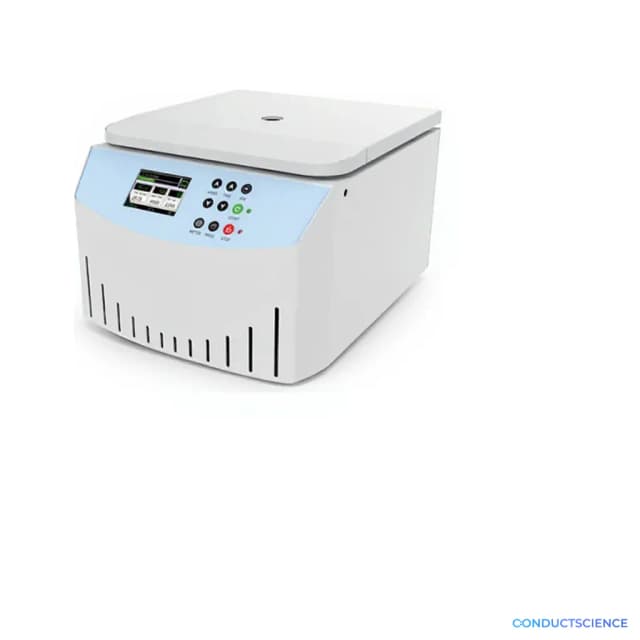
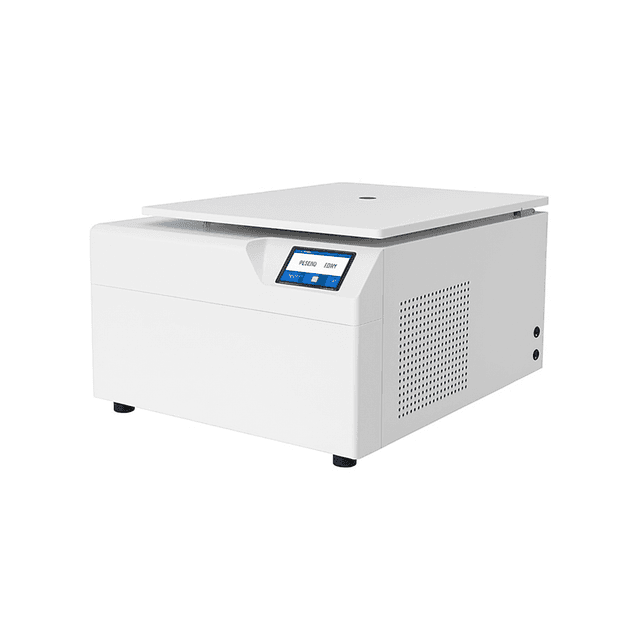
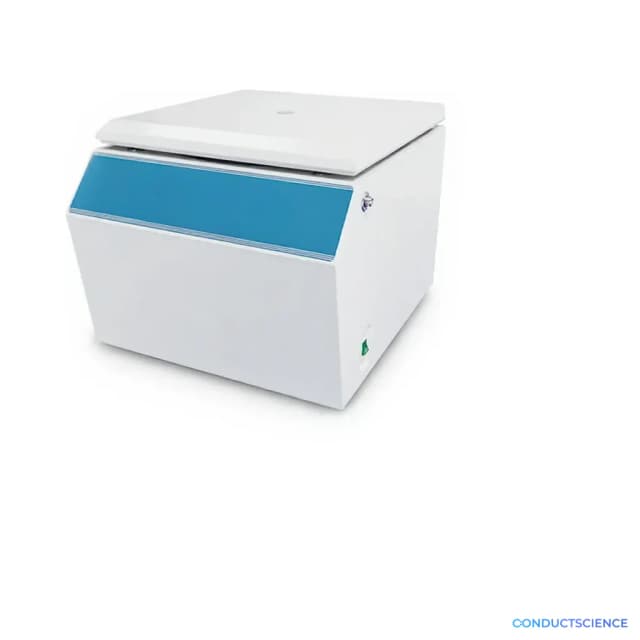
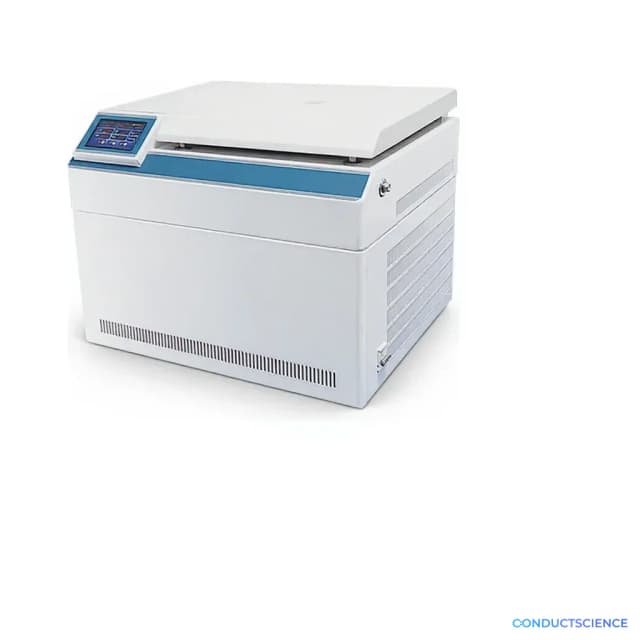
Biosafety Centrifuge
Benchtop biosafety centrifuge operating up to 4,000 rpm (3,580×g) with 16×50ml tube capacity for safe processing of biological samples in contained environments.

Louise Corscadden, PhD
Director of Science · ConductScience
Ask Louise about Biosafety Centrifuge fit, setup, configuration, or quote prep.
Already working with us? Sign in to connect this with My Scientist.
Key Specifications
Full details →- Model fit
- Configured during quote
- SKU family
- BIO-0328
- Shipping box
- 40.0 x 45.0 x 64.0 cm
- Ordering
- Online checkout and quote request available
- Category
- Centrifuges
- Build notes
- Confirm accessories, station layout, and support needs before purchase
The Biosafety Centrifuge is a benchtop centrifugal separation instrument designed for laboratory applications requiring containment and safety protocols. Operating at speeds up to 4,000 rpm with maximum relative centrifugal force of 3,580×g, this unit provides controlled separation of biological samples while maintaining operator safety through enclosed operation. The rotor configuration accommodates up to 16 tubes of 50ml capacity (4×4 arrangement), making it suitable for processing multiple samples simultaneously.
The instrument features precision speed control (±20 rpm accuracy), programmable time settings from 1 second to 99 hours 59 minutes, and operates at noise levels ≤65 dB to minimize laboratory disruption. The enclosed design and safety features make it appropriate for work with potentially hazardous biological materials where containment is required during centrifugal processing.
How It Works
Centrifugal separation operates on the principle of applying centrifugal force to accelerate the natural settling of particles based on density differences. When samples are rotated at high speed, particles experience a force proportional to their mass, the square of the rotational velocity, and the radius of rotation (F = mω²r). Denser components migrate toward the bottom of the tube while less dense components remain in the supernatant.
The biosafety centrifuge incorporates a sealed rotor chamber and containment features to prevent aerosol generation during operation. The motor drives the rotor assembly through a balanced drive system, while electronic controls maintain precise speed regulation within ±20 rpm tolerance. Safety interlocks prevent operation with improperly balanced loads or open chambers, while the enclosed design contains any potential aerosols or spills during processing.
Features & Benefits
Automation Level
- semi-automated
Max speed
- 4,000 rpm
Max. Capacity
- 4*4*50ml
Speed Precision
- ±20rpm
Time Range
- 1s~99h59min
Noise
- ≤65dB
Consumption
- 600W
External Size(L*W*H)
- 450*640*400mm
Package Size(L*W*H)
- 530*700*480mm
No.
- Rotor
Brand
- ConductScience
Research Domain
- Analytical Chemistry
- Cancer Research
- Cell Biology
- Clinical Diagnostics
- Immunology
- Microbiology
- Pharmaceutical QC
Power/Voltage
- AC110~220V, 50/60Hz
Weight
- 65kg
Capacity
- Max. Speed(rpm)
Max force
- 3,580 ×g
Shipping weight
- 50.0 lb
Shipping box
- L: 40.0 cm
- W: 45.0 cm
- H: 64.0 cm
| Feature | This Product | Typical Alternative | Advantage |
|---|---|---|---|
| Maximum Speed | 4,000 rpm with 3,580×g RCF | Entry-level models often limited to 3,000-3,500 rpm | Higher centrifugal force enables more efficient separation of dense particles and cellular components. |
| Sample Capacity | 16 tubes × 50ml (4×4 configuration) | Basic models typically accommodate 8-12 tubes | Greater throughput allows processing larger sample batches in single runs, improving laboratory efficiency. |
| Speed Precision | ±20 rpm accuracy | Standard models often have ±50-100 rpm tolerance | Improved precision ensures reproducible RCF values critical for quantitative protocols and standardized procedures. |
| Time Programming Range | 1 second to 99 hours 59 minutes | Many models limited to shorter maximum times | Extended time capability accommodates specialized protocols requiring prolonged centrifugation for complete separation. |
| Biosafety Features | Enclosed containment design with safety interlocks | Standard centrifuges may lack specialized containment | Prevents aerosol generation and cross-contamination when processing potentially hazardous biological materials. |
| Noise Level | ≤65 dB operation | Many units operate at 70-80 dB | Quieter operation reduces laboratory noise pollution during extended runs and improves working environment. |
This biosafety centrifuge combines high-speed performance (4,000 rpm, 3,580×g) with specialized containment features for safe handling of biological materials. The 16-tube capacity and precise speed control (±20 rpm) support high-throughput applications while maintaining the reproducibility required for quantitative protocols.
Practical Tips
Verify speed accuracy periodically using a tachometer or the built-in diagnostics to ensure the ±20 rpm precision is maintained.
Why: Speed drift over time can affect separation efficiency and protocol reproducibility.
Clean the rotor chamber and lid seals after each use with appropriate disinfectants to prevent cross-contamination between samples.
Why: Biological residues can harbor contaminants and compromise the biosafety containment function.
Always balance tubes to within 0.1g across opposing positions in the rotor to prevent excessive vibration and mechanical stress.
Why: Imbalanced loads can damage bearings, reduce instrument life, and create safety hazards during high-speed operation.
Allow the rotor to come to complete stop before opening the chamber, and never attempt to manually brake the rotor.
Why: Moving rotors can cause injury and sudden braking can disrupt separated samples or damage the drive mechanism.
If excessive vibration occurs during operation, stop immediately and check sample balance, tube integrity, and rotor seating.
Why: Continued operation with imbalanced loads can damage the centrifuge and compromise sample integrity.
Record actual run parameters (speed, time, temperature if measured) rather than just programmed settings for proper documentation.
Why: Slight variations in actual conditions can affect separation results and are important for protocol troubleshooting.
Pre-cool samples and use appropriate tube materials rated for the maximum RCF to prevent tube failure during high-speed runs.
Why: Temperature changes and inadequate tube strength can lead to sample loss and potential contamination of the rotor chamber.
Inspect rotor threads and mounting surfaces regularly for wear or damage that could affect safe operation at maximum speed.
Why: Worn mounting surfaces can lead to rotor imbalance or failure at high speeds, creating serious safety hazards.
Setup Guide
What’s in the Box
- Biosafety Centrifuge main unit
- Fixed angle rotor (4×4×50ml configuration)
- Power cord
- User manual and safety documentation
- Rotor balancing guidance chart (typical)
- Safety interlock test procedures (typical)
Warranty
ConductScience provides a standard one-year manufacturer warranty covering defects in materials and workmanship. Technical support is available for installation guidance, protocol optimization, and maintenance procedures throughout the warranty period.
Compliance
What is the maximum sample volume per tube and total capacity?
The rotor accommodates 16 tubes of 50ml capacity each (4×4 configuration), providing 800ml total sample volume capacity per run.
How precise is the speed control for reproducible protocols?
Speed control maintains ±20 rpm precision across the full range up to 4,000 rpm, ensuring consistent RCF values for quantitative separations.
What safety features are included for biosafety applications?
The enclosed rotor chamber prevents aerosol generation, safety interlocks prevent operation with imbalanced loads or open chambers, and the contained design minimizes cross-contamination risk.
Can this centrifuge handle extended protocols?
Yes, the timer range extends from 1 second pulse spins up to 99 hours 59 minutes for applications requiring extended separation times.
What are the power requirements and noise levels?
The unit operates on universal AC power (110-220V, 50/60Hz) consuming 600W, while maintaining noise levels ≤65 dB for quiet laboratory operation.
How does this compare to standard benchtop centrifuges?
The biosafety design provides containment features not found in standard centrifuges, making it suitable for potentially hazardous biological materials while offering comparable speed and capacity specifications.
What maintenance is required for reliable operation?
Routine maintenance includes rotor cleaning and inspection, balance verification, and periodic calibration checks. Consult product datasheet for detailed maintenance schedules.
Is the rotor configuration fixed or interchangeable?
The specifications indicate a 4×4×50ml rotor configuration. Consult product datasheet for information about additional rotor options or interchangeability.
Have a question about this product?
Have a question? Just ask.
Send it over and we'll email you a personalized answer — no call, no scheduling.
Prefer to talk it through?
Replacement Parts & Consumables
Upgrade Options