Chicken Isolator
Specialized containment system providing HEPA-filtered, controlled environment for poultry research with integrated monitoring, sterilization, and waste management capabilities.

Louise Corscadden, PhD
Director of Science · ConductScience
Ask Louise about Chicken Isolator fit, setup, configuration, or quote prep.
Already working with us? Sign in to connect this with My Scientist.
Key Specifications
Full details →- Model fit
- 1600*750*820mm
- SKU family
- BIO-0078
- Shipping box
- 180.0 x 220.0 x 85.0 cm
- Ordering
- Online checkout and quote request available
- Category
- Isolators
- Build notes
- Confirm accessories, station layout, and support needs before purchase
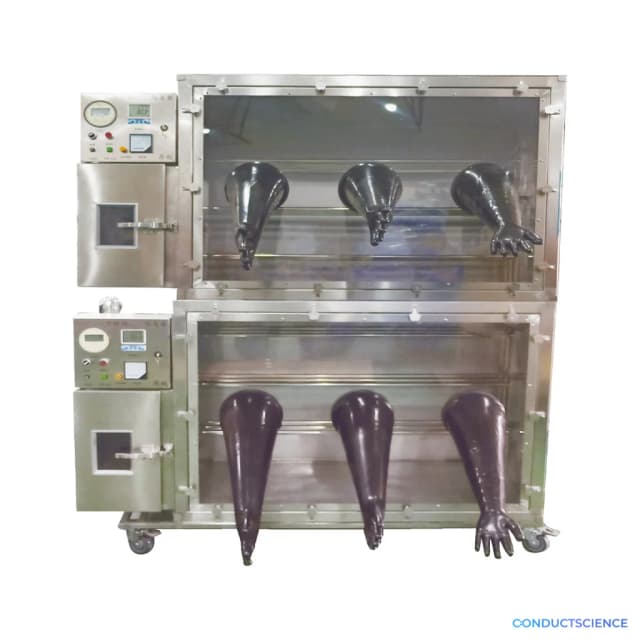
The Chicken Isolator is a specialized containment system designed for maintaining pathogen-free environments in poultry research and production settings. This isolator provides controlled atmospheric conditions with HEPA filtration, environmental monitoring, and complete isolation of the animal activity area from external contamination sources.
The system features a dual-chamber design with dedicated animal activity space (1600×750×820mm) and waste collection area (1600×750×250mm), supporting controlled studies requiring sterile conditions. LED display monitoring tracks temperature and humidity parameters (10-50°C adjustable range), while integrated UV sterilization and heating systems maintain optimal environmental conditions for research protocols.
How It Works
The isolator operates through a multi-stage air filtration system incorporating pre-filter, mid-filter, and HEPA (H14) filtration stages. Air circulation maintains ≥20 air changes per hour at 0.1-0.2 m/s velocity within the animal living space, creating positive pressure conditions that prevent external contamination ingress.
Environmental control systems regulate temperature (10-50°C adjustable) and humidity through LED display monitoring with integrated heating, fluorescent, and UV lamp systems. The dual-chamber configuration separates animal activity areas from waste collection, while the sealed design with glove ports enables manipulation without compromising sterile conditions.
UV sterilization cycles eliminate surface pathogens, while the HEPA filtration achieves zero falling bacteria count (0 numbers/utensil/hour), maintaining sterile atmospheric conditions throughout the isolation period.
Features & Benefits
Automation Level
- semi-automated
External Size(W*D*H)
- 2200*850*1800mm
Animal Activity Area(W*D*H)
- 1600*750*820mm
Waste Collection Area(W*D*H)
- 1600*750*250mm
Air Change Rate
- ≥20 times/h
Airflow Velocity
- 0.1m/s~0.2m/s within the chicken living space
Falling Bacteria(numbers/utensil/hour)
- 0
Filter
- Pre-filter, Mid-filter, HEPA(H14) filter
Noise
- ≤70dB(A)
Alarm
- High and low temperature alarm
Caster
- Universal caster with brake and leveling feet
Rated Power supply
- AC220V±10%, 50/60Hz; 110V±10%, 60Hz
Rated Consumption
- 700W
Brand
- ConductScience
Research Domain
- Developmental Biology
- Environmental Monitoring
- Food Science
- Immunology
- Microbiology
- Pharmaceutical QC
Species
- Chicken
Display Type
- LED display: temperature, humidity adjustable(10~50℃), with fluorescent lamp, UV lamp, heating lamp,
Weight
- 279kg (615 lbs)
Shipping weight
- 279.0 lb
Shipping box
- L: 180.0 cm
- W: 220.0 cm
- H: 85.0 cm
| Feature | This Product | Typical Alternative | Advantage |
|---|---|---|---|
| Air Change Rate | ≥20 changes per hour | Entry-level isolators often provide 10-15 changes per hour | Higher air change rate ensures more rapid contaminant removal and consistent atmospheric conditions |
| Filtration System | Three-stage with HEPA (H14) filter | Basic models may use single-stage or H13-grade filtration | Multi-stage filtration with H14 HEPA achieves superior contaminant removal for critical research applications |
| Environmental Monitoring | LED display with temperature and humidity monitoring (10-50°C) | Limited monitoring options or narrow temperature ranges | Comprehensive environmental control supports diverse research protocols requiring specific atmospheric conditions |
| Activity Area Dimensions | 1600×750×820mm animal space | Smaller isolators may offer limited space | Larger activity area accommodates multiple subjects or extended behavioral studies |
| Integrated Lighting Systems | UV, fluorescent, and heating lamps included | Basic lighting or separate sterilization equipment required | Comprehensive lighting system supports both normal operations and sterilization protocols in single unit |
This isolator combines specialized poultry housing with laboratory-grade environmental control and multi-stage HEPA filtration. The integrated monitoring, sterilization, and dual-chamber design support extended research protocols requiring sterile containment conditions.
Practical Tips
Verify temperature and humidity sensors monthly against certified reference instruments to maintain measurement accuracy.
Why: Environmental parameter accuracy is critical for protocol reproducibility and animal welfare compliance.
Monitor filter pressure differential weekly and replace filters when differential exceeds manufacturer specifications.
Why: Clogged filters reduce air change rates and compromise sterile conditions.
Run UV sterilization cycles between experimental groups and maintain detailed logs of sterilization procedures.
Why: Proper sterilization protocols prevent cross-contamination between experimental subjects.
Always engage brake mechanisms and verify leveling before beginning operations to prevent unit movement during use.
Why: Stable positioning prevents mechanical stress and maintains seal integrity.
Document environmental conditions continuously throughout experiments to identify any parameter excursions that might affect results.
Why: Environmental variations can introduce confounding variables in controlled studies.
If alarms activate frequently, check door seals and glove port integrity for air leaks that affect pressure maintenance.
Why: Air leaks compromise containment and trigger false alarms due to environmental instability.
Clean and inspect caster wheels regularly, especially after repositioning, to ensure smooth mobility and brake function.
Why: Proper caster maintenance enables safe laboratory repositioning and stable operation.
Setup Guide
What’s in the Box
- Chicken Isolator main unit
- Pre-filter, mid-filter, and HEPA (H14) filter set
- Power cable for specified voltage
- Universal casters with brake mechanisms
- User manual and operational protocols
- Temperature and humidity calibration documentation (typical)
- UV lamp replacement instructions (typical)
Warranty
ConductScience provides an 18-month manufacturer warranty covering defects in materials and workmanship, with technical support for operational guidance and troubleshooting assistance.
Compliance
References
Background reading relevant to this product:
What level of sterility can this isolator achieve for pathogen-free studies?
The isolator achieves zero falling bacteria count through HEPA (H14) filtration with ≥20 air changes per hour, supporting specific-pathogen-free research protocols.
How many chickens can be housed in the activity area?
The 1600×750×820mm activity area capacity depends on chicken size and research protocol requirements. Consult product datasheet for specific housing density recommendations.
What temperature range is available for thermal regulation studies?
The system provides adjustable temperature control from 10-50°C with LED display monitoring and high/low temperature alarms for protocol compliance.
How is waste management handled during isolation periods?
The dedicated 1600×750×250mm waste collection area allows waste removal without compromising sterile conditions in the animal activity space.
What power requirements are needed for installation?
The 700W system operates on AC220V±10% 50/60Hz or 110V±10% 60Hz power supplies with standard electrical connections.
How often do filters require replacement?
Filter replacement frequency depends on usage intensity and contamination load. Monitor pressure differential and consult manufacturer guidelines for optimal replacement intervals.
Can the isolator be moved between laboratory locations?
Yes, universal casters enable mobility, though the 279kg weight requires appropriate handling equipment and stable positioning with leveling feet at destination.
Have a question about this product?
Have a question? Just ask.
Send it over and we'll email you a personalized answer — no call, no scheduling.
Prefer to talk it through?