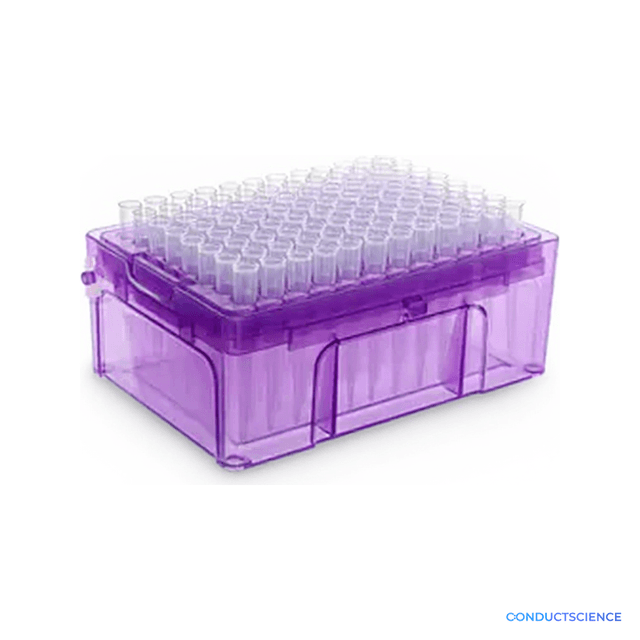
ConductScience Embedding Cassettes, Assorted Colors (Bulk 15-Pack)
$45.00 per unit | 15 units per pack Bulk pricing: Bulk 15-Pack at $675.00 ($45.00 per unit)

Louise Corscadden, PhD
Director of Science · ConductScience
Ask Louise about ConductScience Embedding Cassettes, Assorted Colors (Bulk 15-Pack) fit, setup, configuration, or quote prep.
Already working with us? Sign in to connect this with My Scientist.
Key Specifications
Full details →- Model fit
- Configured during quote
- SKU family
- CS-EC-MC-500
- Shipping box
- 43.2 x 36.0 x 28.8 cm
- Ordering
- Online checkout and quote request available
- Category
- General Labware
- Build notes
- Confirm accessories, station layout, and support needs before purchase
Histology embedding cassettes designed for secure tissue processing and identification during paraffin embedding workflows. These cassettes feature ventilated construction to ensure proper fluid exchange during processing while maintaining tissue integrity throughout fixation, dehydration, and embedding procedures.
Available in five distinct colors to enable systematic sample organization and reduce the risk of specimen mix-ups during multi-sample processing runs. The cassettes accommodate tissue specimens during automated tissue processor cycles and provide secure containment for subsequent microtomy and sectioning operations.
How It Works
Embedding cassettes function as protective containers that maintain tissue specimens throughout the paraffin embedding process. The ventilated design allows complete fluid exchange during each processing step while preventing tissue loss or displacement. Specimens are placed within the cassette compartment and secured with the integrated closure mechanism.
During automated processing, reagents flow freely through the ventilation slots, ensuring uniform fixation, dehydration, and clearing. The cassette structure maintains tissue orientation and prevents mechanical damage during agitation cycles. Color identification enables systematic tracking of multiple specimens without requiring external labeling that may deteriorate during chemical processing.
Following processing completion, the cassettes containing infiltrated tissue proceed directly to embedding stations where molten paraffin is dispensed around the cassette-contained specimen, creating the final paraffin block for microtomy.
Features & Benefits
Research Domain
- Cancer Research
- Developmental Biology
- Histopathology
- Immunology
- Neurodegeneration
- Toxicology
Shipping weight
- 30.92 lb
Shipping box
- L: 43.2 cm
- W: 36.0 cm
- H: 28.8 cm
| Feature | This Product | Typical Alternative | Advantage |
|---|---|---|---|
| Color Options | 5 assorted colors for specimen identification | Single color options require external labeling systems | Reduces specimen mix-ups and eliminates labeling steps that may fail during processing. |
| Closure Mechanism | Integrated secure closure system | Basic closure designs may allow specimen displacement | Prevents tissue loss during automated processing cycles and manual handling. |
| Ventilation Design | Optimized ventilation for reagent exchange | Standard ventilation patterns vary by manufacturer | Ensures complete fluid exchange for uniform processing results across all specimens. |
| Chemical Compatibility | Resistant to standard histology reagents | Material compatibility varies by supplier | Maintains cassette integrity throughout extended processing cycles without degradation. |
These cassettes combine systematic color identification with reliable specimen containment for organized histology workflows. The five-color system reduces processing errors while maintaining compatibility with standard automated processing equipment.
Practical Tips
Assign colors consistently across all experiments and document the coding system in laboratory protocols.
Why: Consistent color assignment prevents confusion and reduces specimen identification errors during processing.
Avoid overfilling cassettes and ensure tissue lies flat within the compartment boundaries.
Why: Proper specimen placement prevents processing artifacts and ensures uniform reagent penetration.
Inspect cassette closure mechanisms before loading to ensure secure specimen containment.
Why: Damaged closures can result in specimen loss during automated processing cycles.
If specimens shift during processing, reduce tissue size or verify cassette closure completeness.
Why: Specimen movement can create processing artifacts and compromise sectioning quality.
Handle cassettes with appropriate PPE when exposed to fixatives and processing chemicals.
Why: Chemical-resistant cassettes may retain traces of hazardous reagents after processing completion.
Photograph color-coded cassettes before processing as backup identification documentation.
Why: Visual records provide additional specimen tracking security for critical samples.
Setup Guide
What’s in the Box
- Embedding cassettes in 5 assorted colors (typical)
- 500 total cassettes (typical)
Warranty
ConductScience provides standard product support for consumable laboratory supplies. These embedding cassettes are manufactured to meet standard histology processing requirements.
Compliance
Are these cassettes compatible with all automated tissue processors?
The cassettes feature standard dimensions compatible with most automated tissue processor platforms. Verify cassette dimensions against your specific instrument's basket specifications.
How should different colors be assigned to experimental groups?
Develop a consistent color-coding system documented in laboratory protocols. Common approaches include assigning colors by treatment group, time point, or anatomical region depending on study design.
Can the cassettes withstand extended processing cycles?
The chemical-resistant construction maintains integrity throughout standard processing protocols including overnight cycles with alcohols, xylene, and molten paraffin exposure.
What specimen thickness works best with these cassettes?
Optimal tissue thickness ranges from 2-3mm to ensure adequate reagent penetration while fitting securely within the cassette compartment.
How do I prevent specimen loss during processing?
Ensure proper cassette closure and avoid overfilling the specimen compartment. Tissue should lie flat within the cassette boundaries without forcing the closure mechanism.
Are the color dyes resistant to processing chemicals?
The color identification system is designed to remain stable throughout standard histological processing reagents including formalin, alcohols, and clearing agents.
Have a question about this product?
Have a question? Just ask.
Send it over and we'll email you a personalized answer — no call, no scheduling.
Prefer to talk it through?
Upgrade Options