Double Emulsion Microfluidic Chip
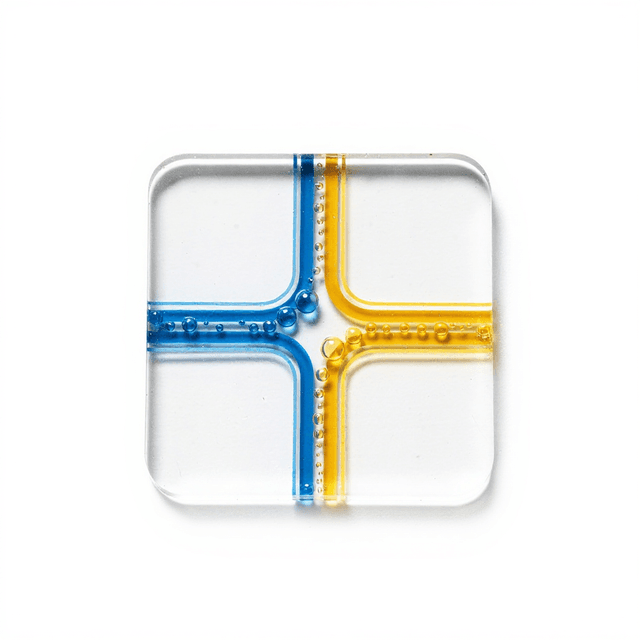
Microfluidic device for generating monodisperse double emulsions (W/O/W or O/W/O) for core-shell particle synthesis, cell encapsulation, and controlled release applications.
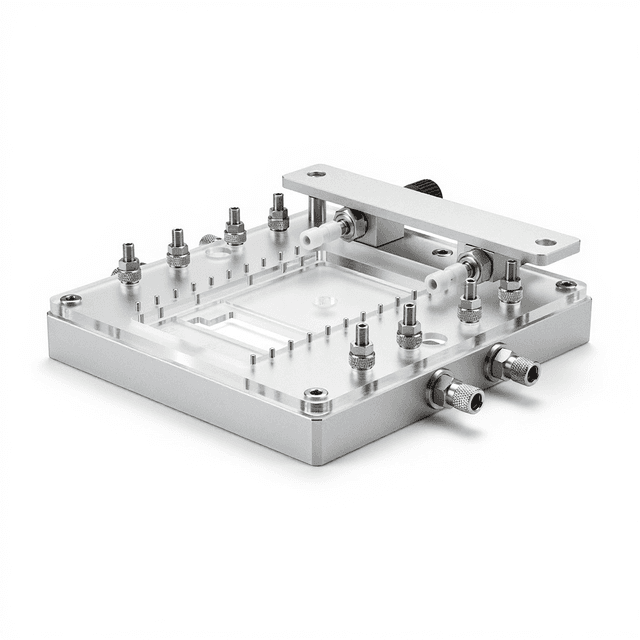
Reusable chip — designed for multiple experimental runs. Compatible with standard microfluidic tubing: steel pins (0.7 mm ID / 1.0 mm OD) and silicone tubing (0.8 mm ID / 1.9 mm OD). Available in bulk packs (5‑, 10‑, and 25‑unit) for lab-scale and consumable workflows.

Louise Corscadden, PhD
Director of Science · ConductScience
Ask Louise about Double Emulsion Microfluidic Chip fit, setup, configuration, or quote prep.
Already working with us? Sign in to connect this with My Scientist.
Key Specifications
Full details →- Model fit
- Configured during quote
- SKU family
- WHM-0068
- Shipping box
- 22.5 x 15.0 x 4.0 cm
- Ordering
- Online checkout and quote request available
- Category
- Lab Equipment
- Build notes
- Confirm accessories, station layout, and support needs before purchase
The Double Emulsion Microfluidic Chip provides researchers with a versatile platform for generating water-in-oil-in-water (W/O/W) or oil-in-water-in-oil (O/W/O) double emulsions through precise microfluidic control. This device enables the formation of complex multi-phase droplets where an inner droplet is encapsulated within an outer droplet of different composition, creating core-shell structures essential for advanced materials synthesis and biological applications.
The chip's microfluidic architecture allows for controlled droplet formation through hydrodynamic flow focusing, enabling researchers to produce monodisperse double emulsions with tunable size distributions and shell thicknesses. Applications span from cell encapsulation studies and drug delivery system development to the synthesis of functional materials with controlled release properties.
How It Works
Double emulsion microfluidic chips operate through hydrodynamic flow focusing at two sequential junction points within microfabricated channels. In the first junction, an inner phase fluid is sheared by a middle phase fluid to form primary droplets. These droplets then flow to a second junction where the middle phase (now containing the primary droplets) is sheared by an outer phase fluid, creating the final double emulsion structure.
The chip design typically features T-junction or flow-focusing geometries where precise control over flow rates determines droplet size and formation frequency. For W/O/W emulsions, an aqueous inner phase is first emulsified in an oil middle phase, then this oil droplet is emulsified in a continuous aqueous outer phase. The reverse sequence applies for O/W/O systems. Channel dimensions and surface wettability properties are engineered to ensure proper phase separation and stable droplet formation.
Flow rate ratios between phases control droplet size distributions, with higher outer phase flow rates typically producing smaller droplets. The microfluidic environment provides excellent size uniformity (typically CV <5%) compared to bulk emulsification methods, enabling precise control over shell thickness and core-to-shell volume ratios.
Features & Benefits
Emulsion Type
- Double (W/O/W or O/W/O)
Automation Level
- manual
Brand
- ConductScience
Research Domain
- Analytical Chemistry
- Cancer Research
- Cell Biology
- Food Science
- Materials Science
- Pharmaceutical QC
Shipping weight
- 0.05 lb
Shipping box
- L: 22.5 cm
- W: 15.0 cm
- H: 4.0 cm
| Feature | This Product | Typical Alternative | Advantage |
|---|---|---|---|
| Emulsion Type Capability | Both W/O/W and O/W/O double emulsion formation | Many chips are designed for single emulsion type only | Provides experimental flexibility to explore different core-shell configurations without equipment changes. |
| Application Scope | Core-shell particles, cell encapsulation, and controlled release applications | Specialized devices often focus on single application types | Supports diverse research applications from materials synthesis to biological studies within one platform. |
| Device Dimensions | 22.5 x 15 x 4 mm compact form factor | Larger devices may require specialized mounting systems | Enables easy integration with standard microscopy setups for real-time droplet monitoring. |
| Weight | 0.05 kg lightweight design | Heavier systems may require permanent mounting | Facilitates rapid setup changes and portable experimental configurations. |
This double emulsion microfluidic chip offers versatile W/O/W and O/W/O capability in a compact, lightweight design suitable for diverse research applications from cell encapsulation to materials synthesis. The device's small form factor enables easy integration with existing laboratory equipment while supporting both biological and materials science workflows.
Practical Tips
Start with well-characterized surfactant systems before exploring novel formulations to establish baseline performance.
Why: Known surfactant systems provide reference points for troubleshooting and optimization.
Use fluorescent dyes in different phases to verify proper channel wetting and phase separation.
Why: Visual confirmation ensures correct flow patterns before proceeding with expensive or sensitive samples.
Flush channels immediately after each experiment with appropriate solvents to prevent protein or polymer deposition.
Why: Prompt cleaning prevents channel blockages that can compromise future experiments.
If droplets are irregular, check for air bubbles in feed lines and verify flow rate stability.
Why: Flow instabilities are the most common cause of poor droplet uniformity in microfluidic systems.
Record formation frequency and droplet size distributions during steady-state operation to characterize system reproducibility.
Why: Quantitative metrics enable optimization and validation of experimental conditions.
Verify chemical compatibility of all solutions with chip materials before use.
Why: Incompatible solvents can cause chip swelling, cracking, or contamination of samples.
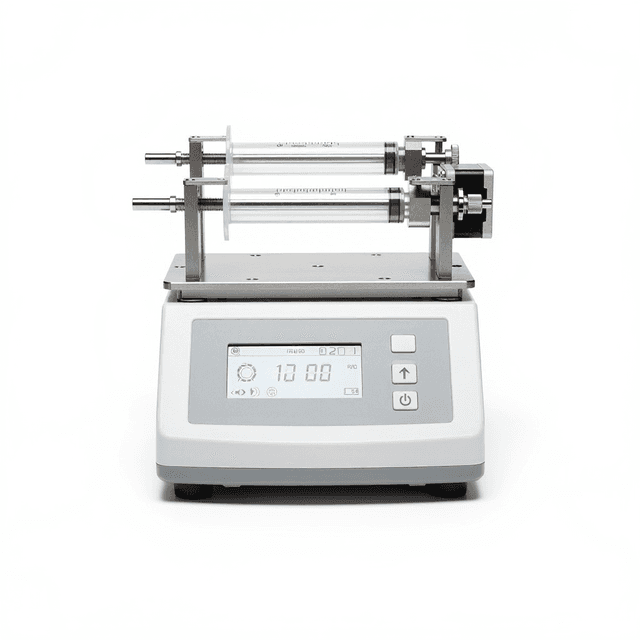
Use syringe pumps with low pulsation for stable flow delivery to minimize droplet size variation.
Why: Flow pulsations translate directly to droplet size variations that can affect experimental reproducibility.
Setup Guide
What’s in the Box
- Double emulsion microfluidic chip
- User manual (typical)
- Connection fittings (typical)
Warranty
ConductScience provides a standard 1-year manufacturer warranty covering defects in materials and workmanship, with technical support available for setup and troubleshooting assistance.
Compliance
References
Background reading relevant to this product:
What flow rate ranges are optimal for stable double emulsion formation?
Optimal flow rates depend on fluid properties and desired droplet sizes. Typically, start with outer phase flow rates 5-20x higher than inner phase rates. Consult product datasheet for specific channel dimensions to calculate appropriate flow parameters.
Can this chip be used with organic solvents?
Compatibility depends on the chip material and solvent properties. Consult product datasheet for chemical compatibility information before using organic phases to avoid channel damage or swelling.
What surfactants are recommended for stable emulsion formation?
Surfactant selection depends on the phase system. Common choices include Span 80 for oil phases and Tween 20 for aqueous phases. Concentrations typically range from 0.5-5% w/v depending on application requirements.
How do I prevent channel clogging during operation?
Filter all solutions through 0.22 μm filters before use, maintain proper flow rate ratios to prevent droplet coalescence, and flush channels with appropriate solvents between experiments.
What droplet size ranges can be achieved?
Droplet sizes typically range from 10-500 μm depending on flow rates, channel geometry, and fluid properties. Smaller droplets require higher shear rates achieved through increased outer phase flow rates.
Is real-time monitoring possible during droplet formation?
Yes, the chip's compact design allows placement under inverted microscopes for real-time observation of droplet formation and size monitoring using high-speed cameras.
How many times can the chip be reused?
Reusability depends on cleaning protocols and experimental conditions. Proper cleaning between experiments and avoiding harsh chemicals can extend chip lifetime to multiple uses.
Have a question about this product?
Have a question? Just ask.
Send it over and we'll email you a personalized answer — no call, no scheduling.
Prefer to talk it through?
Upgrade Options