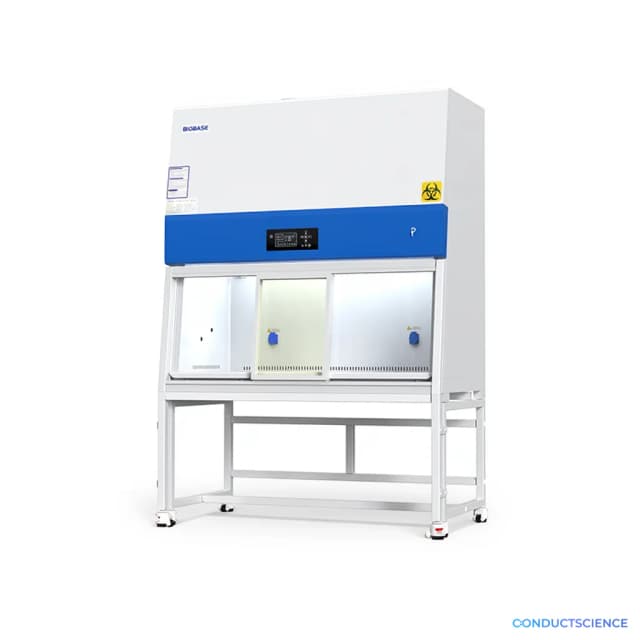
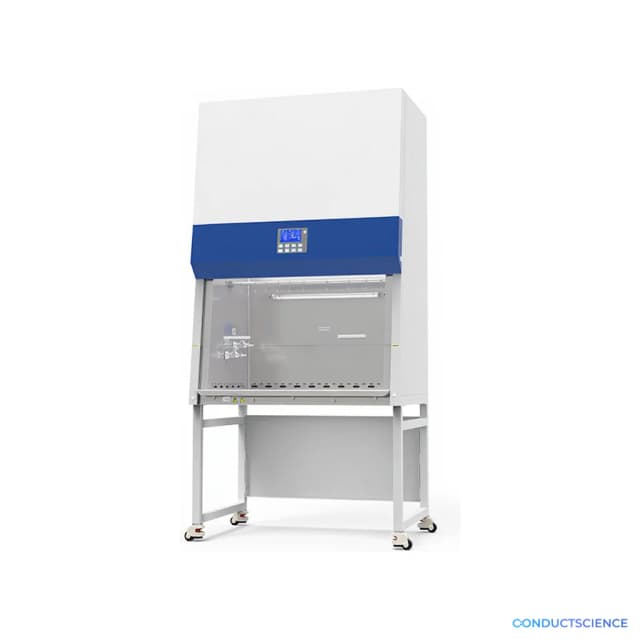
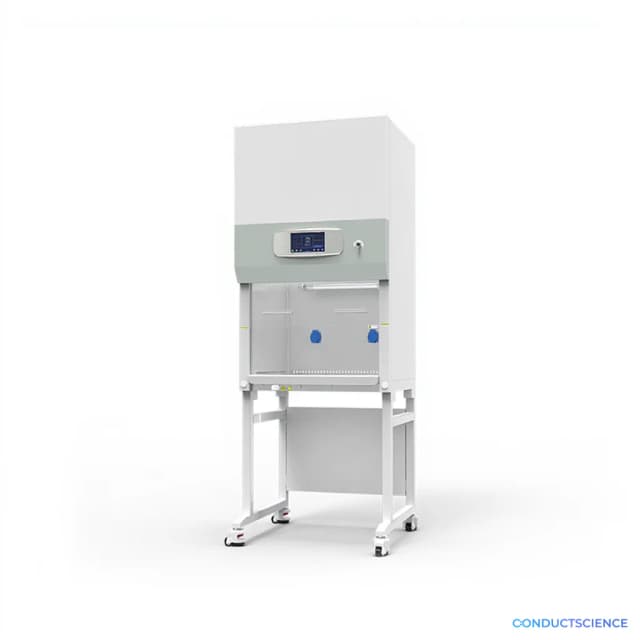
Double Sides Vertical Laminar Flow Cabinet BBS-DSC ,SSC
Vertical laminar flow cabinet with double-sided access providing HEPA-filtered sterile working environment for cell culture and microbiological procedures.

Louise Corscadden, PhD
Director of Science · ConductScience
Ask Louise about Double Sides Vertical Laminar Flow Cabinet BBS-DSC ,SSC fit, setup, configuration, or quote prep.
Already working with us? Sign in to connect this with My Scientist.
Key Specifications
Full details →- Model fit
- Configured during quote
- SKU family
- BIO-0899
- Shipping box
- 177.0 x 104.0 x 66.0 cm
- Ordering
- Online checkout and quote request available
- Category
- Clean Benches & Fume Hoods
- Build notes
- Confirm accessories, station layout, and support needs before purchase
The Double Sides Vertical Laminar Flow Cabinet BBS-DSC ,SSC provides sterile working conditions through filtered air circulation, designed for applications requiring contamination-free environments. This vertical laminar flow configuration delivers HEPA-filtered air downward through the work zone, creating a Class II biological safety cabinet environment suitable for cell culture, microbiological procedures, and sterile sample preparation.
The double-sided design allows access from multiple positions, accommodating collaborative workflows and high-throughput operations. With dimensions of 177 x 104 x 66 cm, this cabinet provides substantial working space while maintaining consistent airflow patterns throughout the work zone. The vertical laminar flow design ensures personnel protection while maintaining sample integrity through continuous air filtration.
How It Works
Vertical laminar flow cabinets operate on the principle of unidirectional airflow created by high-efficiency particulate air (HEPA) filters. The system draws ambient air through pre-filters to remove large particles, then passes it through HEPA filters that remove 99.97% of particles 0.3 micrometers and larger. This filtered air flows vertically downward at uniform velocity across the work surface, creating a sterile barrier that sweeps contaminants away from the work zone.
The double-sided configuration allows the vertical airflow to be maintained while providing access points from multiple positions. Air circulation systems continuously exchange the cabinet atmosphere, typically achieving 100-200 air changes per hour. The vertical flow pattern ensures that any particles introduced during manipulation are immediately carried downward and away from the sterile work zone, preventing contamination of samples or cultures.
Features & Benefits
Automation Level
- manual
Research Domain
- Cancer Research
- Cell Biology
- Environmental Monitoring
- Immunology
- Microbiology
- Pharmaceutical QC
Shipping weight
- 150.0 lb
Shipping box
- L: 177.0 cm
- W: 104.0 cm
- H: 66.0 cm
| Feature | This Product | Typical Alternative | Advantage |
|---|---|---|---|
| Work Surface Area | 177 x 104 cm providing 1.84 square meters | Entry-level models often offer 1.0-1.5 square meters | Larger work surface accommodates multiple culture vessels and equipment for high-throughput operations. |
| Access Configuration | Double-sided access from multiple positions | Most units offer single-sided access only | Multiple access points enable collaborative workflows and flexible positioning in laboratory layouts. |
| Airflow Design | Vertical laminar flow pattern | Some models use horizontal flow patterns | Vertical flow provides both personnel protection and product sterility compared to horizontal-only designs. |
| Interior Height | 66 cm vertical workspace | Compact models may offer 50-60 cm height | Additional vertical space accommodates larger equipment and improves ergonomics during extended procedures. |
This cabinet combines substantial work surface area with double-sided access and vertical laminar flow design. The 1.84 square meter work zone and 66 cm height provide ample space for complex sterile procedures while maintaining Class II biological safety performance.
Practical Tips
Verify airflow velocity and uniformity quarterly using calibrated anemometer measurements across the work surface grid.
Why: Consistent airflow patterns are essential for maintaining sterile conditions throughout the work zone.
Monitor differential pressure across filters weekly and record readings to track filter loading and performance degradation.
Why: Pressure monitoring provides early warning of filter saturation before contamination risk increases.
Allow 15-20 minutes of operation before beginning sterile work to establish stable airflow patterns.
Why: Initial startup period ensures complete air exchange and thermal equilibration for optimal performance.
Work at least 6 inches from the front opening to maintain proper airflow capture velocity.
Why: Adequate distance from the opening ensures protective airflow patterns are not disrupted by hand movements.
Document environmental monitoring results including particle counts and microbial settle plate data.
Why: Trend analysis of contamination data helps identify performance changes and optimize maintenance schedules.
Decontaminate all surfaces with appropriate disinfectant before and after each use period.
Why: Regular decontamination prevents biofilm formation and maintains sterile conditions for subsequent work.
If contamination occurs, verify filter integrity and airflow patterns before resuming critical work.
Why: Systematic investigation prevents repeated contamination incidents and identifies root causes.
Setup Guide
What’s in the Box
- Double-sided vertical laminar flow cabinet (main unit)
- HEPA filter set (typical)
- Pre-filter set (typical)
- Power cable (typical)
- Installation hardware (typical)
- User manual and documentation (typical)
- Filter certification documents (typical)
Warranty
ConductScience provides standard one-year manufacturer warranty covering parts and technical support. Extended warranty options and on-site service plans are available for facilities requiring specialized maintenance agreements.
Compliance
What filter efficiency does the HEPA system achieve?
HEPA filters remove 99.97% of particles 0.3 micrometers and larger. Consult product datasheet for specific filter specifications and replacement schedules.
How often should filters be replaced?
Filter replacement frequency depends on usage intensity and environmental conditions, typically ranging from 6-18 months. Monitor pressure differential across filters to determine replacement timing.
What is the airflow velocity through the work zone?
Consult product datasheet for specific airflow velocity specifications. Vertical laminar flow cabinets typically maintain 70-100 feet per minute downward velocity.
Can this cabinet handle Class II biological safety requirements?
The vertical laminar flow design provides personnel and product protection consistent with Class II biological safety cabinet performance when properly maintained.
What electrical requirements are needed?
Consult product datasheet for specific electrical specifications including voltage, amperage, and grounding requirements for safe installation.
How do I verify sterile performance?
Use settle plates or active air sampling to monitor contamination levels. Establish baseline performance metrics and conduct regular sterility testing.
What maintenance is required?
Regular surface decontamination, filter monitoring, airflow verification, and periodic filter replacement. Establish written maintenance protocols for consistent performance.
Have a question about this product?
Have a question? Just ask.
Send it over and we'll email you a personalized answer — no call, no scheduling.
Prefer to talk it through?
Accessories
Enhance your setup with compatible accessories