Dry Heat CO2 Incubator
80L dry heat CO2 incubator with IR sensor control, 180°C sterilization capability, and 7-inch touchscreen for cell culture applications requiring precise environmental control.

Louise Corscadden, PhD
Director of Science · ConductScience
Ask Louise about Dry Heat CO2 Incubator fit, setup, configuration, or quote prep.
Already working with us? Sign in to connect this with My Scientist.
Key Specifications
Full details →- Model fit
- Configured during quote
- SKU family
- BIO-0186
- Shipping box
- 57.6 x 40.0 x 35.2 cm
- Ordering
- Online checkout and quote request available
- Category
- Laboratory Incubators
- Build notes
- Confirm accessories, station layout, and support needs before purchase
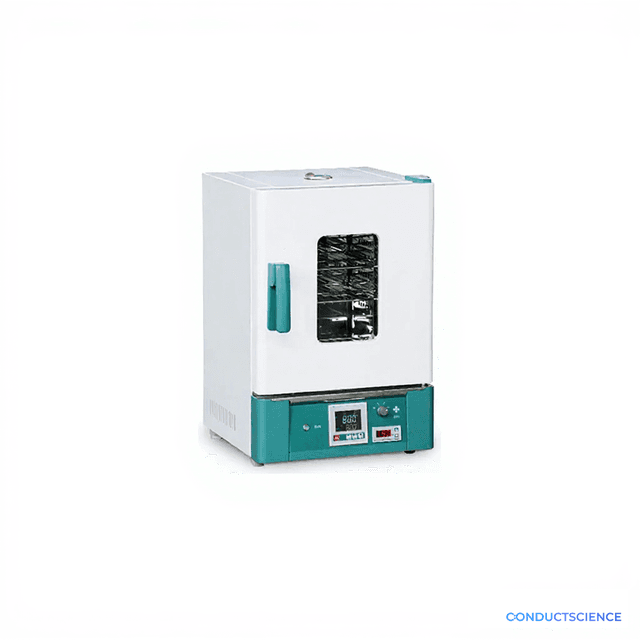
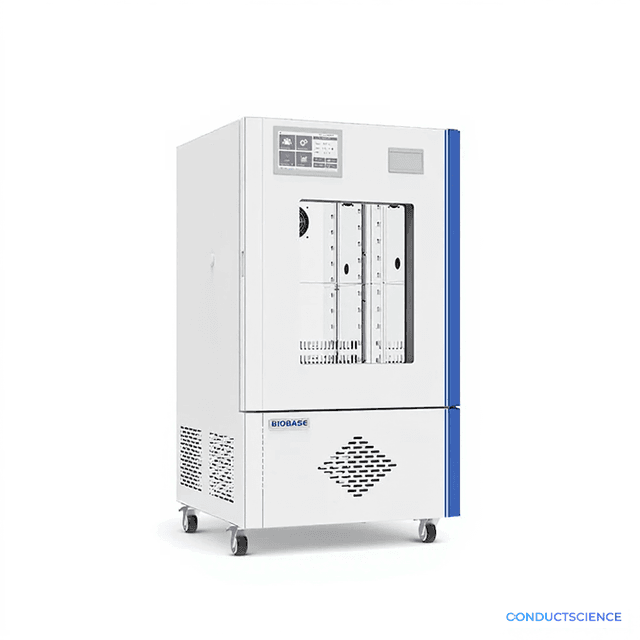
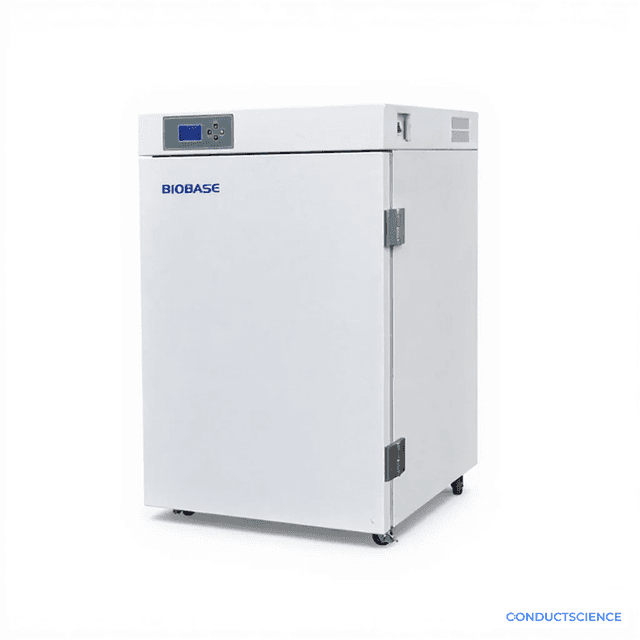
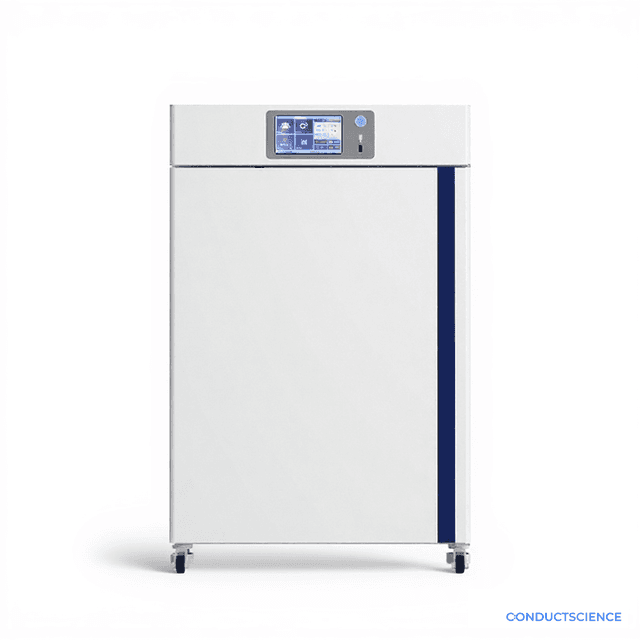
The ConductScience Dry Heat CO2 Incubator (BIO-0186) is an 80L capacity air jacket incubator designed for cell culture applications requiring precise temperature and CO2 control. This dry heat series unit employs 180°C dry heat sterilization for contamination prevention and features PT100 temperature sensing with ±0.3°C fluctuation at 37°C. The system integrates infrared CO2 monitoring with calibration certificate and 7-inch touchscreen interface for protocol management.
The incubator maintains temperature uniformity within ±0.5°C at 37°C across the chamber volume, with CO2 uniformity of 0.2vol% and control resolution to 0.1vol%. Temperature range spans ambient +5°C to 60°C with 0.1°C precision, while CO2 concentration is adjustable from 0-20vol%. Timing control accommodates protocols from 0-999 hours or continuous operation for extended experiments.
How It Works
The incubator operates through air jacket heat distribution, where heated air circulates within the jacket surrounding the culture chamber to maintain uniform temperature. The PT100 resistance temperature detector provides accurate thermal sensing, with the control system maintaining setpoint within ±0.3°C fluctuation at 37°C. The 180°C dry heat sterilization cycle eliminates contamination by exposing all internal surfaces to lethal temperatures.
CO2 concentration control utilizes infrared absorption spectroscopy, where the IR sensor measures CO2-specific wavelength absorption to determine gas concentration. The calibrated IR sensor provides 0.1vol% resolution across the 0-20vol% range. CO2 injection and circulation systems maintain uniform distribution within 0.2vol% throughout the chamber volume. The air jacket design minimizes temperature fluctuations during door opening and provides thermal recovery.
Features & Benefits
Shipping weight
- 90.0 lb
Shipping box
- L: 57.6 cm
- W: 40.0 cm
- H: 35.2 cm
| Feature | This Product | Typical Alternative | Advantage |
|---|---|---|---|
| CO2 Control Range | 0-20vol% with 0.1vol% resolution | Entry-level models often limited to 0-10vol% range | Extended range accommodates specialized applications requiring elevated CO2 concentrations for specific cell types or experimental conditions. |
| Temperature Uniformity | ±0.5°C at 37°C across chamber | Basic models may exhibit ±1-2°C variation | Tighter uniformity ensures consistent culture conditions across all shelf positions for reproducible results. |
| Sterilization Method | 180°C dry heat sterilization | Many units rely on chemical sterilization or lower temperature cycles | Dry heat eliminates contamination without chemical residues and provides validation-friendly sterilization cycles. |
| CO2 Sensing Technology | IR infrared sensor with calibration certificate | Thermal conductivity sensors common in lower-cost models | IR sensors provide superior accuracy and stability with documented calibration traceability for regulated applications. |
| User Interface | 7-inch touchscreen display | Basic models often use LED displays with button controls | Touchscreen interface simplifies protocol programming and provides graphical monitoring for complex experimental setups. |
| Chamber Capacity | 80L working volume | Compact models typically offer 50-60L capacity | Larger capacity accommodates multiple experimental conditions simultaneously while maintaining environmental control. |
This incubator combines precise IR-based CO2 control with dry heat sterilization capability and touchscreen operation. The 80L capacity and extended CO2 range support diverse culture applications requiring documented environmental control and contamination prevention.
Practical Tips
Verify CO2 sensor calibration using certified reference gas standards at both 5% and 10% concentrations annually.
Why: Dual-point calibration ensures accuracy across the working range and maintains traceability for regulated applications.
Execute monthly 180°C sterilization cycles even during continuous use to prevent biofilm accumulation.
Why: Regular thermal sterilization prevents contamination buildup that could compromise culture integrity or sensor performance.
Allow 30-minute equilibration after parameter changes before introducing critical cultures.
Why: Environmental stability ensures cultures experience intended conditions from the start of the experiment.
Monitor CO2 consumption rates to identify potential leaks in gas supply connections or chamber seals.
Why: Excessive gas consumption indicates system leaks that compromise concentration control and increase operating costs.
Position temperature monitoring probes at culture level rather than on chamber walls for accurate condition verification.
Why: Culture-level monitoring provides direct measurement of conditions experienced by samples rather than chamber averages.
Ensure adequate room ventilation when operating at elevated CO2 concentrations to prevent personnel exposure.
Why: CO2 levels above 3% can cause physiological effects in laboratory personnel during equipment maintenance.
Distribute culture vessels evenly across shelves to maintain optimal airflow patterns and CO2 uniformity.
Why: Proper loading ensures consistent environmental conditions and prevents local variations that could affect experimental outcomes.
Clean chamber surfaces with alcohol-based solutions between sterilization cycles to remove organic residues.
Why: Chemical cleaning removes deposits that could interfere with thermal distribution or harbor contaminants resistant to dry heat.
Setup Guide
What’s in the Box
- Dry Heat CO2 Incubator main unit
- Power cord and electrical connections
- CO2 gas connection fittings (typical)
- User manual and operation guide
- Calibration certificate for IR sensor
- Shelf supports and chamber accessories (typical)
- Temperature verification probe (typical)
Warranty
ConductScience provides a standard one-year manufacturer warranty covering parts and labor, with technical support available for troubleshooting and maintenance guidance. Extended warranty options may be available for critical applications requiring enhanced service coverage.
Compliance
What is the recovery time after door opening during operation?
Air jacket design minimizes thermal disturbance during access. Typical temperature recovery to ±0.3°C occurs within 10-15 minutes depending on ambient conditions and door opening duration.
How often does the IR CO2 sensor require calibration?
Annual calibration is recommended for applications requiring documentation. The sensor includes calibration certificate and can be field-calibrated using certified CO2 reference standards.
What CO2 gas purity is required for optimal sensor performance?
99.5% minimum CO2 purity is recommended. Higher purity gases improve sensor accuracy and reduce calibration drift, particularly important for precision applications.
Can the sterilization cycle be programmed automatically?
Sterilization cycles must be manually initiated through the touchscreen interface. The 180°C cycle duration can be programmed based on load requirements and validation protocols.
What data logging capabilities does the unit provide?
Consult product datasheet for specific data output formats and logging intervals. The touchscreen interface displays real-time conditions and alarm status.
How does performance compare to water jacket incubators?
Air jacket design provides faster heating and sterilization capability but may have slightly higher temperature fluctuations compared to water jacket thermal mass. Dry heat sterilization eliminates contamination risk from water systems.
What is the maximum shelf loading capacity?
Consult product specifications for maximum weight loading per shelf. Airflow patterns should be considered when positioning culture vessels to maintain CO2 uniformity.
Does the unit include HEPA filtration for contamination control?
Consult product datasheet for specific air filtration features. The 180°C sterilization capability provides primary contamination control through thermal treatment.
What is the difference between the UV and dry heat CO2 incubator models?
The key difference is the sterilization method. The standard model uses UV lamp sterilization, while the dry heat model uses 140°C dry heat sterilization — a more thorough decontamination method for applications that require it. Both are available in equivalent capacities including 160L with air jacket.
Have a question about this product?
Have a question? Just ask.
Send it over and we'll email you a personalized answer — no call, no scheduling.
Prefer to talk it through?