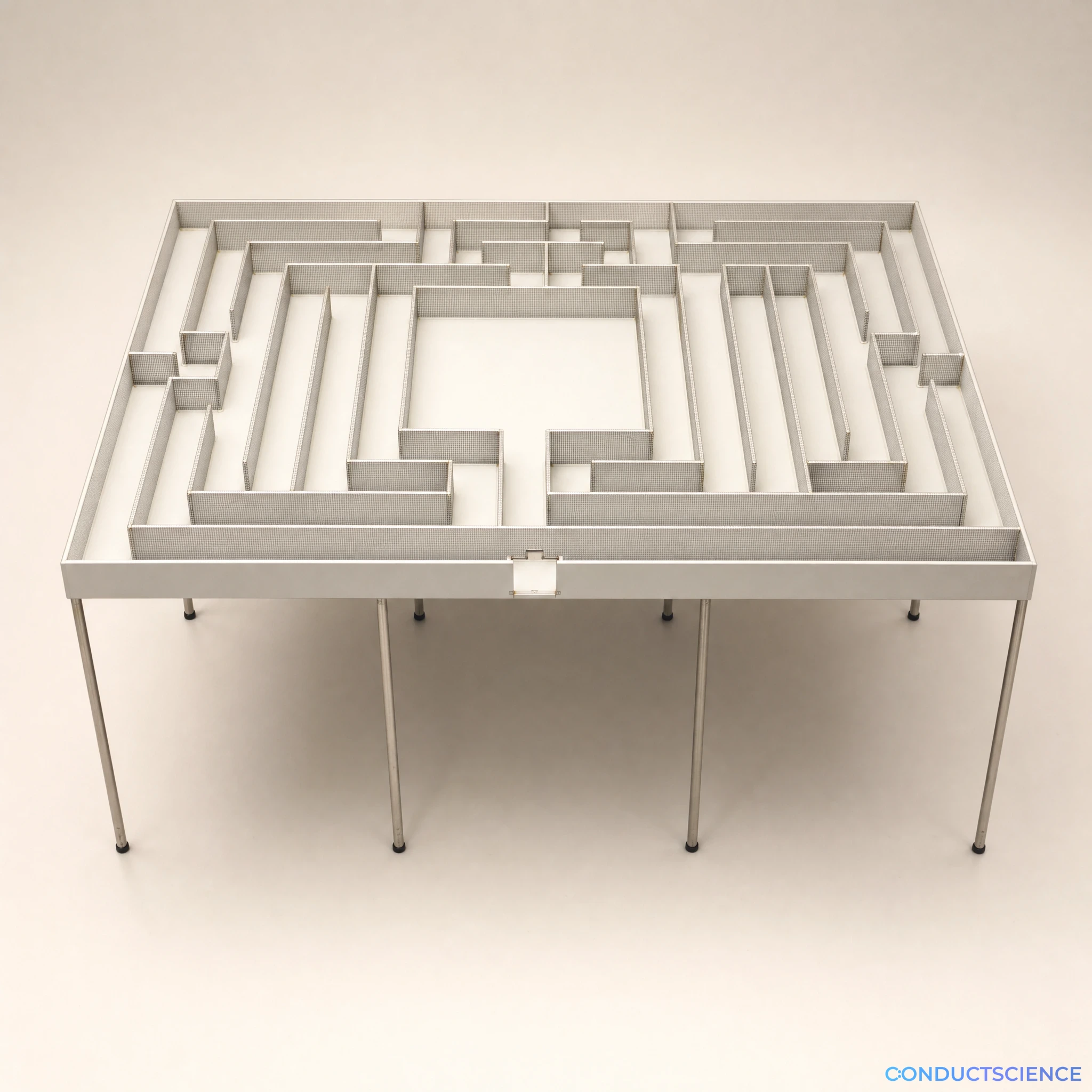
Hampton Court Maze - Historical Rodent Learning Maze
Full-scale manual Hampton Court maze for rat learning and historical replication studies, with one entrance, a central goal, and seven blind alleys.

Louise Corscadden, PhD
Director of Science · ConductScience
Ask Louise about Hampton Court Maze - Historical Rodent Learning Maze fit, setup, configuration, or quote prep.
Already working with us? Sign in to connect this with My Scientist.
Key Specifications
Full details →- Model fit
- Rat
- SKU family
- ME-hampton-court-maze
- Sizing
- Model-specific dimensions confirmed from the selected configuration
- Ordering
- Quote-reviewed before fulfillment
- Category
- Behavioral Mazes
- Build notes
- Historical wire-mesh partitions or an approved modern equivalent
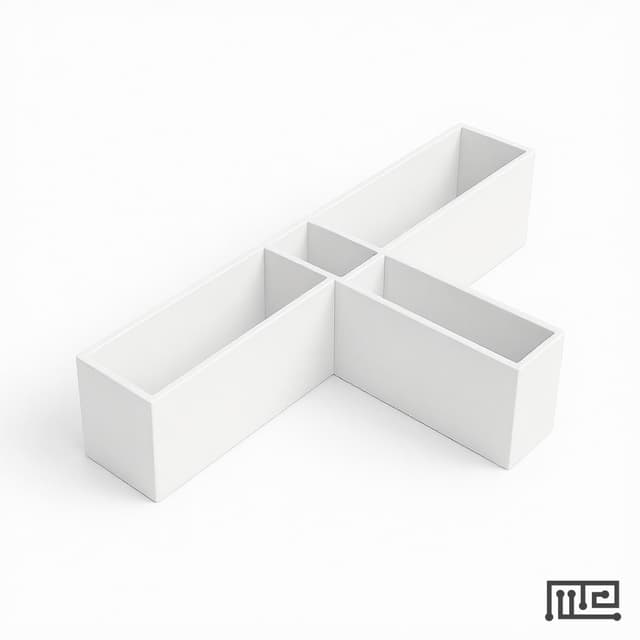
The Hampton Court Maze recreates a historically important large-scale rat-learning apparatus. Its long, constrained route leads from one entrance toward an open central goal while seven blind alleys provide defined error locations.
Historical geometry with modern fabrication review
The source plan occupies six by eight feet with four-inch alley and partition references. Historically faithful wire-mesh partitions or a quote-reviewed modern construction can be specified. The exact connected route, seven error alleys, central goal, support, and modular panel breaks are locked on the fabrication drawing.
Plan the room and scoring workflow together
The large footprint requires room-access, assembly, camera-height, and cleaning review before ordering. Investigators can score completion time, distance, reversals, and entries into each blind alley while maintaining stable distal cues and a consistent start procedure.
Features & Benefits
Evidence-backed species
- Rat
Historical footprint
- 6 ft × 8 ft (approximately 182.9 cm × 243.8 cm)
Alley reference
- 4 in wide (approximately 10.2 cm)
Partition reference
- 4 in high (approximately 10.2 cm)
Entrance
- One
Goal
- One open central goal area
Blind alleys
- Exactly seven
Construction options
- Historical wire-mesh partitions or an approved modern equivalent
Operation
- Fully manual; no sensors, motors, or automated doors
Installation
- Modular breakdown, support, access, and crating confirmed during quote review
Practical Tips
Verify the assembled footprint, aisle clearance, door path, and camera height before fabrication.
Why: The six-by-eight-foot system requires installation planning.
Number the seven blind alleys in the study record rather than on the maze.
Why: A fixed scoring map preserves clean apparatus surfaces and consistent error definitions.
Setup Guide
What’s in the Box
- Sectioned Hampton Court maze in the approved construction
- Supports, connectors, and goal components itemized in the approved quote
- Route map and final assembly schedule matched to the fabrication drawing
Warranty
Fabrication support, replacement options, and warranty terms are confirmed with the final drawing and quote.
References
Background reading relevant to this product:
Is this a modern high-throughput maze?
This is a historically important manual apparatus intended for replication, teaching, and comparative complex-route studies.
How many blind alleys are included?
The source-grounded route contains exactly seven blind alleys and one open central goal.
Is a mouse size available?
The evidence-backed standard is rat scale. A smaller apparatus would be a new custom adaptation rather than the historical design.
Can the maze ship as one piece?
The final quote defines modular sections, connectors, crating, access, and assembly based on the destination room.
Have a question about this product?
Have a question? Just ask.
Send it over and we'll email you a personalized answer — no call, no scheduling.
Prefer to talk it through?