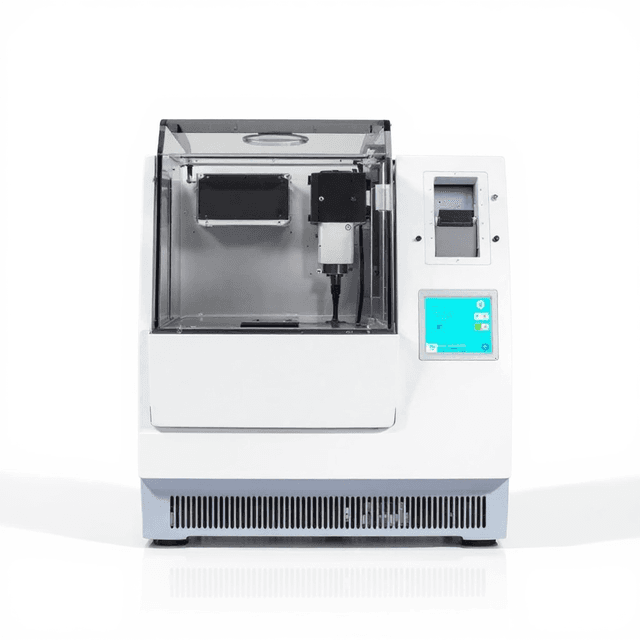
Muffle Furnace 1200°C 2L
Compact benchtop muffle furnace with 1200°C maximum temperature and 2.5L chamber volume, featuring programmable PID control for ashing, calcination, and thermal analysis applications.

Louise Corscadden, PhD
Director of Science · ConductScience
Ask Louise about Muffle Furnace 1200°C 2L fit, setup, configuration, or quote prep.
Already working with us? Sign in to connect this with My Scientist.
Key Specifications
Full details →- Model fit
- Configured during quote
- SKU family
- BIO-MF-2512
- Shipping box
- 42.0 x 43.6 x 38.0 cm
- Ordering
- Online checkout and quote request available
- Category
- Benchtop Instruments
- Build notes
- Confirm accessories, station layout, and support needs before purchase
The Muffle Furnace 1200C - 2.5L is a compact benchtop instrument designed for high-temperature thermal processing applications in analytical and materials research laboratories. This unit combines silicon carbide heating elements with ceramic fiber insulation to achieve maximum temperatures up to 1200°C within a 2.5-liter chamber volume. The programmable PID temperature control system provides precise thermal management for consistent sample processing.
This furnace serves as an essential tool for ashing organic materials, calcination processes, heat treatment of inorganic samples, and loss on ignition determinations. The ceramic fiber construction ensures uniform heat distribution while maintaining energy efficiency and rapid heating rates. The compact design accommodates standard laboratory benchtops while providing sufficient chamber volume for routine analytical sample processing.
How It Works
The muffle furnace operates through resistive heating using silicon carbide heating elements that surround the ceramic fiber-lined chamber. When electrical current passes through the silicon carbide elements, they generate infrared radiation that heats the chamber atmosphere uniformly. The ceramic fiber insulation provides thermal barrier properties that maintain temperature stability while minimizing heat loss to the external environment.
The programmable PID (Proportional-Integral-Derivative) control system continuously monitors chamber temperature through a thermocouple sensor and adjusts power output to the heating elements. This feedback control maintains precise temperature regulation within the programmed thermal profile. The muffle design isolates samples from combustion gases and heating elements, providing a clean atmosphere for thermal processing without contamination from external sources.
Features & Benefits
Automation Level
- semi-automated
Research Domain
- Analytical Chemistry
- Environmental Monitoring
- Food Science
- Materials Science
- Pharmaceutical QC
Shipping weight
- 30.0 lb
Shipping box
- L: 42.0 cm
- W: 43.6 cm
- H: 38.0 cm
| Feature | This Product | Typical Alternative | Advantage |
|---|---|---|---|
| Maximum Temperature | 1200°C | Entry-level models often limited to 1000°C or require larger floor-mounted designs for higher temperatures | Accommodates high-temperature calcination and ashing procedures without requiring larger equipment footprint. |
| Chamber Volume | 2.5L capacity | Benchtop models commonly offer 1-2L while larger capacities typically require floor mounting | Provides good sample throughput while maintaining convenient benchtop installation. |
| Temperature Control | Programmable PID controller | Basic units often use simple on/off control or limited programming capability | Enables complex thermal profiles with automated ramp rates for reproducible analytical procedures. |
| Heating Technology | Silicon carbide heating elements | Standard resistance wire elements in lower-cost models | Delivers superior heat uniformity and faster heating rates with better temperature stability. |
| Insulation System | Ceramic fiber construction | Traditional brick insulation in older designs | Provides faster heating and cooling cycles with improved energy efficiency and reduced thermal mass. |
This muffle furnace combines high temperature capability with programmable control in a compact benchtop design. The silicon carbide heating and ceramic fiber insulation provide efficient thermal performance suitable for analytical and materials research applications requiring precise temperature control.
Practical Tips
Verify temperature accuracy quarterly using certified reference thermometer placed in chamber center during heating cycle.
Why: Temperature drift can affect analytical reproducibility and compliance with standard test methods.
Inspect heating elements monthly for cracks or discoloration that indicate degradation or contamination.
Why: Early detection prevents element failure and maintains uniform heating performance.
Use appropriate crucible materials and avoid overloading chamber to ensure uniform heat distribution to all samples.
Why: Proper sample arrangement prevents temperature gradients that can cause inconsistent results.
Allow complete cool-down before opening chamber and always use heat-resistant gloves when handling hot components.
Why: High-temperature surfaces retain heat for extended periods and can cause severe burns.
Record thermal profiles and heating rates for each analytical batch to ensure procedural reproducibility.
Why: Documentation enables troubleshooting and supports analytical method validation requirements.
If temperature control becomes erratic, check thermocouple connections and clean chamber of any sample residues.
Why: Contamination or loose connections can interfere with temperature sensing and control accuracy.
Setup Guide
What’s in the Box
- Muffle furnace main unit
- Power cord
- User manual and operating instructions
- Sample handling tongs (typical)
- Temperature calibration certificate (typical)
Warranty
ConductScience provides a one-year manufacturer warranty covering defects in materials and workmanship, with technical support for operational guidance and troubleshooting assistance.
Compliance
What is the temperature accuracy and uniformity of this furnace?
Consult product datasheet for specific temperature accuracy specifications. The PID control system and ceramic fiber construction provide stable thermal conditions, but verification with certified reference thermometer is recommended for critical applications.
How long does it take to reach maximum temperature?
Heating rate depends on thermal mass and target temperature. Consult product datasheet for specific heating rate specifications from ambient to 1200°C.
What crucible materials are compatible with 1200°C operation?
Alumina, platinum, and high-temperature ceramic crucibles are suitable. Avoid glass or porcelain containers which will soften or melt at these temperatures.
Can I program multi-step heating profiles?
Yes, the programmable PID controller allows custom thermal profiles with multiple temperature ramps, hold times, and cooling segments for complex analytical procedures.
What are the power requirements for this unit?
Consult product datasheet for specific electrical requirements including voltage, current draw, and recommended circuit protection.
How does this compare to larger capacity furnaces?
The 2.5L chamber provides good sample throughput while maintaining benchtop portability. Larger units offer higher capacity but require floor mounting and greater power consumption.
What maintenance is required for the heating elements?
Silicon carbide elements are durable but should be inspected periodically for cracks or degradation. Avoid rapid temperature changes and contamination to extend element life.
Have a question about this product?
Have a question? Just ask.
Send it over and we'll email you a personalized answer — no call, no scheduling.
Prefer to talk it through?