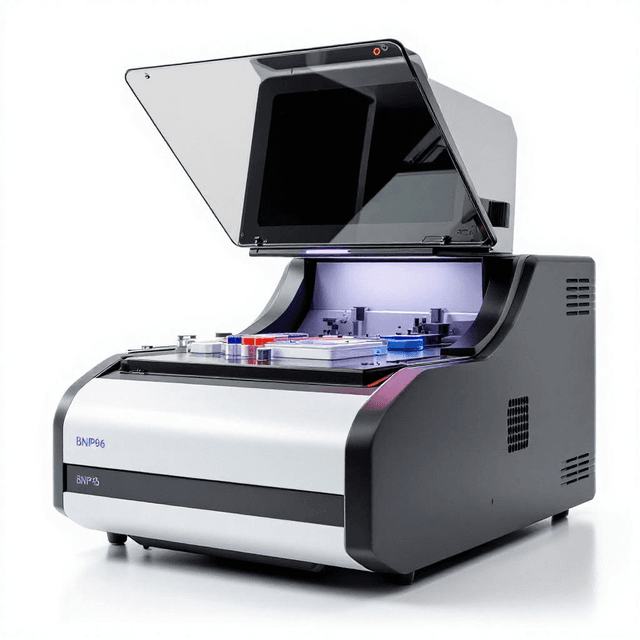
Nucleic Acid Extractor System BNP32 BNP48
Automated magnetic bead-based nucleic acid extraction system supporting 32 or 48-sample throughput for DNA and RNA isolation from biological samples.

Louise Corscadden, PhD
Director of Science · ConductScience
Ask Louise about Nucleic Acid Extractor System BNP32 BNP48 fit, setup, configuration, or quote prep.
Already working with us? Sign in to connect this with My Scientist.
Key Specifications
Full details →- Model fit
- Configured during quote
- SKU family
- BIO-0651
- Shipping box
- 42.0 x 43.6 x 38.0 cm
- Ordering
- Online checkout and quote request available
- Category
- Imaging & Analysis
- Build notes
- Confirm accessories, station layout, and support needs before purchase
The Nucleic Acid Extractor System BNP32/BNP48 is an automated laboratory instrument designed for high-throughput isolation and purification of DNA and RNA from biological samples. This system employs magnetic bead-based extraction protocols to deliver consistent nucleic acid recovery across diverse sample types including tissue, blood, saliva, and cultured cells.
The dual-configuration design accommodates laboratories with varying throughput requirements, supporting both 32-sample and 48-sample processing formats. The system integrates programmable extraction protocols, temperature control, and magnetic separation technology to minimize cross-contamination while maximizing nucleic acid yield and purity for downstream molecular applications.
How It Works
The system utilizes magnetic bead-based separation technology combined with chaotropic salt chemistry for nucleic acid binding and purification. Sample lysis occurs through a combination of mechanical disruption and chemical treatment using guanidinium-based buffers that denature proteins while maintaining nucleic acid integrity.
Paramagnetic silica beads selectively bind DNA or RNA under high-salt conditions. An automated magnetic separation module moves the bead-bound nucleic acids through successive wash steps to remove proteins, lipids, and other contaminants. Final elution occurs in low-salt buffer or water, releasing purified nucleic acids ready for downstream applications.
Temperature-controlled incubation chambers maintain optimal binding and washing conditions throughout the protocol, while integrated pipetting systems ensure precise reagent delivery and mixing for reproducible results across all sample positions.
Features & Benefits
Automation Level
- fully-automated
Research Domain
- Analytical Chemistry
- Cancer Research
- Clinical Diagnostics
- Microbiology
- PCR and Genomics
- Pharmaceutical QC
Shipping weight
- 51.0 lb
Shipping box
- L: 42.0 cm
- W: 43.6 cm
- H: 38.0 cm
| Feature | This Product | Typical Alternative | Advantage |
|---|---|---|---|
| Sample Throughput | 32 or 48 samples per batch | Entry-level systems often process 16-24 samples | Higher throughput reduces processing time and increases laboratory efficiency for routine sample volumes. |
| Automation Level | Fully automated magnetic separation with programmable protocols | Semi-automated systems require manual intervention | Minimizes technician time and reduces variability between operators and processing batches. |
| Sample Format Flexibility | Multiple biological sample types with protocol selection | Limited to specific sample types | Single system handles diverse sample types, reducing equipment investment and training requirements. |
| Temperature Control | Integrated temperature management throughout extraction | External heating blocks or ambient processing | Precise temperature control optimizes nucleic acid binding and release for maximum yield and quality. |
| System Weight | 51 kg shipping weight | Benchtop units typically weigh 20-40 kg | Robust construction ensures stable operation and precise magnetic separation across all sample positions. |
| Protocol Programmability | Customizable extraction parameters | Fixed protocols with limited adjustment | Enables protocol optimization for specific research applications and sample types. |
This nucleic acid extraction system offers high-throughput automated processing with flexible protocol programming and robust magnetic separation technology. The dual-configuration design and comprehensive sample compatibility make it suitable for laboratories requiring reliable, scalable nucleic acid purification workflows.
Practical Tips
Perform magnetic separation calibration monthly or after any maintenance to ensure optimal bead capture efficiency.
Why: Proper magnetic field strength is critical for consistent nucleic acid recovery across all sample positions.
Clean liquid lines weekly with nuclease-free water followed by 70% ethanol to prevent reagent contamination.
Why: Residual reagents can affect extraction efficiency and introduce nucleases that degrade target nucleic acids.
Allow frozen samples to reach room temperature before processing and ensure complete lysis for optimal yield.
Why: Temperature equilibration and complete cell disruption are essential for maximum nucleic acid release and recovery.
If yields are consistently low, verify bead resuspension and check magnetic separation timing parameters.
Why: Inadequate bead mixing or insufficient separation time reduces nucleic acid capture efficiency.
Include negative controls and known-positive samples in each batch to monitor extraction performance.
Why: Quality controls detect contamination, reagent degradation, or instrument malfunctions that could compromise results.
Use appropriate PPE when handling chaotropic reagents and ensure adequate ventilation during operation.
Why: Guanidinium-based lysis buffers are hazardous and require proper handling to protect laboratory personnel.
Store extracted nucleic acids at -20°C or -80°C immediately after processing to maintain integrity.
Why: Nucleic acids are susceptible to degradation at room temperature, especially RNA which is sensitive to nucleases.
Replace magnetic beads and check reagent expiration dates regularly to maintain consistent performance.
Why: Expired reagents and degraded magnetic particles can significantly reduce extraction efficiency and reproducibility.
Setup Guide
What’s in the Box
- Main extraction unit (typical)
- Magnetic separation module (typical)
- Temperature control system (typical)
- Liquid handling components (typical)
- Power adapter and cables (typical)
- USB/network interface cable (typical)
- Control software installation media (typical)
- User manual and protocol guide (typical)
- Calibration standards (typical)
- Initial reagent starter kit (typical)
Warranty
ConductScience provides a standard one-year manufacturer warranty covering parts and labor, with comprehensive technical support for installation, training, and troubleshooting assistance.
Compliance
References
Background reading relevant to this product:
What types of samples can be processed with this system?
The system handles diverse biological samples including whole blood, tissue specimens, buccal swabs, saliva, cultured cells, and bacterial samples. Protocol selection determines optimal processing parameters for each sample type.
How does nucleic acid quality compare to manual extraction methods?
Automated magnetic bead separation typically provides higher purity and more consistent A260/A280 ratios compared to manual methods, with reduced risk of cross-contamination between samples.
What is the typical processing time per batch?
Processing time varies by protocol complexity and sample number, ranging from 45 minutes to 2 hours per batch. Consult protocol specifications for exact timing requirements.
Can the system handle both DNA and RNA extractions?
Yes, the system supports separate protocols optimized for DNA isolation, RNA purification, or simultaneous DNA/RNA extraction depending on experimental requirements.
What maintenance is required for consistent performance?
Regular maintenance includes magnetic module calibration, liquid line cleaning, temperature verification, and replacement of wear components according to the maintenance schedule.
How much sample input is required for optimal yields?
Input requirements depend on sample type and target nucleic acid concentration. Consult protocol guides for recommended sample volumes and expected yield ranges.
What data outputs does the system provide?
The system logs processing parameters, temperatures, timing, and error conditions. Integration with LIMS systems enables automated data transfer and batch tracking.
Can protocols be customized for specific research applications?
Yes, the programmable interface allows modification of incubation times, temperatures, wash steps, and elution volumes to optimize recovery for specific sample types or downstream applications.
Have a question about this product?
Have a question? Just ask.
Send it over and we'll email you a personalized answer — no call, no scheduling.
Prefer to talk it through?