Waveform Generator: 20MHz
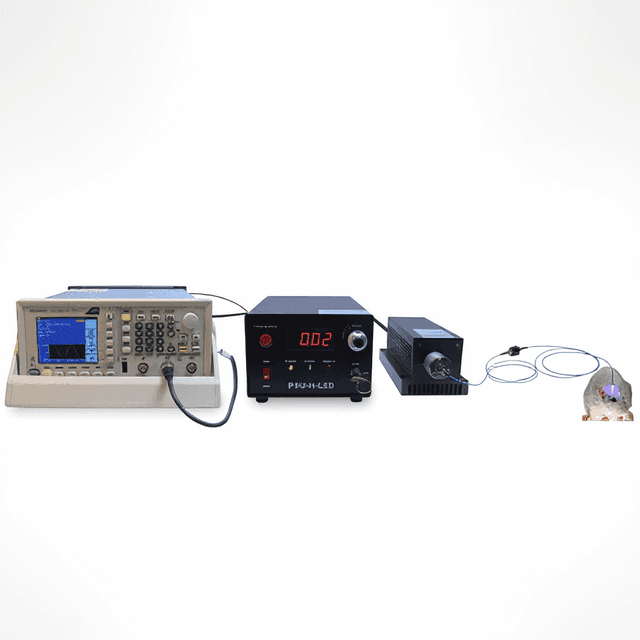
RWD new intelligent optogenetics system, on the basis of the last generation of integrated machines (laser and waveform generator integrated into one), has made another leap in the promotion..
The new system is equipped with remote control function, one-click test conversion and three signal trigger

Louise Corscadden, PhD
Director of Science · ConductScience
Ask Louise about Waveform Generator: 20MHz fit, setup, configuration, or quote prep.
Already working with us? Sign in to connect this with My Scientist.
Key Specifications
Full details →- Model fit
- Configured during quote
- SKU family
- RWD-AFG2021-SC
- Shipping box
- 34.0 x 39.0 x 33.0 cm
- Ordering
- Online checkout and quote request available
- Category
- Optogenetics & Photometry
- Build notes
- Confirm accessories, station layout, and support needs before purchase
Key performance specifications
- 20 MHz sine, 10 MHz pulse waveforms provide coverage for your most common applications
- 250 MS/s sampling rate and 14-bit vertical resolution enable the creation of high-fidelity signals
Key features
- The innovative UI reduces setup and evaluation time with direct access to frequently used functions and parameters
- The internal 4 × 16 kS memory and the USB memory expansion capability provide substantial capacity for defining complex waveforms
- USB host port on the front panel for saving/reloading arbitrary waveforms and instrument settings
- Built-in Modulation, Noise Generator, Burst, and Sweep modes for greater versatility
- Built-in waveforms provide quick access to commonly used signals
- Large 3.5-inch color screen displays both graphical and numeric waveform information simultaneously
- Menu and online help in Simplified Chinese and English
- 2U height and half-rack width fits benchtop applications
- Free ArbExpress software makes waveform editing extremely easy
Applications
- Electronic test and design
- Sensor simulation
- Education and training
- Functional test
How It Works
The waveform generator operates through direct digital synthesis (DDS), converting digital waveform data into analog voltage outputs at frequencies up to 20 MHz. The 250 MS/s sampling rate enables reconstruction of complex waveforms with high temporal resolution, while 14-bit vertical resolution provides 16,384 discrete amplitude levels for precise signal fidelity.
Internal memory stores predefined waveform data in 4 × 16 kS blocks, allowing rapid recall of complex arbitrary patterns. The USB expansion capability extends storage for user-defined waveforms created through the ArbExpress software interface. Modulation modes alter carrier waveforms through amplitude, frequency, or phase variations, while burst and sweep functions provide time-domain and frequency-domain signal modifications essential for stimulus-response protocols.
Features & Benefits
Sine Waveform Frequency
- 20 MHz
Pulse Waveform Frequency
- 10 MHz
Sampling Rate
- 250 MS/s
Internal Memory
- 4 × 16 kS
USB Host Port
- front panel
Built in Modes
- ['Modulation', 'Noise Generator', 'Burst', 'Sweep']
Menu Languages
- ['Simplified Chinese', 'English']
Included Software
- ArbExpress waveform editing software
Memory Expansion
- USB memory expansion capability
Automation Level
- semi-automated
Accuracy
- 14-bit vertical resolution
Display Type
- 3.5-inch color screen
Dimensions
- half-rack width x 2U height
Brand
- RWD
Research Domain
- Analytical Chemistry
- Behavioral Pharmacology
- Cell Biology
- Neuroscience
- Optogenetics
Shipping weight
- 8.27 lb
Shipping box
- L: 34.0 cm
- W: 39.0 cm
- H: 33.0 cm
| Feature | This Product | Typical Alternative | Advantage |
|---|---|---|---|
| Maximum Frequency | 20 MHz sine waves, 10 MHz pulse | Entry-level models often provide 1-5 MHz bandwidth | Higher frequency capability enables RF applications and fast optogenetic protocols requiring rapid modulation. |
| Sampling Rate | 250 MS/s | Basic generators typically offer 50-100 MS/s | Higher sampling rate provides better waveform fidelity and reduced artifacts in arbitrary pattern generation. |
| Amplitude Resolution | 14-bit vertical resolution | Standard models often use 8-12 bit resolution | Increased amplitude precision enables fine control of stimulus intensity in dose-response studies. |
| Memory Capacity | 4 × 16 kS internal memory with USB expansion | Basic units typically offer limited or no arbitrary waveform storage | Substantial memory capacity allows storage of complex experimental protocols without external computer connection. |
| Display Interface | 3.5-inch color display with graphical waveform preview | Many models use small LCD or LED displays | Visual waveform representation enables immediate verification of signal parameters without external monitoring. |
This generator offers 20 MHz bandwidth with 250 MS/s sampling rate and 14-bit resolution, providing high-fidelity waveform generation. The 4 × 16 kS memory capacity with USB expansion and color display interface enhance operational flexibility compared to basic function generators.
Practical Tips
Verify frequency accuracy using a frequency counter at multiple points across the bandwidth, particularly at the frequencies most critical to your experimental protocols.
Why: Frequency drift can affect stimulus timing precision in time-sensitive experiments.
Keep the ventilation slots clear and clean the display with a lint-free cloth to maintain optimal cooling and visibility.
Why: Proper ventilation prevents thermal drift while clean displays ensure accurate parameter reading.
Use 50-ohm termination on unused outputs and verify load impedance matches the generator's output impedance for maximum power transfer.
Why: Proper impedance matching prevents signal reflections and ensures accurate amplitude delivery.
If waveform distortion occurs at high frequencies, check cable quality and length, as poor connections introduce signal degradation.
Why: High-frequency signals are sensitive to cable impedance mismatches and connector quality.
Save instrument settings and custom waveforms to USB storage before critical experiments to ensure reproducible protocols.
Why: Standardized settings eliminate parameter variation between experimental sessions.
Verify maximum safe input levels for connected equipment before enabling output, as high-amplitude signals can damage sensitive devices.
Why: Function generator outputs can exceed safe input ranges of some laboratory equipment.
Use the ArbExpress software to pre-design complex waveforms offline, then transfer to the generator for execution.
Why: Software-based design allows precise waveform construction and documentation for protocol validation.
Setup Guide
What’s in the Box
- RWD-AFG2021-SC waveform generator
- AC power cord
- USB cable
- BNC output cables (typical)
- ArbExpress software CD
- User manual
- Calibration certificate (typical)
Warranty
ConductScience provides a comprehensive 1-year manufacturer warranty covering parts and labor, with technical support for setup, calibration, and operational guidance throughout the warranty period.
Compliance
References
Background reading relevant to this product:
What is the amplitude accuracy and stability of the output signals?
Consult product datasheet for specific amplitude accuracy and temperature stability specifications, as these critical parameters vary with frequency and environmental conditions.
Can this generator synchronize with external triggers for optogenetic protocols?
The burst and sweep modes support external triggering capabilities, allowing synchronization with experimental protocols and other laboratory equipment.
What file formats are supported for arbitrary waveform import?
The ArbExpress software supports standard waveform file formats, with USB storage enabling transfer of custom patterns between instruments and computers.
How does the phase noise performance affect sensitive measurements?
Consult product datasheet for phase noise specifications, particularly important for applications requiring stable frequency references or low-jitter timing signals.
What is the maximum arbitrary waveform length that can be stored?
Internal memory supports 4 × 16 kS waveforms, with USB expansion providing essentially unlimited storage capacity for complex experimental protocols.
Can both channels operate independently with different waveforms?
The dual-channel design allows independent waveform generation on each output, enabling simultaneous control of multiple experimental parameters.
What calibration procedures are recommended for maintaining accuracy?
Regular verification against known frequency and amplitude standards is recommended, with annual professional calibration for applications requiring traceable measurements.
Have a question about this product?
Have a question? Just ask.
Send it over and we'll email you a personalized answer — no call, no scheduling.
Prefer to talk it through?