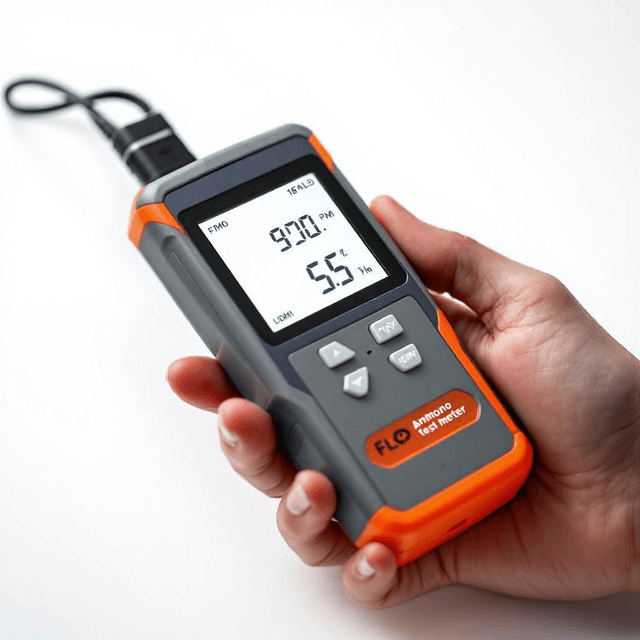
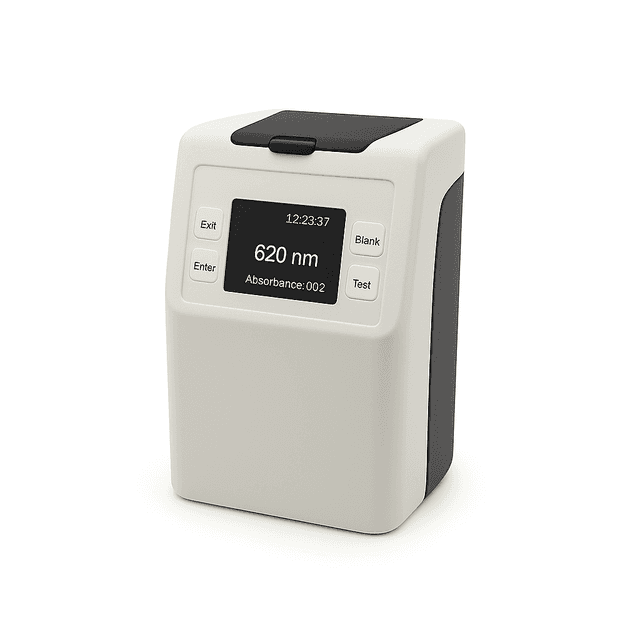
Portable Water Analyzer
Portable spectrophotometric water analyzer with 380-800nm range, touchscreen interface, and thermal printer for field and laboratory water quality analysis.

Louise Corscadden, PhD
Director of Science · ConductScience
Ask Louise about Portable Water Analyzer fit, setup, configuration, or quote prep.
Already working with us? Sign in to connect this with My Scientist.
Key Specifications
Full details →- Model fit
- Configured during quote
- SKU family
- BIO-0466
- Shipping box
- 39.0 x 52.5 x 20.0 cm
- Ordering
- Online checkout and quote request available
- Category
- Portable Analyzers
- Build notes
- Confirm accessories, station layout, and support needs before purchase
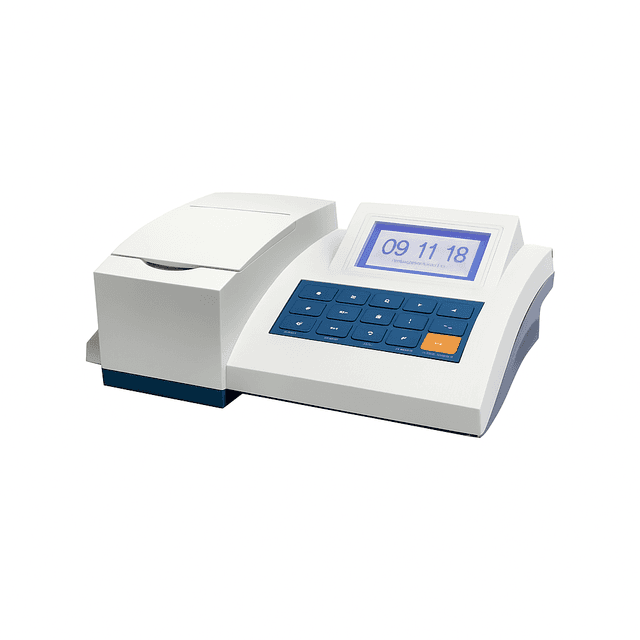
The Portable Water Analyzer (BIO-0466) is a spectrophotometric instrument designed for quantitative analysis of water quality parameters in field and laboratory environments. The system employs visible-light spectroscopy across 380-800nm wavelength range to determine concentrations of dissolved analytes through colorimetric detection methods.
Featuring a 7-inch color touchscreen interface and built-in thermal printer, the analyzer accommodates standard cuvettes and colorimetric tubes for sample analysis. The instrument stores up to 200 calibration curves and 5000 data points, with measurement cycles completing in 10 minutes. Optical stability of ≤0.001A/10min and repeatability of ≤±3% support quantitative analytical workflows requiring portable spectroscopic measurements.
How It Works
The analyzer employs absorption spectroscopy principles, where light from an LED source passes through the sample and is detected by a photodiode array. When analytes are present in solution, they absorb specific wavelengths of light proportional to their concentration, following Beer-Lambert law (A = εbc), where absorbance correlates directly with analyte concentration.
Sample preparation involves adding specific reagents that react with target analytes to form colored complexes with characteristic absorption spectra. The instrument measures absorbance at predetermined wavelengths, compares against stored calibration curves, and calculates concentrations using pre-programmed algorithms. The 380-800nm wavelength range covers visible spectrum absorption bands for most common colorimetric water analysis protocols.
Features & Benefits
Automation Level
- semi-automated
Display Error
- ≤8%
Repeatability
- ≤±3%
Optical Stability
- ≤0.001A/10min
Light Source Life
- 100,000 hours
Measurement Time
- 10min
Number of Curves
- 200 can be set
Data Storage
- 5000 pieces can be stored
Wavelength Range
- 380~800nm
Printer
- Built-in thermal printer
Reading Cuvette
- Cuvette /Colorimetric tube
pH
- Range
Brand
- ConductScience
Research Domain
- Analytical Chemistry
- Environmental Monitoring
- Food Science
- Industrial Hygiene
- Microbiology
- Pharmaceutical QC
Display Type
- 7 inch color touch screen/5.6-inch omron button integrated screen
Accuracy
- ±0.10 mg/L
Shipping weight
- 17.0 lb
Shipping box
- L: 39.0 cm
- W: 52.5 cm
- H: 20.0 cm
| Feature | This Product | Typical Alternative | Advantage |
|---|---|---|---|
| Wavelength Range | 380-800nm full visible spectrum | Limited wavelength models often provide 400-700nm ranges | Broader spectral coverage accommodates more colorimetric methods and improves analytical flexibility |
| Data Storage Capacity | 5000 data points and 200 calibration curves | Entry-level analyzers typically store fewer data points and curves | Extensive storage supports large sampling campaigns without data loss or frequent downloads |
| Display Interface | 7-inch color touchscreen | Basic models often feature smaller LCD displays with button navigation | Large touchscreen interface improves field usability and reduces operator error during measurements |
| Integrated Printer | Built-in thermal printer | Many portable analyzers require external printers or lack printing capability | Immediate hard-copy documentation supports chain-of-custody requirements in field sampling |
| Measurement Time | 10-minute analysis cycle | Varies by model and measurement complexity | Consistent timing supports workflow planning and batch processing in field operations |
| Optical Stability | ≤0.001A/10min drift specification | Stability specifications vary widely among portable instruments | Low optical drift maintains measurement accuracy during extended field deployments |
The analyzer combines laboratory-grade optical performance with field-portable design, offering comprehensive wavelength coverage and extensive data management. Integrated thermal printing and large touchscreen interface distinguish this system from basic portable colorimeters.
Practical Tips
Verify calibration curves using certified reference materials before each field deployment campaign.
Why: Environmental conditions during transport can affect optical alignment and measurement accuracy.
Clean optical surfaces with lint-free wipes and appropriate solvents after exposure to dusty field conditions.
Why: Particulate contamination on optical components degrades measurement precision and increases baseline drift.
Allow 15-minute thermal equilibration before measurements when moving between temperature environments.
Why: Temperature changes affect LED output and detector sensitivity, impacting measurement repeatability.
Run blank measurements between different sample types to detect carryover contamination.
Why: Residual analytes from previous samples can bias subsequent measurements in trace-level analysis.
Check cuvette positioning and cleanliness if measurements show unexpected variability between replicates.
Why: Optical path obstructions or contamination introduce systematic errors in spectroscopic measurements.
Ensure adequate ventilation when using colorimetric reagents in enclosed field vehicles or shelters.
Why: Some analytical reagents release vapors that require proper ventilation to prevent operator exposure.
Record ambient temperature and humidity conditions with measurement data for quality assurance documentation.
Why: Environmental conditions can influence reagent stability and instrument performance in field applications.
Store calibration standards in temperature-controlled conditions and verify expiration dates before use.
Why: Degraded standards compromise measurement accuracy and can invalidate analytical results.
Setup Guide
What’s in the Box
- Portable Water Analyzer main unit
- Power adapter and charging cable
- Sample cuvettes (typical)
- Calibration standards set (typical)
- USB cable for data transfer (typical)
- User manual and operation guide
- Carrying case (typical)
Warranty
ConductScience provides a standard one-year manufacturer warranty covering defects in materials and workmanship. Technical support includes calibration guidance and method development assistance for water analysis applications.
Compliance
What types of water samples can be analyzed with this instrument?
The analyzer accommodates drinking water, surface water, groundwater, and process water samples using standard colorimetric protocols. Sample preparation may require dilution or pre-treatment depending on turbidity and dissolved solids content.
How do I establish calibration curves for new analytes?
Create calibration curves by measuring known standard concentrations across the expected sample range. The instrument stores up to 200 curves with linear or non-linear curve fitting algorithms.
What is the detection limit for trace contaminants?
Detection limits depend on the specific colorimetric method and reagent sensitivity. Consult product datasheet for method-specific detection limits, as these vary by analyte and reaction chemistry.
Can the analyzer operate in extreme environmental conditions?
Consult product datasheet for operating temperature and humidity specifications. Portable design suggests field capability, but specific environmental limits are not detailed in basic specifications.
How do I transfer stored data to laboratory information systems?
Data transfer methods should be confirmed in the user manual. The thermal printer provides immediate hard copies, and USB connectivity may support electronic data transfer.
What maintenance is required for consistent performance?
Regular maintenance includes optical system cleaning, lamp replacement after 100,000 hours, and periodic calibration verification. Specific protocols depend on usage frequency and sample matrix effects.
How does this compare to benchtop spectrophotometers?
Portable design trades some optical sophistication for field deployment capability. Wavelength range and accuracy specifications should be compared against specific benchtop models for laboratory requirements.
Have a question about this product?
Have a question? Just ask.
Send it over and we'll email you a personalized answer — no call, no scheduling.
Prefer to talk it through?