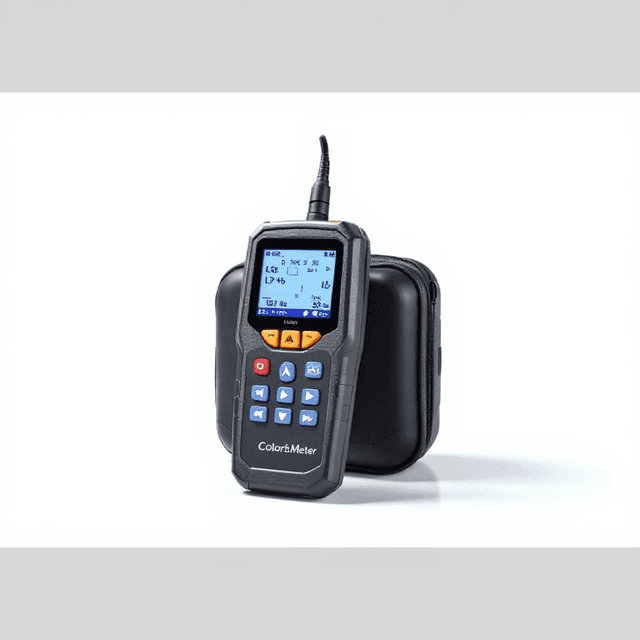
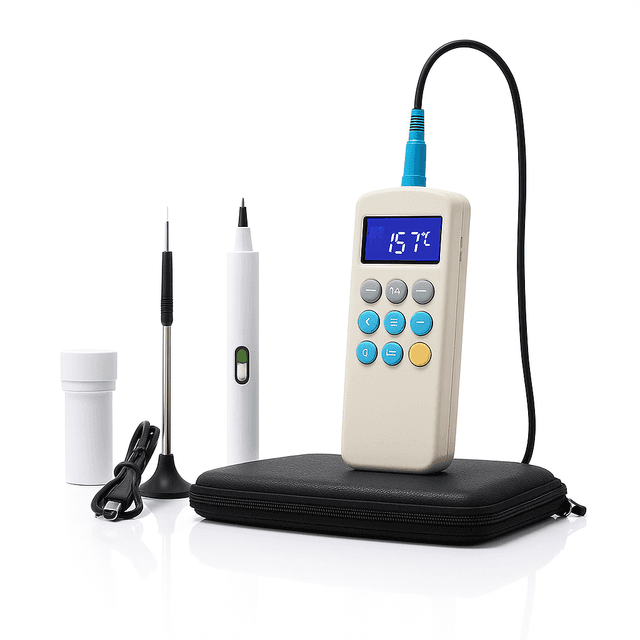
Portable Water Quality Dissolved Oxygen Meter
Fluorescence-based portable dissolved oxygen meter for environmental monitoring and water quality assessment, featuring 0-20 mg/L measurement range and IP67 waterproof design.

Louise Corscadden, PhD
Director of Science · ConductScience
Ask Louise about Portable Water Quality Dissolved Oxygen Meter fit, setup, configuration, or quote prep.
Already working with us? Sign in to connect this with My Scientist.
Key Specifications
Full details →- Model fit
- Configured during quote
- SKU family
- CS-LH-D702
- Shipping box
- 7.87 x 3.98 x 1.42 cm
- Ordering
- Online checkout and quote request available
- Category
- Portable Analyzers
- Build notes
- Confirm accessories, station layout, and support needs before purchase
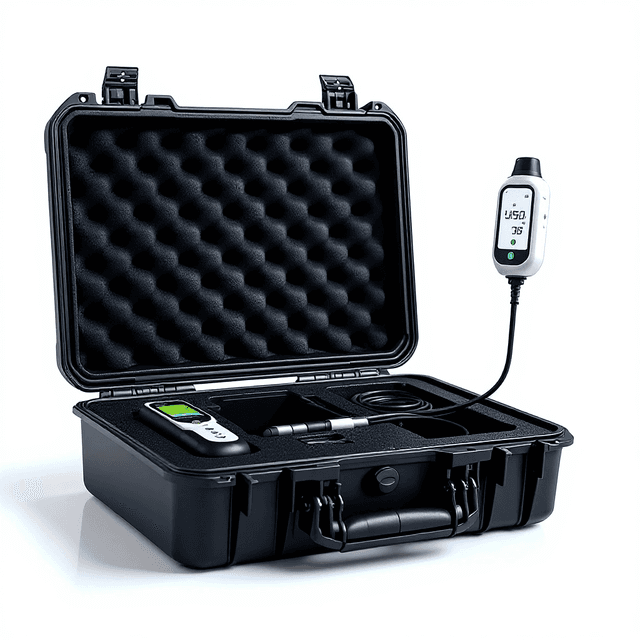
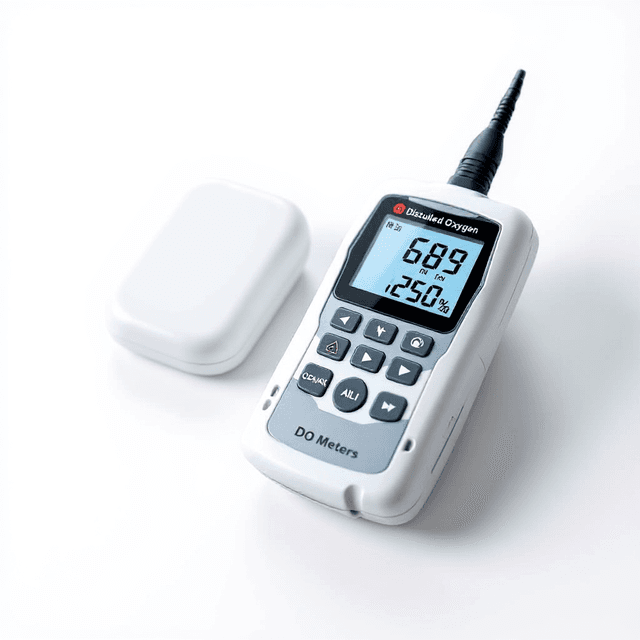
The Portable Water Quality Dissolved Oxygen Meter (Model LH-D702) employs fluorescence quenching technology for precise dissolved oxygen measurement across environmental, biochemical, food processing, and water treatment applications. This hand-held optical analyzer utilizes a fluorescent sensor that responds to oxygen concentration through dynamic quenching of luminescence, providing accurate measurements without consuming oxygen from the sample.
The instrument features a 3.3-inch monochrome LCD display and operates across a measurement range of 0-20 mg/L dissolved oxygen with simultaneous temperature and saturation percentage monitoring. Built to IP67 waterproof specifications, the meter supports field measurements in challenging environments with GPS and WiFi connectivity options for data management and location tracking.
How It Works
The LH-D702 operates on the principle of fluorescence quenching, where dissolved oxygen molecules interact with a fluorescent indicator compound to reduce fluorescence intensity and shorten fluorescence lifetime. The sensor contains a ruthenium-based luminophore immobilized in a gas-permeable membrane that selectively allows oxygen penetration while excluding interfering substances.
When blue-green LED excitation light illuminates the sensing element, the luminophore emits characteristic fluorescence. The presence of dissolved oxygen quenches this fluorescence according to the Stern-Volmer equation, creating a measurable relationship between oxygen concentration and fluorescence characteristics. The instrument measures phase shift between excitation and emission signals, providing temperature-compensated dissolved oxygen readings that are independent of fluorescence intensity variations.
Simultaneous temperature measurement enables automatic compensation for temperature-dependent oxygen solubility, while barometric pressure correction accounts for altitude effects on oxygen saturation calculations. The optical measurement principle eliminates oxygen consumption during measurement, enabling continuous monitoring without sample depletion.
Features & Benefits
Model
- LH-D702
Data storage
- Support
Language
- Chinese/English
Air pressure measurement
- 50~115kPa
Waterproof
- IP67
Optional function
- GPS/Wifi
Relative humidity
- 10-85%RH(no condensation)
Working temperature
- -10~60â
Transportation and storage conditions
- Temperature:-15~65âï¼Relative humidity:5-85%RH(no condensation)
Measurement principle
- Fluorescence
Measuring range
- Dissolved Oxygen:0-20mg/L;Saturation:0-200%;Temperature:0-50â
Calibration
- One or two point calibration
Automation Level
- manual
Brand
- ConductScience
Display Type
- 3.3 inch monochrome LCD screen
Dimensions
- 200*101*36mm
Weight
- 420g
Power/Voltage
- 4*AA batteries
Research Domain
- Analytical Chemistry
- Environmental Monitoring
- Food Science
- Industrial Hygiene
- Microbiology
- Pharmaceutical QC
Shipping weight
- 0.33 lb
Shipping box
- L: 7.87 cm
- W: 3.98 cm
- H: 1.42 cm
| Feature | This Product | Typical Alternative | Advantage |
|---|---|---|---|
| Measurement Principle | Fluorescence quenching with optical sensor | Entry-level models often use polarographic electrodes | Eliminates oxygen consumption during measurement, enabling continuous monitoring without sample depletion. |
| Measurement Range | 0-20 mg/L dissolved oxygen, 0-200% saturation | Basic meters typically offer 0-15 mg/L range | Extended range accommodates supersaturated conditions encountered in industrial processes and algae blooms. |
| Display Interface | 3.3-inch monochrome LCD with dual language support | Smaller displays with limited readability | Large display ensures clear data visualization in field conditions with multilingual interface for international use. |
| Environmental Protection | IP67 waterproof rating | Lower IP ratings or splash-resistant designs | Full immersion capability enables direct in-water measurements without protective housings. |
| Connectivity Options | Optional GPS/WiFi modules with data storage | Limited or no wireless connectivity | Enables location-tagged measurements and wireless data transfer for field survey applications. |
| Calibration Flexibility | One or two-point calibration options | Single-point calibration only | Two-point calibration maximizes accuracy across the full measurement range for demanding applications. |
The LH-D702 combines fluorescence-based optical measurement with comprehensive data management features and rugged field-ready construction. The extended measurement range and optional connectivity modules position it for both routine monitoring and advanced survey applications.
Practical Tips
Perform calibration at temperatures similar to your measurement conditions, as temperature affects both sensor response and oxygen solubility.
Why: Temperature-matched calibration minimizes compensation errors and improves measurement accuracy.
Use two-point calibration when measuring samples with very low (< 2 mg/L) or very high (> 15 mg/L) dissolved oxygen concentrations.
Why: Two-point calibration provides better accuracy at the extremes of the measurement range where linearity deviations are most significant.
Clean the sensor probe with deionized water after each use and store in a protective cap to prevent contamination.
Why: Regular cleaning prevents fouling buildup that can affect fluorescence signal intensity and measurement accuracy.
Verify calibration stability monthly by testing in air-saturated water of known temperature and comparing to theoretical saturation values.
Why: Regular verification detects sensor drift and determines when recalibration is needed for consistent accuracy.
Allow 2-3 minutes for sensor equilibration when moving between samples of significantly different temperatures or oxygen concentrations.
Why: Adequate equilibration time ensures the fluorescent sensor reaches steady-state response for accurate readings.
Record barometric pressure and sample temperature alongside dissolved oxygen measurements for complete documentation.
Why: These parameters are essential for converting between concentration and saturation units and for data validation.
If readings appear unstable, check for air bubbles on the sensor surface or insufficient sample depth for proper immersion.
Why: Air bubbles and inadequate immersion create measurement artifacts that affect fluorescence signal quality.
Cross-validate measurements periodically using Winkler titration or other reference methods, especially for critical applications.
Why: Independent verification confirms sensor accuracy and identifies potential drift or interference issues.
Setup Guide
What’s in the Box
- LH-D702 dissolved oxygen meter with fluorescence sensor
- Calibration solution kit (air-saturated water reference)
- 4×AA battery pack
- Protective carrying case
- USB data cable (typical)
- User manual with calibration procedures
- Sensor maintenance kit with cleaning materials (typical)
Warranty
ConductScience provides a standard one-year manufacturer warranty covering defects in materials and workmanship, with technical support for calibration procedures and measurement optimization.
Compliance
References
Background reading relevant to this product:
What is the typical response time for dissolved oxygen measurements using fluorescence quenching?
Fluorescence-based dissolved oxygen sensors typically achieve 90% response in 30-60 seconds, depending on sample temperature and flow conditions. The optical measurement principle provides faster equilibration compared to electrochemical sensors, as no membrane diffusion limitations exist and oxygen is not consumed during measurement.
How does temperature affect dissolved oxygen measurements and calibration?
Dissolved oxygen solubility decreases with increasing temperature following Henry's Law. The instrument provides automatic temperature compensation using the built-in temperature sensor (0-50°C range) to correct readings for temperature-dependent solubility changes. Calibration should be performed at temperatures similar to measurement conditions for optimal accuracy.
What maintenance procedures are required for the fluorescence sensor?
The sensor requires periodic cleaning with deionized water to remove fouling deposits and verification of calibration stability. Unlike electrochemical sensors, no electrolyte replacement or membrane changes are needed. The fluorescent indicator has a typical lifespan of 2-3 years under normal use conditions before requiring replacement.
Can the meter measure dissolved oxygen in colored or turbid samples?
Fluorescence-based measurements are less susceptible to optical interference compared to colorimetric methods. However, extremely high turbidity or strong color absorption in the blue-green excitation range may affect accuracy. Sample filtration or dilution may be necessary for heavily contaminated samples.
How does barometric pressure affect dissolved oxygen saturation calculations?
Oxygen saturation percentage depends on barometric pressure, as lower atmospheric pressure reduces maximum oxygen solubility. The instrument measures ambient pressure (50-115 kPa range) and automatically corrects saturation calculations for altitude effects, ensuring accurate saturation readings at various elevations.
What calibration standards are recommended for two-point calibration?
Two-point calibration typically uses zero-oxygen solution (prepared with sodium sulfite and cobalt catalyst) for the low point and air-saturated water at known temperature for the high point. This approach maximizes accuracy across the full measurement range, particularly important for samples with very low or very high oxygen concentrations.
How does this fluorescence method compare to polarographic electrodes?
Fluorescence sensors offer several advantages: no oxygen consumption during measurement, faster response time, reduced drift, and elimination of stirring requirements. However, polarographic electrodes may provide slightly better precision at very low oxygen concentrations below 1 mg/L, while fluorescence sensors excel in stability and ease of use.
What data output formats are supported for integration with laboratory information systems?
The instrument supports data storage with optional USB connectivity for data transfer. GPS/WiFi optional modules enable wireless data transmission and location tagging. Consult product datasheet for specific file formats and communication protocols supported.
Have a question about this product?
Have a question? Just ask.
Send it over and we'll email you a personalized answer — no call, no scheduling.
Prefer to talk it through?
Accessories
Enhance your setup with compatible accessories
Frequently Bought Together