Separatory Funnel Shaker
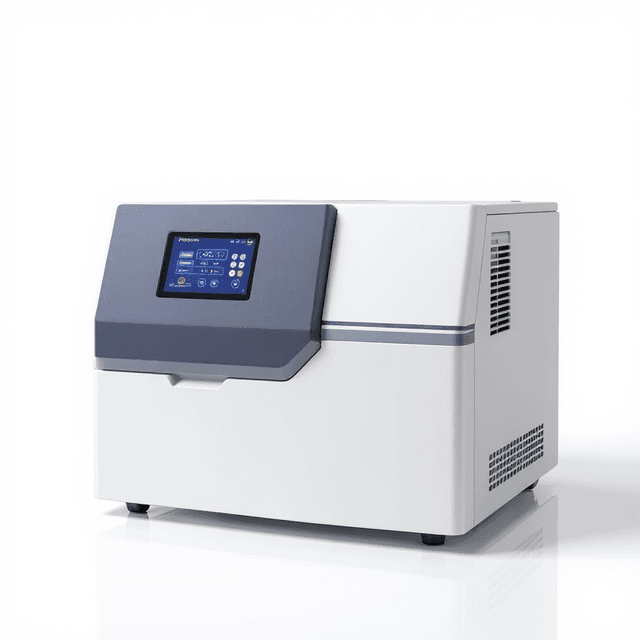
Automated vertical shaker for liquid-liquid extractions, accommodating 6 separatory funnels with adjustable tilt angles and variable speed control from 100-300 rpm.

Louise Corscadden, PhD
Director of Science · ConductScience
Ask Louise about Separatory Funnel Shaker fit, setup, configuration, or quote prep.
Already working with us? Sign in to connect this with My Scientist.
Key Specifications
Full details →- Model fit
- Configured during quote
- SKU family
- BIO-0969
- Shipping box
- 108.0 x 81.0 x 71.0 cm
- Ordering
- Online checkout and quote request available
- Category
- Benchtop Instruments
- Build notes
- Confirm accessories, station layout, and support needs before purchase
The Separatory Funnel Shaker provides automated vertical shaking for liquid-liquid extraction processes in analytical and preparative chemistry. This benchtop instrument accommodates 6 separatory funnels simultaneously, with adjustable tilt angles from 0-20° and shaking frequencies from 100-300 times per minute. The unit supports vessels ranging from 50ml to 2000ml separatory funnels, along with conical flasks and measuring cylinders.
The instrument features infinitely variable speed control and multiple operation modes including continuous, interval, and curve operations with programmable timing up to 15 minutes. With rated bilateral symmetry load capacity of 11kg and extraction efficiency of 95-110%, this shaker streamlines sample preparation workflows requiring consistent, reproducible mixing conditions for phase separation and extraction procedures.
How It Works
The separatory funnel shaker operates on the principle of controlled mechanical agitation to enhance mass transfer between immiscible liquid phases. The vertical shaking motion with adjustable tilt angle (0-20°) creates optimal mixing conditions while maintaining the funnel orientation necessary for effective phase separation. The adjustable amplitude (≤40mm) and frequency (100-300 times/min) allow optimization of extraction conditions for different solvent systems and analytes.
The shaking motion increases the interfacial contact area between phases, accelerating the partitioning of target compounds according to their distribution coefficients. The programmable operation modes enable consistent extraction protocols, while the bilateral symmetry design ensures uniform mixing across all six positions. After shaking, the funnels remain in position for phase settling and separation, allowing direct collection of the desired phase without additional handling.
Features & Benefits
Shipping weight
- 120.0 lb
Shipping box
- L: 108.0 cm
- W: 81.0 cm
- H: 71.0 cm
| Feature | This Product | Typical Alternative | Advantage |
|---|---|---|---|
| Sample Capacity | 6 positions simultaneously | Entry-level models often offer 2-4 positions | Higher throughput reduces batch processing time and improves workflow efficiency in busy laboratories. |
| Tilt Angle Adjustment | 0-20° adjustable tilt | Fixed angle designs are common | Optimizes mixing geometry for different vessel types and extraction systems without compromising phase separation. |
| Operation Modes | Continuous, interval, and curve operations | Basic models typically offer only continuous operation | Enables customized extraction profiles for method development and specialized analytical procedures. |
| Load Capacity | 11kg bilateral symmetry | Lower capacity units limit vessel size options | Accommodates large separatory funnels up to 2000ml for preparative-scale extractions and sample concentration work. |
| Speed Control | 100-300 rpm infinitely variable | Fixed or stepped speed settings are typical | Precise parameter optimization for sensitive extractions and method validation requirements. |
| Timer Function | 15-minute programmable countdown | Varies by model | Automated timing ensures reproducible extraction durations and prevents operator-dependent variations. |
This shaker provides comprehensive automation for liquid-liquid extraction workflows with its 6-position capacity, variable parameter control, and multiple operation modes. The adjustable tilt angle and high load capacity accommodate diverse vessel types from analytical to preparative scales.
Practical Tips
Balance loads across all six positions even when processing fewer samples to minimize vibration and ensure smooth operation.
Why: Unbalanced loading can cause excessive vibration and reduce extraction efficiency.
Verify shaking frequency quarterly using a digital tachometer or stroboscope, especially for method validation work.
Why: Speed accuracy is critical for reproducible extraction efficiency and regulatory compliance.
Clean clamps and contact surfaces after each use with appropriate solvents to prevent sample cross-contamination.
Why: Residual solvents can interfere with subsequent extractions and compromise analytical results.
Ensure adequate ventilation and use appropriate PPE when working with volatile organic solvents during extraction procedures.
Why: Solvent vapors pose health risks and require proper containment and protective measures.
If extraction efficiency decreases, check clamp tightness and verify vessel positioning for proper phase contact during mixing.
Why: Loose vessels or poor positioning reduces mixing effectiveness and extraction recovery.
Document all shaking parameters (speed, angle, time) in analytical protocols to ensure method reproducibility.
Why: Parameter variations significantly affect extraction efficiency and analytical precision.
Allow adequate settling time after shaking before phase separation to ensure clean interfaces and accurate volume measurements.
Why: Insufficient settling time leads to emulsions and compromised phase separation quality.
Setup Guide
What’s in the Box
- Separatory funnel shaker main unit
- 6 adjustable vessel clamps
- Power cord and external transformer (if 110V model)
- User manual and operating instructions
- Calibration certificate (typical)
- Basic tool kit for assembly (typical)
Warranty
ConductScience provides a standard one-year manufacturer warranty covering parts and labor, with technical support for setup, operation, and troubleshooting assistance.
Compliance
References
Background reading relevant to this product:
What vessel types and sizes are compatible with this shaker?
The unit accommodates 50ml to 2000ml separatory funnels, 100ml and 250ml conical flasks, and 100ml measuring cylinders with stoppers. The 6-position clamp system is adjustable to secure different vessel geometries while maintaining proper balance.
How do I optimize shaking parameters for different extraction systems?
Start with moderate settings (200 rpm, 10° tilt) and adjust based on phase separation behavior. Aqueous-organic systems typically require 150-250 rpm, while more viscous systems may need higher frequencies. Monitor extraction efficiency and adjust amplitude and angle accordingly.
What maintenance is required for consistent performance?
Regular cleaning of clamps and contact surfaces, periodic verification of speed calibration, and inspection of moving parts for wear. Lubricate pivot points as specified in the manual and check balance loading before each use.
Can the unit handle different extraction protocols simultaneously?
No, all six positions operate with the same parameters (speed, angle, timing). For different protocols, process samples in separate batches with appropriate parameter adjustments between runs.
How accurate is the extraction efficiency specification?
The 95-110% efficiency range represents typical recovery under standard conditions. Actual efficiency depends on analyte properties, solvent system, and extraction parameters. Validate efficiency with your specific methods using appropriate standards.
What safety considerations apply during operation?
Ensure proper ventilation for solvent vapors, use appropriate personal protective equipment, and verify vessel security before starting. The unit should be placed away from ignition sources when using flammable solvents.
Is the timing function accurate for method validation work?
The countdown timer provides timing control up to 15 minutes suitable for routine extractions. For critical timing applications requiring higher precision, use external timing devices and validate timer accuracy against certified standards.
Have a question about this product?
Have a question? Just ask.
Send it over and we'll email you a personalized answer — no call, no scheduling.
Prefer to talk it through?