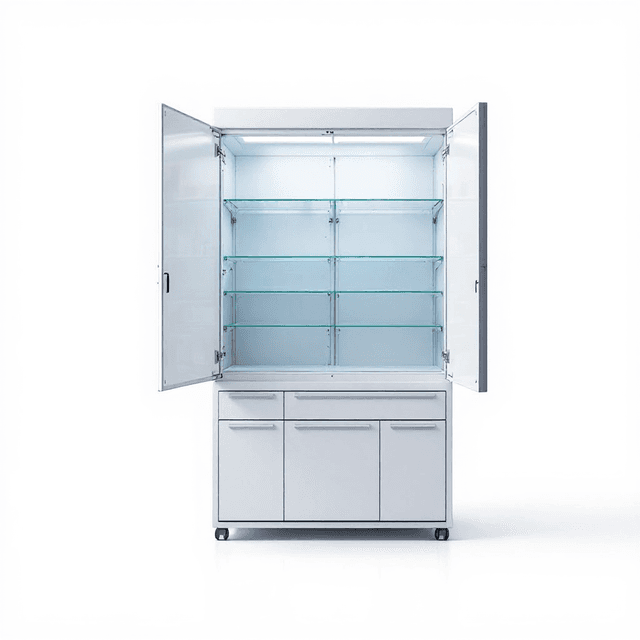
Stainless Steel Locker
Stainless steel laboratory locker providing secure, corrosion-resistant storage for research equipment and supplies with easy decontamination capabilities.

Louise Corscadden, PhD
Director of Science · ConductScience
Ask Louise about Stainless Steel Locker fit, setup, configuration, or quote prep.
Already working with us? Sign in to connect this with My Scientist.
Key Specifications
Full details →- Model fit
- Configured during quote
- SKU family
- BIO-0759
- Shipping box
- 42.0 x 43.6 x 38.0 cm
- Ordering
- Online checkout and quote request available
- Category
- Storage & Furniture
- Build notes
- Confirm accessories, station layout, and support needs before purchase
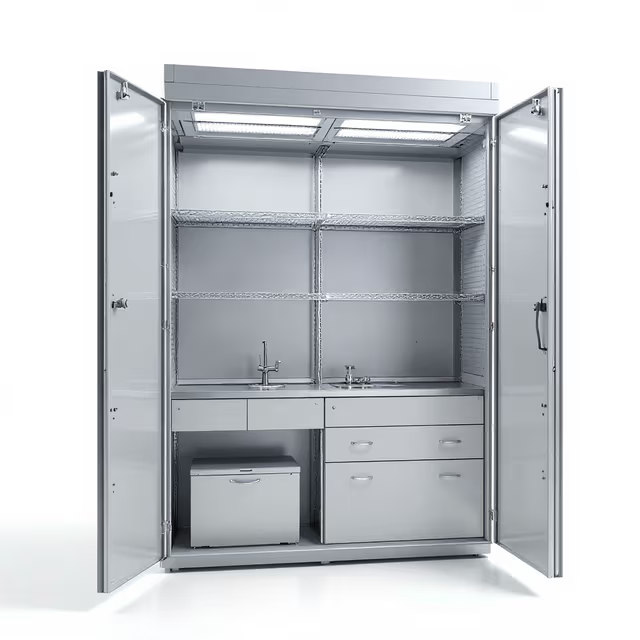
The ConductScience Stainless Steel Locker provides secure, durable storage for laboratory equipment, samples, and supplies in research environments. Constructed from stainless steel, this storage solution offers corrosion resistance and easy decontamination protocols essential for maintaining laboratory hygiene standards. The locker design accommodates various storage requirements while providing controlled access to sensitive materials and equipment.
This storage system serves research facilities requiring organized, secure storage of laboratory supplies, personal protective equipment, and sensitive materials. The stainless steel construction supports routine cleaning and sterilization procedures commonly implemented in controlled laboratory environments.
How It Works
The stainless steel locker functions as a secure storage compartment utilizing mechanical locking mechanisms to control access to stored materials. The stainless steel construction provides a non-porous surface that resists corrosion from laboratory chemicals and cleaning agents commonly used in research environments.
The locker design incorporates ventilation considerations and internal organization features to accommodate various laboratory storage requirements. The material properties of stainless steel allow for effective cleaning and decontamination using standard laboratory disinfection protocols without compromising structural integrity.
Features & Benefits
Brand
- ConductScience
Research Domain
- Analytical Chemistry
- Cell Biology
- Clinical Diagnostics
- Environmental Monitoring
- Microbiology
- Pharmaceutical QC
Shipping weight
- 29.98 lb
Shipping box
- L: 42.0 cm
- W: 43.6 cm
- H: 38.0 cm
| Feature | This Product | Typical Alternative | Advantage |
|---|---|---|---|
| Construction Material | Stainless steel construction | Painted steel or polymer materials in entry-level models | Provides superior chemical resistance and decontamination compatibility for laboratory environments. |
| Surface Properties | Non-porous stainless steel surfaces | Porous or coated surfaces in standard storage units | Enables effective cleaning and sterilization protocols required in research facilities. |
| Corrosion Resistance | Stainless steel corrosion resistance | Variable corrosion resistance depending on coating quality | Maintains structural integrity and appearance under laboratory cleaning regimens. |
| Security Features | Integrated locking mechanism | Basic locks or no security features in general storage | Provides controlled access essential for managing sensitive laboratory materials and equipment. |
This stainless steel locker offers laboratory-specific construction and surface properties optimized for research environments requiring chemical resistance and decontamination capabilities. The design addresses security and organization needs common in controlled laboratory settings.
Practical Tips
Clean surfaces regularly with laboratory-approved disinfectants using non-abrasive cleaning cloths to maintain surface integrity.
Why: Regular cleaning prevents contamination buildup and maintains the non-porous surface properties.
Implement inventory tracking system for stored materials to maintain laboratory organization and material accountability.
Why: Systematic inventory management supports research reproducibility and regulatory compliance requirements.
Ensure proper ventilation around the locker when storing materials that may emit vapors or require air circulation.
Why: Adequate ventilation prevents accumulation of potentially hazardous vapors in enclosed storage spaces.
Group stored materials by compatibility and usage frequency to optimize laboratory workflow efficiency.
Why: Organized storage reduces retrieval time and minimizes risk of incompatible material interactions.
Inspect locking mechanism periodically and lubricate if specified in manufacturer guidelines to ensure reliable operation.
Why: Regular maintenance prevents lock failures that could compromise material security or accessibility.
Address any door alignment issues promptly to maintain proper seal and security function.
Why: Proper door alignment ensures effective closure and maintains the integrity of the storage environment.
Setup Guide
What’s in the Box
- Stainless steel locker unit (typical)
- Locking mechanism with keys (typical)
- Installation hardware (typical)
- Assembly instructions (typical)
Warranty
ConductScience provides standard manufacturer warranty coverage for laboratory storage equipment with technical support for installation and operational guidance.
Compliance
What cleaning agents are compatible with the stainless steel construction?
Standard laboratory disinfectants and cleaning agents are typically compatible with stainless steel surfaces. Consult product documentation for specific chemical compatibility information.
Can the locker be used in temperature-controlled environments?
Stainless steel construction generally supports use in controlled temperature environments. Verify specific temperature range compatibility through product specifications.
What security level does the locking mechanism provide?
The locking mechanism provides basic security for laboratory storage applications. Consult product specifications for specific security features and key management options.
Is the locker suitable for storing volatile chemicals?
Storage of volatile chemicals requires proper ventilation and containment considerations. Verify ventilation specifications and chemical storage guidelines for your specific applications.
What internal organization options are available?
Internal shelving and organization features may be available. Consult product specifications for available accessories and configuration options.
How is the locker secured during installation?
Installation typically involves wall or floor mounting hardware. Review installation instructions for specific mounting requirements and stability considerations.
Have a question about this product?
Have a question? Just ask.
Send it over and we'll email you a personalized answer — no call, no scheduling.
Prefer to talk it through?