The Colosseum Maze
A mouse-first spatial learning and memory maze that uses the natural drive to seek elevated shelter — no water, food deprivation, or aversive stimuli.
Developed and validated by the Murphy Lab, University of Michigan.

Louise Corscadden, PhD
Director of Science · ConductScience
Ask Louise about The Colosseum Maze fit, setup, configuration, or quote prep.
Already working with us? Sign in to connect this with My Scientist.
Key Specifications
Full details →- Model fit
- Configured during quote
- SKU family
- CS-COLOSSEUM-01
- Sizing
- Model-specific dimensions confirmed from the selected configuration
- Ordering
- Online checkout and quote request available
- Category
- Behavioral Mazes
- Build notes
- Confirm accessories, station layout, and support needs before purchase
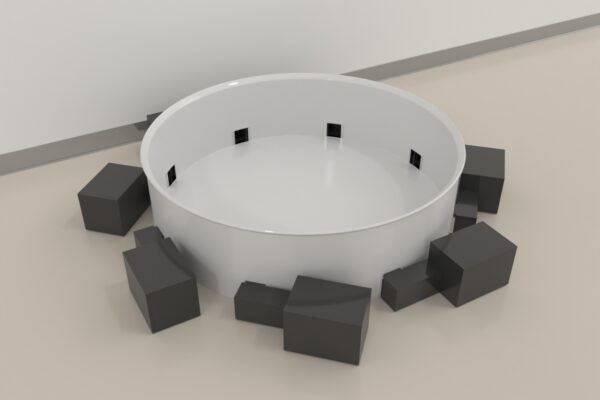
The Colosseum Maze is a mouse-first apparatus for assessing spatial learning and memory. It leverages the instinctive tendency of mice to seek elevated shelter, so investigators can measure spatial cognition without water, bright light, loud noise, or food deprivation.
Most established spatial assays were originally developed for rats, whose natural behaviors — such as swimming in the Morris Water Maze — are not ethologically relevant to mice. The Colosseum Maze closes that gap: a mouse on an open, elevated circular platform is motivated to locate and enter a sheltered escape box, a goal-directed task that draws on its innate drive for cover rather than on externally applied stressors.
Developed and validated by the Murphy Lab at the University of Michigan, and manufactured and commercialized worldwide by ConductScience under our Technology Transfer program.
How It Works
The arena is a 48-inch circular platform ringed by eight equally spaced exits, each leading to a removable black escape box with a corridor. Difficulty advances through a structured progression — from a single open door, to six doors, to all eight — so animals can be trained and tested across graded levels of spatial demand. Interchangeable door sets (0.75, 1.0, and 1.12 inch openings) tune task difficulty further.
Across training, mice learn the location of the escape box using distal room cues. A 90-degree arena rotation test confirms allocentric, room-cue-based navigation rather than reliance on local features.
Features & Benefits
- Stress-minimized. No water, bright light, loud noise, or food deprivation, which reduces stress-related confounds.
- Ethologically valid for mice. Built around the natural drive to seek elevated shelter.
- Graded difficulty. 1-, 6-, and 8-door progression plus interchangeable door openings.
- Validated and sensitive. Detects spatial-memory deficits in the 5xFAD model while baseline motor function and anxiety remain normal.
- Flexible configuration. Available in white, blue, grey, or black.
| Arena diameter | 48 in |
|---|---|
| Wall height | 12 in |
| Exits | 8, each 3 in long × 3 in wide |
| Escape boxes | 8 black boxes with corridor, 8 in × 6 in × 8 in (L × W × H) |
| Interchangeable door openings | 0.75, 1.0, and 1.12 in diameters (semicircular) |
| Available colors | White, blue, grey, or black |
| Species | Mouse (Mus musculus) |
| Training progression | 1-door → 6-door → 8-door |
Behavioral parameters measured: latency to escape, distance travelled, velocity, time and distance in the center, and time and distance in thigmotaxis (wall-hugging).
- Spatial learning and reference memory in mice
- Allocentric versus egocentric navigation (distal-cue testing via arena rotation)
- Cognitive phenotyping of transgenic and disease-model mice, including the 5xFAD model
- Aging and neurodegeneration research
- Pharmacological and intervention studies on spatial cognition
Validated strains: C57BL/6NTac; C57BL/6NTac × C3H sighted F1 hybrid; 129SvEv; and the 5xFAD model (Jax MMRRC #034848-JAX), in both male and female mice.
Setup Guide
Place the maze in a room with stable, high-contrast distal cues. Train mice using the 1-door configuration first, then 6-door, then the full 8-door arena. Capture trials with an overhead camera and tracking software (for example, ConductVision) to record latency to escape, distance travelled, velocity, time and distance in the center, and time and distance in thigmotaxis.
What’s in the Box
- Colosseum Maze arena (48 in diameter, 12 in walls)
- Eight escape boxes with corridors
- Interchangeable door sets (0.75, 1.0, and 1.12 in semicircular openings)
References
Apparatus developed and validated by the Murphy Lab, University of Michigan. A validation summary describing performance across wildtype strains and the 5xFAD model is available on request.
Does the Colosseum Maze require water or food deprivation? No. It relies on the mouse's innate drive to seek elevated shelter, so no aversive stimuli or deprivation are needed.
How is it different from the Barnes Maze? Both use escape motivation, but the Colosseum Maze presents an elevated arena with enclosed escape boxes and a graded 1-, 6-, and 8-door training progression designed around mouse behavior.
Which species is it for? Mice. Validation was performed across multiple strains and the 5xFAD disease model in male and female animals.
Have a question about this product?
Have a question? Just ask.
Send it over and we'll email you a personalized answer — no call, no scheduling.
Prefer to talk it through?
Creator Insights
About the Creator
Geoffrey G. Murphy is a professor at the University of Michigan, appointed in the Department of Molecular and Integrative Physiology and the Michigan Neuroscience Institute. His laboratory studies how voltage-gated L-type calcium channels (CaV1.2 and CaV1.3) shape neuronal physiology and hippocampus-dependent spatial learning and memory, including work showing that CaV1.2 is required for remote spatial memory and that elevated CaV1.3 recapitulates features of age-related cognitive decline. Recognizing that most established rodent spatial assays were designed for rats and depend on aversive conditions that are not naturalistic for mice, the Murphy Lab developed the Colosseum Maze to exploit a mouse’s instinctive drive to seek elevated shelter. The apparatus was validated across multiple mouse strains and in the 5xFAD model, where it detected allocentric spatial memory guided by distal room cues.
To view Geoffrey G. Murphy’s publications, visit PubMed.
Are you Geoffrey G. Murphy? to review your photo and bio, and find out how to submit Creator Insights.
ConductScience celebrates method creators: researchers who, through rigorous and often ingenious experiments, develop the tools that reveal how the brain and body work. These are real scientific discoveries that become everyday instruments for the labs that follow.
Foundational papers
- White, J. A., McKinney, B. C., John, M. C., Powers, P. A., Kamp, T. J., & Murphy, G. G. (2008). Conditional forebrain deletion of the L-type calcium channel CaV1.2 disrupts remote spatial memories in mice. Learning & Memory, 15(1), 1–5. doi:10.1101/lm.773208
- Temme, S. J., Bell, R. Z., Fisher, G. L., & Murphy, G. G. (2016). Deletion of the mouse homolog of CACNA1C disrupts discrete forms of hippocampal-dependent memory and neurogenesis within the dentate gyrus. eNeuro, 3(6), ENEURO.0118-16.2016. doi:10.1523/ENEURO.0118-16.2016
- Moore, S. J., Cazares, V. A., Temme, S. J., & Murphy, G. G. (2023). Age-related deficits in neuronal physiology and cognitive function are recapitulated in young mice overexpressing the L-type calcium channel, CaV1.3. Aging Cell, 22(3), e13781. doi:10.1111/acel.13781