Primary Assay — Honeybee
Aggression / Defensive Behavior
Apis mellifera
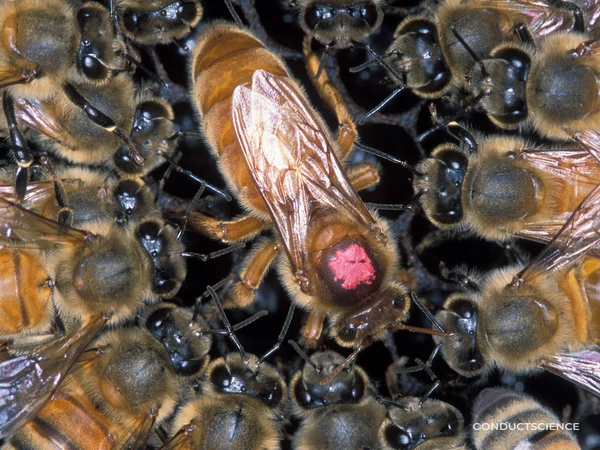
Quantification of colony defense behavior including stinging latency, pursuit distance, and alarm pheromone escalation. Key endpoint for assessing Africanized bee genetics and environmental stressors.

Quantitative Output
Measured Parameters
Every parameter is automatically tracked frame-by-frame in the ConductVision pipeline for Apis mellifera.
| Parameter | Unit | Description |
|---|---|---|
| Stinging latency | s | Time to sting intruder |
| Pursuit distance | m | Chase range |
| Alarm pheromone release | threshold | Escalation trigger |
References
Citations for Aggression / Defensive Behavior
- Nouvian M, et al. (2016). The defensive response of the honeybee Apis mellifera. J Exp Biol, 219(22), 3505-3517. PMID: 27852760
Compatible Equipment
Hardware for Honeybee Research
PER Conditioning Harness
Proboscis extension reflex assays
Hive Observation Camera
In-hive waggle dance recording
RFID Tracking System
Individual bee flight monitoring
Sucrose Stimulus Delivery
Gustatory response scoring
Video Arena
Defensive behavior testing
Related Assays
Other Honeybee Primary Assays
03
Proboscis Extension Reflex (PER) Conditioning
Apis mellifera
The gold-standard invertebrate associative learning paradigm. Bees learn to extend their proboscis to a conditioned odor…
03
Waggle Dance Quantification
Apis mellifera
Automated analysis of the honeybee waggle dance — nature's only known symbolic communication system. Dance parameters en…
03
Foraging / Flight Tracking
Apis mellifera
GPS and radar-based tracking of individual bee foraging flights. Reveals navigation strategies, path efficiency, and spa…
Run Aggression / Defensive Behavior on ConductVision
Our team will configure the protocol, camera rig, and analysis pipeline for your honeybee facility.