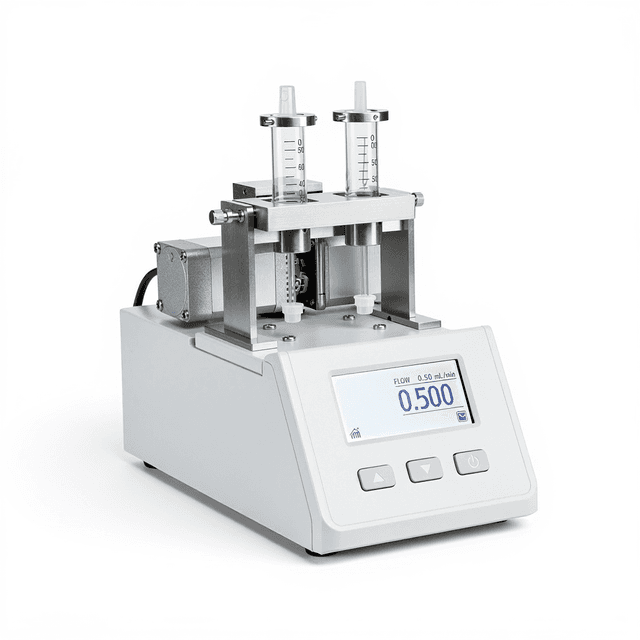
4-Channel Microfluidic Syringe Pump System
4-channel syringe pump system with 0.078 μm resolution and 0.5% accuracy for precise microfluidic fluid delivery from 10 μL to 30 mL syringes.
| Number of Channels | 4 |
| Syringe Range | 10 uL - 30 mL |
| Stroke | 130 mm |
| Speed Range | 4.68 um/min - 133 mm/min |
| Thrust | 35 kgf |
| Connectivity | USB, RS485 |

The 4-Channel Microfluidic Syringe Pump System provides precise fluid delivery for microfluidic applications requiring simultaneous control of multiple fluid streams. This system accommodates syringes ranging from 10 μL to 30 mL capacity with submicron positioning resolution (0.078 μm) and maintains flow rate accuracy within 0.5%. The 130 mm stroke length enables extended operation duration while the 35 kgf thrust force handles high-viscosity fluids and back-pressure conditions.
The system features independent channel control through a 5-inch LCD touchscreen interface, with programmable flow rates spanning from 4.68 μm/min to 133 mm/min. USB and RS485 connectivity enable integration with laboratory automation systems and external control software. The compact benchtop design (300 × 250 × 165 mm) facilitates installation in space-constrained laboratory environments while providing the precision required for quantitative microfluidic experiments.
How It Works
The system operates through precision stepper motor-driven linear actuators that advance syringe plungers at controlled rates. Each channel contains an independent drive mechanism with 0.078 μm positioning resolution, achieved through high-resolution motor encoders and precision lead screw assemblies. The 35 kgf thrust force capability enables operation with viscous fluids and against significant back-pressure from microfluidic channel networks.
Flow rate control is achieved by varying the linear velocity of the syringe plunger based on the selected syringe diameter and target volumetric flow rate. The system calculates the required plunger displacement rate using the syringe cross-sectional area, maintaining flow accuracy within 0.5% through closed-loop position feedback. The 130 mm stroke length accommodates standard laboratory syringes while providing extended operation duration before refilling.
The touchscreen interface provides real-time monitoring of flow parameters, accumulated volumes, and system status for each channel. USB and RS485 communication protocols enable remote control and data logging, supporting integration with laboratory information management systems and automated experimental protocols.
Features & Benefits
Number of Channels
- 4
Syringe Range
- 10 uL - 30 mL
Stroke
- 130 mm
Speed Range
- 4.68 um/min - 133 mm/min
Thrust
- 35 kgf
Connectivity
- USB, RS485
Automation Level
- semi-automated
Brand
- ConductScience
Accuracy
- 0.078 um
Display Type
- 5-inch LCD touchscreen
Research Domain
- Analytical Chemistry
- Cell Biology
- Environmental Monitoring
- Materials Science
- Microbiology
- Pharmaceutical QC
Weight
- 4.5 kg
Dimensions
- L: 300.0 mm
- W: 250.0 mm
- H: 165.0 mm
Comparison Guide
| Feature | This Product | Typical Alternative | Advantage |
|---|---|---|---|
| Number of Channels | 4 independent channels | Entry-level models typically offer 1-2 channels | Enables complex multi-component experiments and gradient generation protocols requiring simultaneous fluid delivery |
| Positioning Resolution | 0.078 μm resolution | Standard systems often provide micron-level resolution | Submicron precision enables ultra-low flow rate applications and precise concentration control in sensitive assays |
| Syringe Compatibility Range | 10 μL to 30 mL capacity | Many systems have narrower syringe size ranges | Single instrument accommodates both nanoliter precision work and milliliter-scale applications without equipment changes |
| Flow Accuracy | ≤0.5% accuracy | Basic models may offer 1-2% accuracy | Higher precision supports quantitative studies requiring reproducible concentration gradients and dosing protocols |
| User Interface | 5-inch LCD touchscreen | Simple LED displays or basic LCD screens | Intuitive operation with real-time parameter monitoring reduces setup time and training requirements |
| Thrust Force | 35 kgf per channel | Lower-cost systems often provide reduced thrust | Handles high-viscosity fluids and significant back-pressure from narrow microfluidic channels without flow interruption |
This system provides multi-channel precision with submicron positioning resolution and wide syringe compatibility range. The combination of high thrust force capability and touchscreen interface addresses both technical performance and operational convenience requirements in microfluidic applications.
Practical Tips
Perform gravimetric calibration with deionized water at room temperature using an analytical balance with 0.1 mg resolution.
Why: Temperature and fluid properties affect volumetric accuracy, making standardized calibration conditions essential for reproducible results.
Flush all fluid pathways with appropriate solvents between experiments and store syringes empty to prevent crystallization and contamination.
Why: Residual fluids can form deposits that affect flow accuracy and create cross-contamination in subsequent experiments.
Pre-wet all tubing and connections with working fluid before beginning timed experiments to eliminate priming volume errors.
Why: Initial fluid absorption by tubing materials can introduce systematic errors in delivered volumes during critical experimental phases.
Use glass syringes for organic solvents and plastic syringes for aqueous solutions to prevent chemical compatibility issues.
Why: Syringe material selection affects both measurement accuracy and long-term system reliability when handling diverse fluid types.
If flow irregularities occur, check for air bubbles in the syringe barrel and verify proper plunger engagement with the drive mechanism.
Why: Air compressibility and mechanical coupling issues are the most common causes of flow rate deviations in syringe pump systems.
Log ambient temperature and humidity during experiments as these parameters can affect fluid properties and evaporation rates.
Why: Environmental conditions influence fluid viscosity and evaporation, which impact actual delivered volumes in microfluidic applications.
Install appropriate containment for hazardous fluids and ensure proper ventilation when handling volatile organic solvents.
Why: Microfluidic systems often use concentrated reagents and organic solvents that require appropriate safety measures to protect laboratory personnel.
Setup Guide
What’s in the Box
- 4-Channel syringe pump main unit
- Power adapter and cord
- USB communication cable (typical)
- RS485 communication cable (typical)
- Syringe mounting hardware (typical)
- User manual and software documentation
- Calibration certificate (typical)
Warranty
ConductScience provides a one-year manufacturer warranty covering defects in materials and workmanship, with technical support available for installation, calibration, and troubleshooting assistance.
Compliance
References
Background reading relevant to this product:
What is the minimum achievable flow rate with a 10 μL syringe?
With a 10 μL syringe, the minimum flow rate depends on the syringe diameter and the system's minimum plunger speed of 4.68 μm/min. Consult the product datasheet for syringe-specific flow rate calculations.
Can the system handle back-pressure from narrow microfluidic channels?
Yes, the 35 kgf thrust force per channel enables operation against significant back-pressure typical of microfluidic devices with channel dimensions in the micron range.
How is flow rate calibration performed and verified?
Flow rates can be calibrated through gravimetric measurement or volumetric collection over timed intervals. The system maintains ±0.5% accuracy when properly calibrated with appropriate syringe parameters.
What external control software interfaces are supported?
The system supports USB and RS485 communication protocols. Specific software compatibility and command protocols should be verified in the technical documentation.
Can different syringe sizes be used simultaneously across channels?
Yes, each channel operates independently and can accommodate different syringe sizes within the 10 μL to 30 mL range, with individual flow rate control per channel.
What maintenance procedures are required?
Regular maintenance includes cleaning fluid pathways between experiments, lubricating drive mechanisms according to the maintenance schedule, and periodic flow rate verification.
How does temperature affect flow accuracy?
Temperature variations can affect fluid viscosity and system mechanical tolerances. Consult the operating specifications for temperature compensation requirements and environmental operating limits.
Have a question about this product?
Accessories
Enhance your setup with compatible accessories
Frequently Bought Together
Upgrade Options