Water-in-Oil Microdroplet Glass Chip
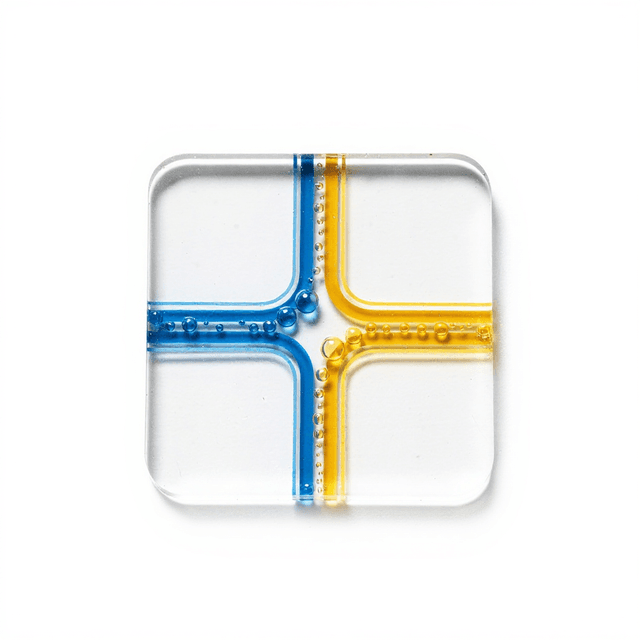
Hydrophobic surface-treated glass microfluidic chip for generating water-in-oil microdroplets with optical transparency and chemical resistance.
Reusable chip — designed for multiple experimental runs. Compatible with standard microfluidic tubing: steel pins (0.7 mm ID / 1.0 mm OD) and silicone tubing (0.8 mm ID / 1.9 mm OD). Available in bulk packs (5‑, 10‑, and 25‑unit) for lab-scale and consumable workflows.

Louise Corscadden, PhD
Director of Science · ConductScience
Ask Louise about Water-in-Oil Microdroplet Glass Chip fit, setup, configuration, or quote prep.
Already working with us? Sign in to connect this with My Scientist.
Key Specifications
Full details →- Model fit
- Configured during quote
- SKU family
- WHM-0067
- Shipping box
- 22.5 x 15.0 x 4.0 cm
- Ordering
- Online checkout and quote request available
- Category
- Lab Equipment
- Build notes
- glass
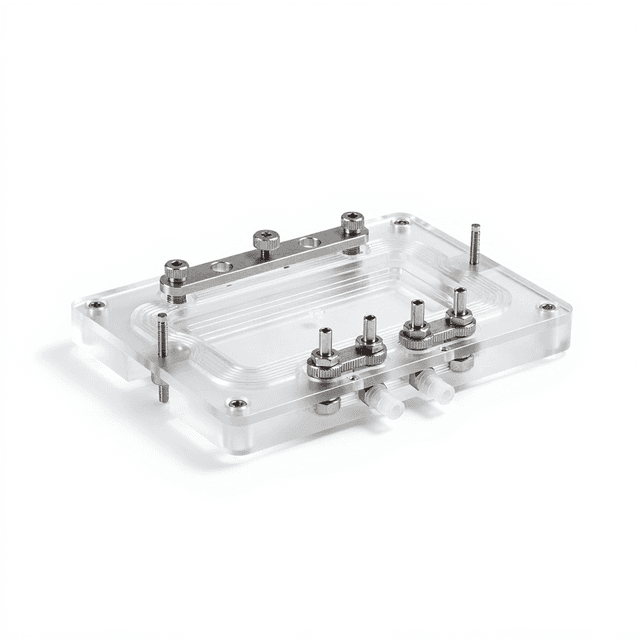
The Water-in-Oil Microdroplet Glass Chip is a hydrophobic surface-treated glass microfluidic device designed for generating water-in-oil (W/O) emulsions at the microscale. This glass-based microchip enables controlled droplet formation through precise channel geometries, allowing researchers to create uniform aqueous droplets suspended in an oil continuous phase.
The hydrophobic surface treatment ensures stable W/O droplet formation by promoting oil wetting of the channel walls while facilitating aqueous phase breakup. The glass construction provides optical transparency for real-time observation and imaging, chemical resistance for diverse solvent systems, and dimensional stability under varying flow conditions. This chip serves as a fundamental tool for microfluidic droplet generation in research applications requiring controlled encapsulation and compartmentalization.
How It Works
Water-in-oil droplet formation occurs through hydrodynamic flow focusing, where an aqueous phase stream is broken into droplets by a surrounding oil phase at a junction geometry. The hydrophobic surface treatment creates preferential wetting conditions that promote oil adhesion to channel walls while destabilizing the aqueous phase interface, leading to controlled droplet pinch-off.
The glass substrate provides several advantages including optical transparency for microscopic observation, chemical inertness for compatibility with diverse solvents, and precise channel definition through established microfabrication techniques. The droplet size and generation frequency depend on the flow rate ratio between phases, fluid properties, and channel dimensions.
Generated droplets serve as isolated microreactors, each containing a defined volume of aqueous solution surrounded by an oil shell. This compartmentalization enables parallel processing of multiple samples or reactions while preventing cross-contamination between individual droplets.
Features & Benefits
Emulsion Type
- Water-in-Oil (W/O)
Surface Treatment
- Hydrophobic
Automation Level
- manual
Brand
- ConductScience
Material
- glass
Research Domain
- Analytical Chemistry
- Cell Biology
- Materials Science
- Microbiology
Shipping weight
- 0.05 lb
Shipping box
- L: 22.5 cm
- W: 15.0 cm
- H: 4.0 cm
| Feature | This Product | Typical Alternative | Advantage |
|---|---|---|---|
| Substrate Material | Glass construction | PDMS or plastic substrates in many commercial devices | Glass provides superior chemical resistance and optical clarity for imaging applications |
| Surface Treatment | Hydrophobic surface treatment | Untreated surfaces requiring surfactants | Built-in hydrophobic treatment eliminates need for additional chemical treatments during operation |
| Emulsion Type | Water-in-oil droplet formation | Some devices focus on oil-in-water systems | W/O configuration provides better stability for aqueous sample encapsulation and long-term storage |
| Device Size | 22.5 × 15 × 4 mm dimensions | Larger footprint devices in some systems | Compact design integrates easily with standard microscopy stages and minimizes dead volume |
This glass microfluidic chip combines the chemical resistance and optical properties of glass substrates with specialized hydrophobic surface treatment for stable W/O droplet generation in a compact form factor.
Practical Tips
Prime channels with oil phase before introducing aqueous samples to ensure proper surface wetting.
Why: Proper channel priming prevents air bubble entrapment that can disrupt droplet formation.
Store chip with channels filled with compatible oil to prevent surface treatment degradation.
Why: Maintaining oil contact preserves hydrophobic properties between experiments.
If droplet formation becomes irregular, check for channel blockages or surface contamination.
Why: Consistent droplet formation requires clean channels and intact surface treatment.
Monitor droplet size distribution regularly to ensure experimental reproducibility.
Why: Droplet size variation can affect encapsulation efficiency and downstream analysis results.
Handle glass chip carefully to avoid breakage and use appropriate eye protection during microscopy.
Why: Glass fragments pose injury risk and proper safety procedures ensure safe laboratory operation.
Setup Guide
What’s in the Box
- Water-in-Oil Microdroplet Glass Chip
- Product specifications sheet
- Handling and storage guidelines (typical)
Warranty
ConductScience provides standard warranty coverage for manufacturing defects with technical support for proper device handling and integration into microfluidic systems.
Compliance
What flow rate ratios are recommended for stable droplet formation?
Optimal flow rate ratios depend on fluid properties and desired droplet size. Consult product datasheet for specific recommendations and start with typical oil-to-aqueous ratios for initial testing.
How should the chip be cleaned between different sample types?
Flush channels thoroughly with appropriate solvents compatible with both phases used. The glass construction allows use of various cleaning agents, but verify compatibility with the hydrophobic surface treatment.
What types of oil phases are compatible with the hydrophobic treatment?
The hydrophobic surface treatment is designed for mineral oils and fluorinated oils commonly used in droplet microfluidics. Consult product specifications for specific oil compatibility data.
Can this chip be reused for multiple experiments?
Yes, the glass construction allows for cleaning and reuse provided proper flushing protocols are followed and the surface treatment remains intact.
What microscopy setup is needed for droplet observation?
Standard inverted microscopy with appropriate magnification for droplet size visualization. The optical transparency of glass enables bright-field, fluorescence, and other imaging modalities.
Have a question about this product?
Have a question? Just ask.
Send it over and we'll email you a personalized answer — no call, no scheduling.
Prefer to talk it through?
Accessories
Enhance your setup with compatible accessories
Upgrade Options