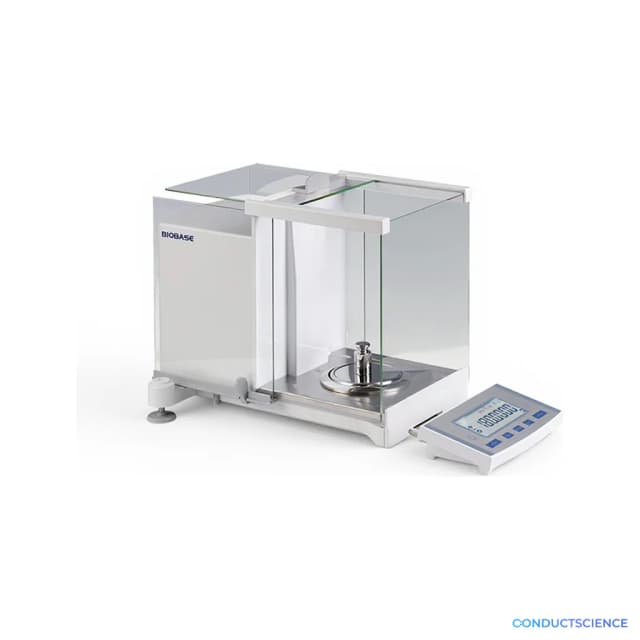
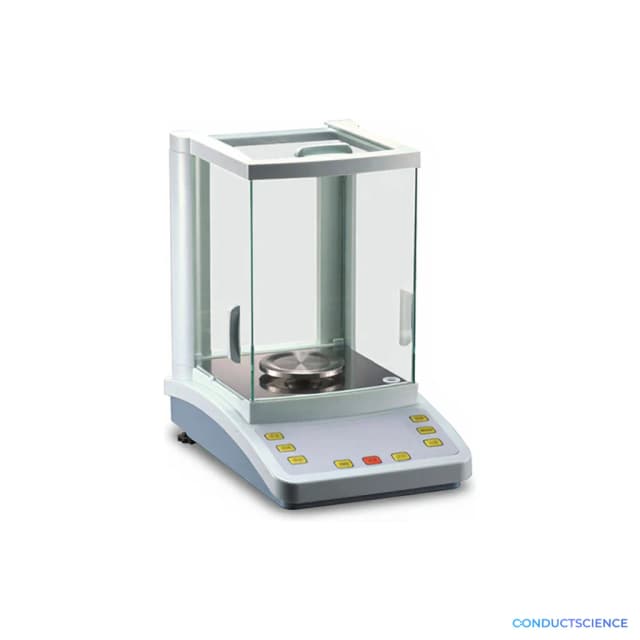
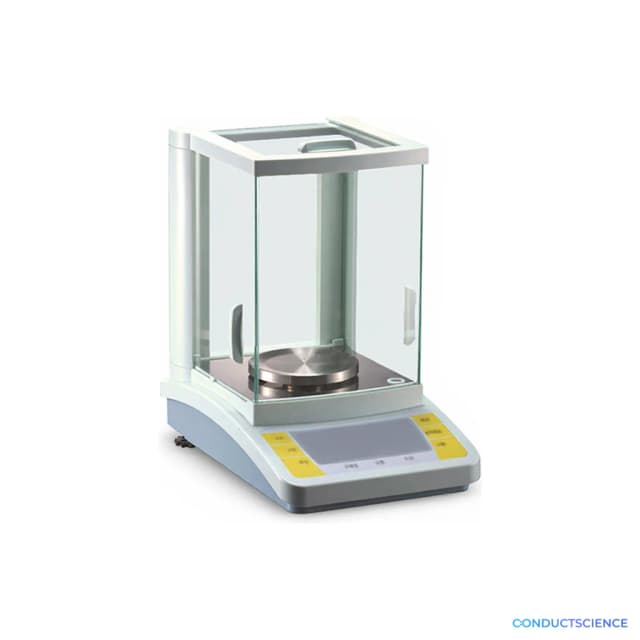
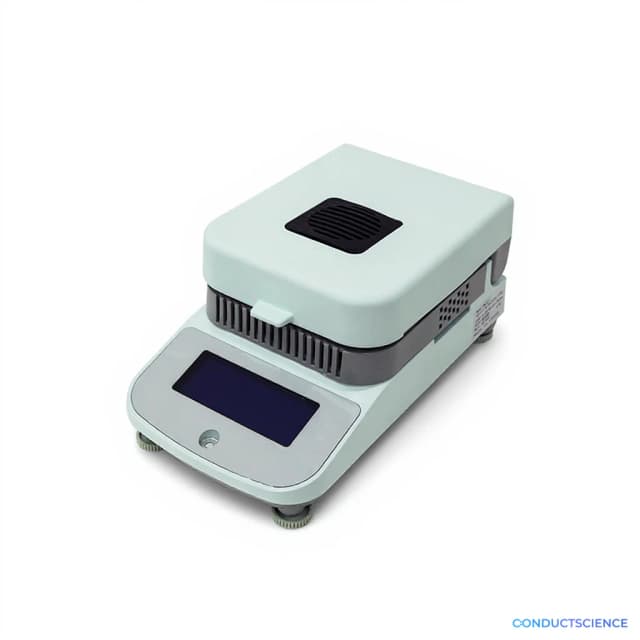
Automatic Electronic Analytical Balance
Precision Grade I analytical balance with 0.1mg readability and 120g capacity for accurate mass determination in analytical and research laboratories.

Louise Corscadden, PhD
Director of Science · ConductScience
Ask Louise about Automatic Electronic Analytical Balance fit, setup, configuration, or quote prep.
Already working with us? Sign in to connect this with My Scientist.
Key Specifications
Full details →- Model fit
- Configured during quote
- SKU family
- BIO-0355
- Shipping box
- 31.5 x 21.0 x 31.0 cm
- Ordering
- Online checkout and quote request available
- Category
- Balances
- Build notes
- Confirm accessories, station layout, and support needs before purchase
The Automatic Electronic Analytical Balance (BIO-0355) is a precision Grade I analytical instrument designed for accurate mass determination in laboratory environments. With 0.1mg readability and 120g maximum capacity, this balance provides reliable quantitative measurements for analytical chemistry, pharmaceutical quality control, and research applications requiring sub-milligram precision.
The balance features external calibration capability, a 90mm diameter weighing pan, and environmental protection within a 210mm height weighing chamber. Operational parameters include 10-30°C temperature range and 20-80% relative humidity tolerance, with stabilization time ≤2.5 seconds and 30-60 minute pre-heating requirement after startup.
How It Works
The analytical balance operates on electromagnetic force restoration principles, where the sample mass is counterbalanced by an electromagnetically generated force. A position sensor detects pan displacement, and a servo system adjusts electromagnetic current to restore the pan to its null position. The current required for force restoration is proportional to the sample mass and is converted to a digital mass readout.
The balance incorporates internal vibration dampening and environmental protection through the enclosed weighing chamber, minimizing external influences on measurement accuracy. The external calibration system uses certified reference weights to establish and verify measurement traceability, ensuring consistent performance across the specified operational range.
Features & Benefits
Automation Level
- semi-automated
BG1204C
- BG2204B
Readability
- 0.1mg
Maximum Range(max)
- 120g
Repeat Ability
- ±0.2mg
Liner
- ±0.2mg
Stable Time
- ≤2.5s
Pre-heating Time after Startup
- 30~60min
Precision Grade
- I
Pan Diameter
- ф90mm
Height of Weighing Chamber
- 210mm
Operational Temperature Range
- 10~30℃
Relative Humidity
- 20%~80%
Calibration Mode
- External
Internal
- External
Brand
- ConductScience
Research Domain
- Analytical Chemistry
- Clinical Diagnostics
- Environmental Monitoring
- Food Science
- Materials Science
- Pharmaceutical QC
Shipping weight
- 7.0 lb
Shipping box
- L: 31.5 cm
- W: 21.0 cm
- H: 31.0 cm
| Feature | This Product | Typical Alternative | Advantage |
|---|---|---|---|
| Readability | 0.1mg | Entry-level models often offer 1mg readability | Enables more precise quantitative analysis for applications requiring sub-milligram accuracy. |
| Capacity Range | 120g maximum | Comparable precision balances typically offer 100-200g ranges | Provides optimal balance between precision and sample capacity for analytical laboratory work. |
| Stabilization Speed | ≤2.5 seconds | Standard models often require 3-5 seconds | Reduces measurement time and increases laboratory throughput for routine analytical procedures. |
| Precision Grade | Grade I classification | Lower-cost models may offer Grade II precision | Meets analytical laboratory standards for quantitative chemical analysis and pharmaceutical testing. |
| Calibration Method | External calibration system | Some models offer only internal calibration | Enables measurement traceability verification using certified reference weights for regulatory compliance. |
| Environmental Tolerance | 10-30°C, 20-80% RH | Basic models often have narrower operating ranges | Provides operational flexibility across varied laboratory environmental conditions. |
This analytical balance combines 0.1mg precision with 120g capacity and fast stabilization for efficient analytical laboratory workflows. The Grade I precision classification and external calibration system support quantitative analysis requirements in pharmaceutical, analytical chemistry, and research applications.
Practical Tips
Perform daily calibration verification using certified check weights before critical analytical measurements.
Why: Ensures measurement accuracy and traceability for quantitative analytical procedures.
Clean weighing chamber and pan weekly with appropriate solvents to prevent contamination buildup.
Why: Maintains measurement accuracy and prevents cross-contamination between samples.
Allow samples and containers to equilibrate to room temperature before weighing to minimize thermal effects.
Why: Prevents measurement drift caused by thermal expansion and convection currents.
Check balance leveling if repeatability exceeds ±0.2mg specification during routine verification.
Why: Improper leveling is a common source of measurement precision degradation.
Record environmental conditions (temperature, humidity) with analytical measurements for quality documentation.
Why: Enables identification of environmental factors affecting measurement uncertainty in analytical results.
Use anti-static weighing materials and ground connections when weighing static-sensitive samples.
Why: Prevents electrostatic discharge that can affect measurement accuracy and sample integrity.
Position balance away from ventilation systems and high-traffic areas to minimize air current interference.
Why: Reduces measurement variability caused by environmental disturbances affecting the sensitive weighing mechanism.
Setup Guide
What’s in the Box
- Automatic Electronic Analytical Balance main unit
- AC power adapter
- Weighing pan and pan support
- Anti-static weighing chamber with glass panels
- External calibration weight set (typical)
- User manual and calibration certificate
- Anti-vibration leveling feet
Warranty
ConductScience provides standard 1-year manufacturer warranty covering defects in materials and workmanship, with technical support for calibration procedures and operational guidance.
Compliance
What calibration weights are required for external calibration?
Consult product datasheet for specific calibration weight specifications. External calibration typically requires certified reference weights spanning the operational range with appropriate uncertainty specifications.
How does environmental variation affect measurement accuracy?
The balance operates within 10-30°C temperature and 20-80% relative humidity specifications. Variations outside these ranges can affect measurement accuracy and require environmental control or measurement correction.
What is the minimum sample size for reliable measurement?
With 0.1mg readability and ±0.2mg repeatability, reliable measurements typically require sample masses at least 10 times the readability (1mg minimum) for acceptable measurement uncertainty.
How often should calibration be performed?
Calibration frequency depends on usage intensity and accuracy requirements. Daily verification with check weights is recommended for analytical work, with full calibration weekly or monthly based on laboratory protocols.
Can the balance interface with laboratory information systems?
Consult product datasheet for available data connectivity options. Modern analytical balances typically provide digital interfaces for data logging and laboratory automation integration.
What maintenance is required for optimal performance?
Regular cleaning of weighing chamber and pan, periodic calibration verification, and environmental monitoring are essential. Replace damaged weighing chamber seals and level adjustment as needed.
How does this compare to higher capacity balances?
This 120g capacity balance provides higher precision (0.1mg) compared to larger capacity analytical balances, making it optimal for small sample analytical work where maximum precision is required.
Have a question about this product?
Have a question? Just ask.
Send it over and we'll email you a personalized answer — no call, no scheduling.
Prefer to talk it through?
Accessories
Enhance your setup with compatible accessories
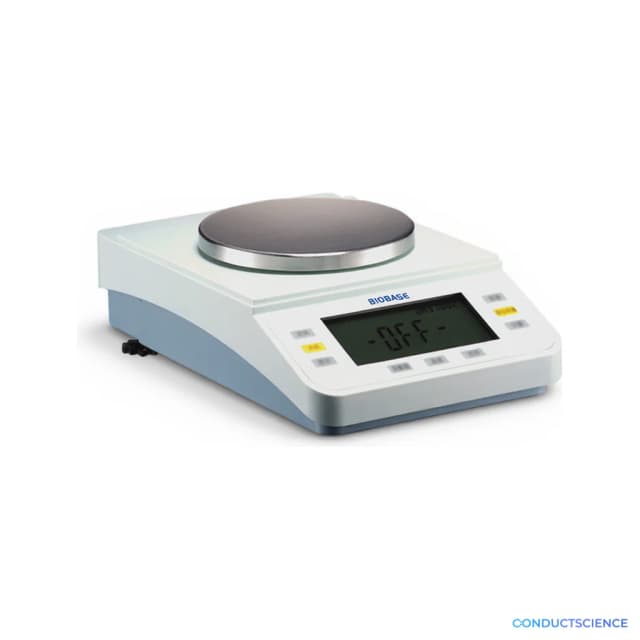
Upgrade Options