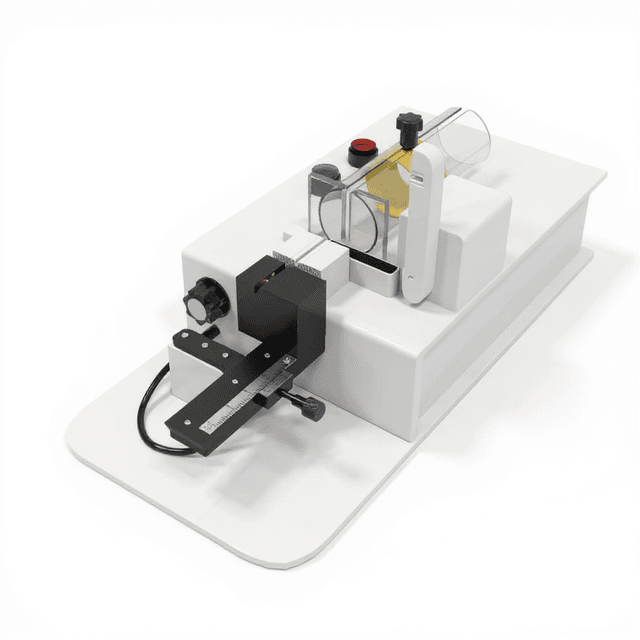
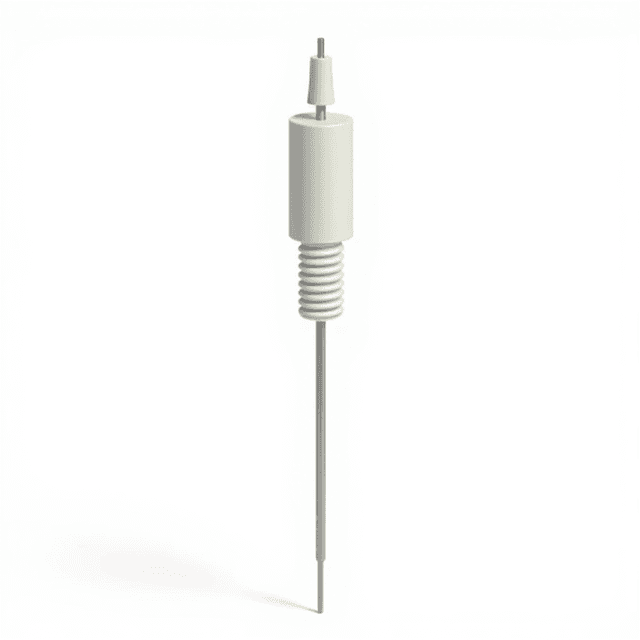
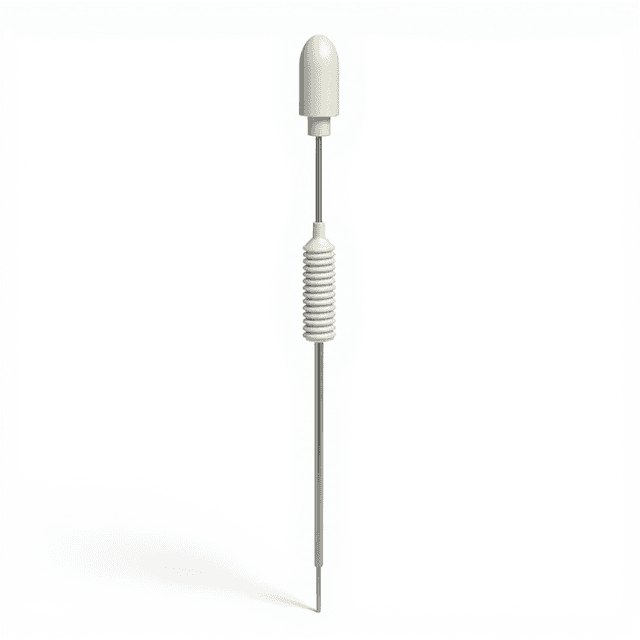
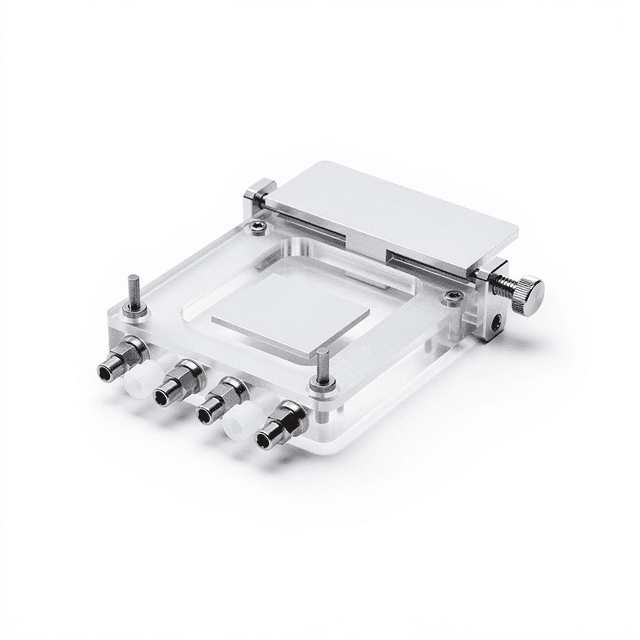
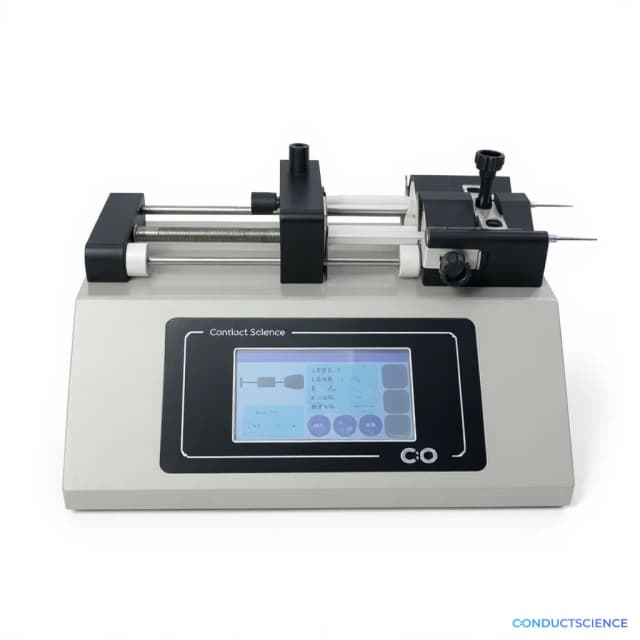
ConductScience Syringe Pump
Precision syringe pump for controlled microinjection and infusion studies, delivering volumes from 0.5 μL to 140 mL with programmable flow rates for in vivo research applications.

Louise Corscadden, PhD
Director of Science · ConductScience
Ask Louise about ConductScience Syringe Pump fit, setup, configuration, or quote prep.
Already working with us? Sign in to connect this with My Scientist.
Key Specifications
Full details →- Model fit
- Hamster, Non-human Primate, Rabbit, Mouse, Rat, Guinea pig
- SKU family
- ME-CSP-01
- Shipping box
- 3.43 x 0.47 x 27.9 cm
- Ordering
- Online checkout and quote request available
- Category
- Microinjection & Infusion
- Build notes
- Confirm accessories, station layout, and support needs before purchase
The ConductScience Syringe Pump is a precision microinjection device designed for controlled fluid delivery in biological and pharmacological research applications. This programmable infusion system enables precise administration of test compounds, pharmaceuticals, and biological fluids at predetermined volumes and flow rates for in vivo studies. The pump accommodates a wide range of syringe sizes and delivers accurate fluid volumes from 0.5 μL to 140 mL with exceptional precision.
The system operates with a linear force of 18 kg and provides both infusion and withdrawal capabilities across a flow rate range of 0.001 μL/min to 138.7 mL/min. With stroke resolution down to 0.039 μm per step and stroke rates from 0.0094 mm/min to 87.211 mm/min, researchers can achieve precise control over drug delivery kinetics for dose-response studies, pharmacokinetic analyses, and chronic infusion protocols.
How It Works
The syringe pump operates through precision stepper motor control that drives a threaded lead screw mechanism. The motor advances or retracts a syringe plunger at precisely controlled rates, creating positive or negative pressure to deliver or withdraw fluids. The system calculates infusion speed using the formula: 0.001 × (d/2)² × π × rpm, where d represents syringe diameter and rpm is the pump speed parameter.
Flow rate accuracy depends on the mechanical precision of the stepper motor (0.039 μm step resolution) and the cross-sectional area of the selected syringe. Users specify syringe diameter parameters (default 12 mm), which the system uses to calculate volumetric flow rates from linear displacement. The 18 kg linear force capability ensures consistent flow delivery even against back-pressure from catheters, tubing resistance, or tissue impedance.
The pump's programmable control system allows researchers to define complex infusion protocols including single bolus injections, continuous infusions, and multi-phase delivery patterns. Maximum infusion limits can be set to prevent overdose, while the withdrawal function enables sampling or clearing of delivery lines between experimental phases.
Features & Benefits
Automation Level
- semi-automated
Research Domain
- Addiction Research
- Behavioral Pharmacology
- Cancer Research
- Cardiovascular
- Neuroscience
- Pain Research
- Pharmaceutical QC
- Toxicology
Species
- Hamster
- Non-human Primate
- Rabbit
- Mouse
- Rat
- Guinea pig
Shipping weight
- 39.68 lb
Shipping box
- L: 3.43 cm
- W: 0.47 cm
- H: 27.9 cm
| Feature | This Product | Typical Alternative | Advantage |
|---|---|---|---|
| Volume Range | 0.5 μL to 140 mL | Entry-level models often limited to smaller volume ranges or require multiple syringe changes | Single instrument handles both microinjection protocols and large-volume chronic infusion studies. |
| Flow Rate Precision | 0.001 μL/min minimum with 0.039 μm step resolution | Basic pumps typically offer lower resolution and higher minimum flow rates | Enables ultra-slow delivery protocols required for sensitive neurochemistry and pharmacokinetic studies. |
| Linear Force | 18 kg force capability | Standard pumps often provide lower force output | Maintains consistent flow against catheter resistance and tissue back-pressure in chronic implant applications. |
| Voltage Compatibility | 110V and 240V operation | Many pumps require specific voltage or external converters | Simplifies installation in international laboratories without additional power conditioning equipment. |
| Bidirectional Operation | Infusion and withdrawal modes | Basic models often provide infusion-only capability | Supports complex protocols including sampling, line clearing, and push-pull perfusion techniques. |
| Safety Features | Programmable maximum infusion limits | Entry-level systems may lack overdose protection | Prevents accidental overdosing during automated protocols, improving experimental safety and validity. |
This syringe pump combines wide volume range capability with high-precision flow control and robust force output. The dual voltage compatibility and bidirectional operation provide flexibility for diverse research applications, while programmable safety limits ensure reliable automated operation.
Practical Tips
Perform gravimetric flow rate verification monthly using precision analytical balance and timed infusion protocols.
Why: Mechanical wear and temperature changes can affect stepper motor accuracy over time.
Clean syringe mounting surfaces with alcohol after each experiment and lubricate lead screw quarterly.
Why: Residual compounds can interfere with syringe sealing and cause mechanical binding in drive mechanisms.
Prime the entire fluid path including dead volume before connecting catheters to experimental subjects.
Why: Eliminates air bubbles and ensures accurate timing between pump activation and drug delivery.
Check syringe diameter parameter settings if calculated flow rates do not match measured delivery volumes.
Why: Incorrect diameter settings cause systematic errors in volumetric flow rate calculations.
Record ambient temperature during long-term infusions as thermal expansion affects syringe volume accuracy.
Why: Temperature variations can introduce 1-2% volume errors in precision dosing applications.
Set maximum infusion limits 20% below lethal dose calculations to account for individual animal variability.
Why: Provides safety margin against accidental overdose while maintaining experimental validity.
Use consistent catheter lengths and diameters within experimental groups to minimize flow rate variability.
Why: Different catheter specifications create varying back-pressure that affects actual delivery rates.
Verify step accuracy using precision linear measurement tools when flow rates appear inconsistent.
Why: Stepper motor skipping or mechanical wear can cause cumulative dosing errors in long-term studies.
Setup Guide
What’s in the Box
- ConductScience Syringe Pump main unit
- Power cord (110V/240V compatible)
- Control interface and programming software (typical)
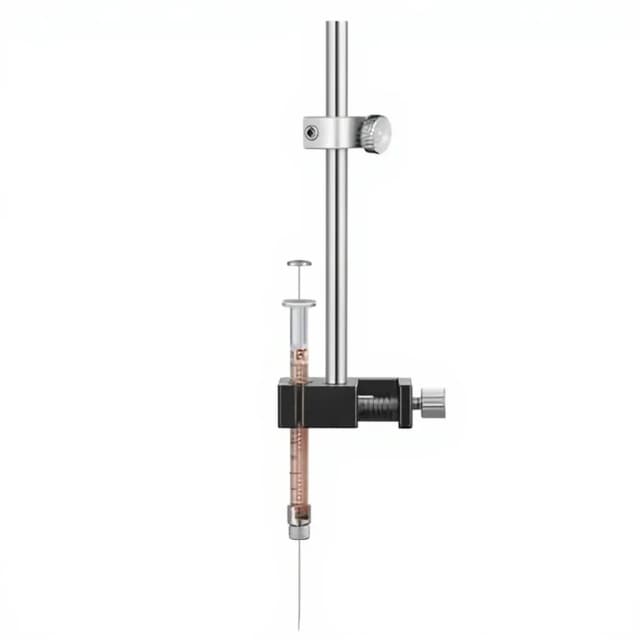
- Syringe mounting hardware
- User manual and operation guide
- Calibration verification protocol (typical)
Warranty
ConductScience provides a standard one-year manufacturer warranty covering defects in materials and workmanship, with comprehensive technical support for operation and protocol development.
Compliance
What factors affect flow rate accuracy during chronic infusion studies?
Flow rate accuracy depends on syringe diameter calibration, catheter resistance, and mechanical backlash. Verify syringe diameter settings match installed syringes, use consistent catheter lengths, and perform periodic volume verification with gravimetric measurements.
Can the pump handle viscous solutions or suspensions?
The 18 kg linear force accommodates moderately viscous solutions, but particle suspensions may cause clogging in small-bore catheters. Pre-filter solutions and use appropriate catheter diameters based on solution viscosity and particle size.
How do I prevent air bubble formation during microinjection protocols?
Prime the entire fluid path including catheter dead volume before connecting to the animal. Use degassed solutions when possible and maintain positive pressure in the syringe to prevent air aspiration during withdrawal phases.
What maintenance is required for consistent long-term operation?
Clean syringe mounting surfaces after each use, lubricate lead screw mechanisms monthly, and verify step accuracy quarterly using precision volume measurements. Replace worn syringe seals to maintain pressure integrity.
How does this compare to osmotic pumps for chronic drug delivery?
Syringe pumps offer programmable dosing schedules and real-time flow rate changes, while osmotic pumps provide passive delivery at fixed rates. Choose based on whether experimental design requires dosing flexibility or simple continuous infusion.
Can the system log infusion data for regulatory documentation?
Consult product datasheet for specific data logging capabilities. Most programmable pumps provide event logs for GLP compliance, including infusion times, volumes, and any error conditions during operation.
What is the minimum stable flow rate for neurochemistry applications?
The specified minimum of 0.001 μL/min enables microdialysis and slow-release protocols, but verify stability at your specific flow rate using long-term volume measurements before critical experiments.
How do I calculate catheter priming volume for accurate dosing?
Measure catheter internal diameter and length to calculate dead volume (π × r² × length). Prime with this volume plus 10% safety margin before beginning timed infusions to ensure accurate drug delivery timing.
Have a question about this product?
Have a question? Just ask.
Send it over and we'll email you a personalized answer — no call, no scheduling.
Prefer to talk it through?
Accessories
Enhance your setup with compatible accessories