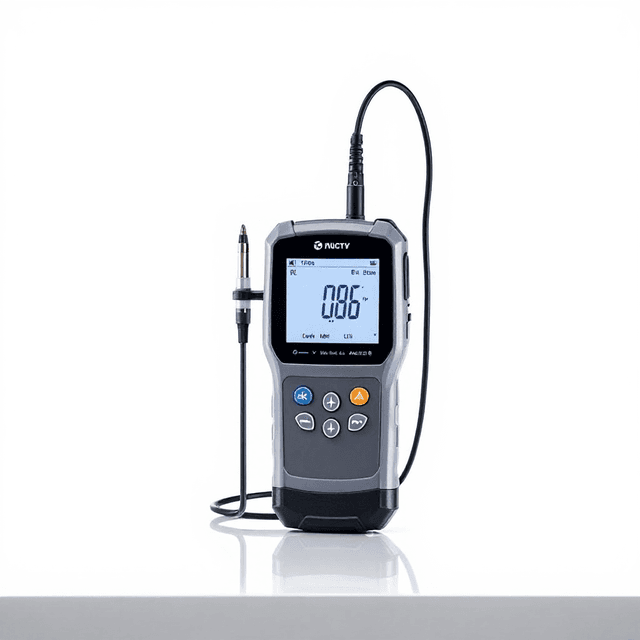
Digital Salinity Meter
Handheld digital salinity meter with 0-10% measurement range, automatic temperature compensation, and waterproof design for field and laboratory water quality analysis.

Louise Corscadden, PhD
Director of Science · ConductScience
Ask Louise about Digital Salinity Meter fit, setup, configuration, or quote prep.
Already working with us? Sign in to connect this with My Scientist.
Key Specifications
Full details →- Model fit
- Configured during quote
- SKU family
- CS-LH-SA10
- Shipping box
- 6.46 x 0.98 x 0.63 cm
- Ordering
- Online checkout and quote request available
- Category
- Portable Analyzers
- Build notes
- Confirm accessories, station layout, and support needs before purchase
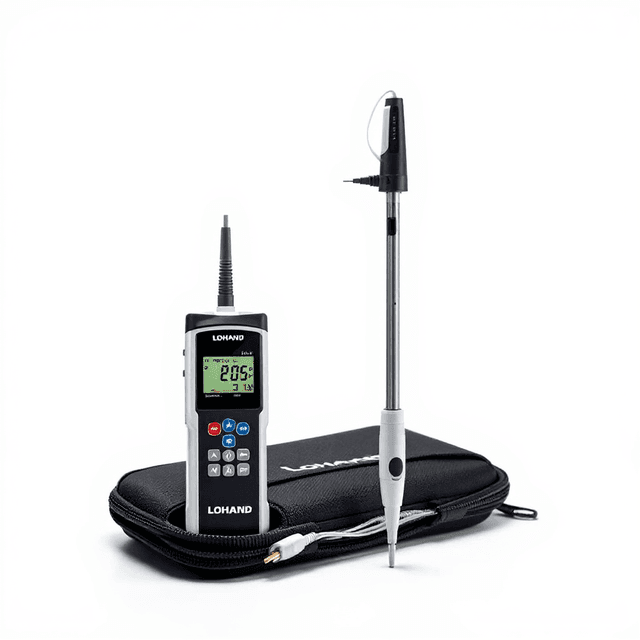
The ConductScience Digital Salinity Meter Model LH-SA10 provides precise salinity measurements from 0-10% using electrical conductivity detection principles. This compact handheld instrument features automatic temperature compensation across 0-80°C, delivering resolution of 0.01% for salinity and 0.1°C for temperature measurements. The waterproof design enables direct immersion sampling for field and laboratory applications.
Engineered with a low-power microprocessor chip and dual AAA battery operation, the instrument provides rapid readings within seconds while maintaining measurement accuracy of ±0.1% for low-salinity samples (0-1.99%) and scaled accuracy for higher concentrations. The probe-style configuration with integrated temperature sensor ensures consistent performance across varying environmental conditions.
How It Works
The Digital Salinity Meter operates on electrical conductivity measurement principles, where dissolved salts increase the conductivity of aqueous solutions in proportion to their ionic concentration. The instrument applies a controlled electrical field between electrode surfaces immersed in the sample, measuring the resulting current flow. Higher salt concentrations produce greater ionic mobility and increased conductivity values.
Automatic temperature compensation corrects for temperature-dependent changes in ionic mobility, as conductivity typically increases 1-3% per degree Celsius. The integrated temperature sensor continuously monitors sample temperature and applies mathematical correction factors to report salinity values standardized to a reference temperature. This compensation ensures accurate readings across the 0-80°C operating range.
The microprocessor converts raw conductivity measurements to salinity percentage using established algorithms that correlate electrical conductivity with total dissolved salt content. The waterproof probe design allows direct immersion in samples while protecting internal electronics from moisture ingress.
Features & Benefits
Measuring range
- 0-10%
Temperature measuring range
- 0-80â
Research Domain
- Analytical Chemistry
- Environmental Monitoring
- Food Science
- Industrial Hygiene
- Microbiology
- Pharmaceutical QC
Model
- LH-SA10
Automation Level
- manual
Brand
- ConductScience
Accuracy
- (0-1.99)%±0.1%ï¼ï¼2-4.99ï¼%±0.2%ï¼ï¼5-10%ï¼%±0.5%
Power/Voltage
- AAA 1.5V*2
Size
- 164*25*16mm
Weight
- 47g
Shipping weight
- 0.1 lb
Shipping box
- L: 6.46 cm
- W: 0.98 cm
- H: 0.63 cm
| Feature | This Product | Typical Alternative | Advantage |
|---|---|---|---|
| Measurement Range | 0-10% salinity | Basic models often limited to 0-5% or require multiple ranges | Single-range operation covers most environmental and industrial applications without range switching. |
| Temperature Compensation | Automatic compensation from 0-80°C | Manual compensation or limited temperature range | Eliminates calculation errors and ensures accuracy across field temperature variations. |
| Resolution | 0.01% salinity resolution | Lower-cost models typically offer 0.1% resolution | Higher precision enables detection of small concentration changes for research applications. |
| Accuracy Specification | Multi-point accuracy: ±0.1% (0-2%), ±0.2% (2-5%), ±0.5% (5-10%) | Single accuracy specification across full range | Optimized accuracy at each concentration level provides better measurement confidence for diverse samples. |
| Form Factor | 47g weight, 164×25×16mm dimensions | Larger bench-style units or less portable designs | Compact pen-style design enables single-handed operation and easy field transport. |
The LH-SA10 combines wide measurement range (0-10%) with high resolution (0.01%) and automatic temperature compensation in a compact 47g package. The multi-point accuracy specification provides optimized precision across different concentration levels for diverse research applications.
Practical Tips
Verify accuracy monthly using certified reference standards that bracket your typical sample range.
Why: Regular verification ensures measurement reliability and identifies probe degradation before it affects data quality.
Store the probe dry and clean electrodes gently with distilled water after measuring high-concentration samples.
Why: Salt crystallization on electrodes can cause measurement drift and reduced sensitivity over time.
Allow samples to equilibrate to ambient temperature when possible to minimize temperature compensation uncertainty.
Why: Smaller temperature corrections reduce measurement uncertainty and improve reproducibility.
Stir samples gently or move the probe slightly during measurement to ensure representative sampling.
Why: Eliminates stratification effects and ensures the probe senses bulk solution properties rather than localized concentrations.
If readings appear unstable, check for air bubbles on electrodes or insufficient sample volume.
Why: Air bubbles create electrical discontinuities while shallow immersion can cause field geometry artifacts.
Record both salinity and temperature for each measurement to enable post-measurement verification of compensation calculations.
Why: Complete documentation allows retrospective data quality assessment and detection of systematic errors.
Rinse probe thoroughly when transitioning between chemically incompatible samples or concentration ranges.
Why: Prevents cross-contamination and chemical interactions that might damage the electrode surfaces.
Setup Guide
What’s in the Box
- Digital Salinity Meter LH-SA10 main unit
- User manual and quick start guide (typical)
- AAA batteries (typical)
- Protective carrying case (typical)
- Calibration verification certificate (typical)
Warranty
ConductScience provides a one-year manufacturer warranty covering defects in materials and workmanship. Technical support includes calibration guidance and troubleshooting assistance for optimal measurement performance.
Compliance
References
Background reading relevant to this product:
What is the measurement principle and how does temperature compensation work?
The meter measures electrical conductivity, which correlates with ionic salt concentration. Automatic temperature compensation corrects for temperature-dependent changes in ionic mobility, applying mathematical correction factors based on the integrated temperature sensor reading to standardize results to a reference temperature.
How do I verify measurement accuracy for my specific application?
Use certified reference standards or prepare gravimetric salt solutions of known concentration within your working range. Compare meter readings to known values to assess accuracy. Consult product datasheet for factory calibration procedures if adjustment is required.
What types of samples can be measured and are there interference considerations?
The meter works with any aqueous solution containing dissolved salts. Avoid samples with suspended solids that might coat electrodes. Organic solvents, extreme pH, or non-ionic solutes may interfere with conductivity-based measurements.
How should I maintain the probe and ensure long-term stability?
Rinse probe with distilled water after each use and store dry. For heavily contaminated samples, clean electrodes gently with soft brush. Avoid abrasive cleaning that might damage electrode surfaces. Regular verification with standards confirms ongoing accuracy.
What is the relationship between salinity percentage and conductivity units?
The meter converts conductivity measurements to salinity percentage using programmed algorithms. The exact relationship depends on solution composition, as different salts have different conductivity coefficients. The instrument is typically calibrated for sodium chloride equivalents.
Can this meter replace laboratory conductivity measurements?
For many applications, yes. The ±0.1-0.5% accuracy is suitable for most field and quality control purposes. However, precise analytical work may require laboratory-grade instruments with certified calibration standards and controlled measurement conditions.
How does sample volume and immersion depth affect readings?
Ensure complete immersion of both conductivity electrodes and temperature sensor. Minimum sample volume should allow unrestricted probe insertion without touching container walls, which might affect the electrical field geometry.
What is the expected battery life and are there power management features?
Dual AAA batteries provide extended operation due to low-power chip design. Exact life depends on usage frequency and ambient temperature. The unit likely includes auto-shutoff to conserve power, though specific timing should be confirmed in the user manual.
Have a question about this product?
Have a question? Just ask.
Send it over and we'll email you a personalized answer — no call, no scheduling.
Prefer to talk it through?
Accessories
Enhance your setup with compatible accessories