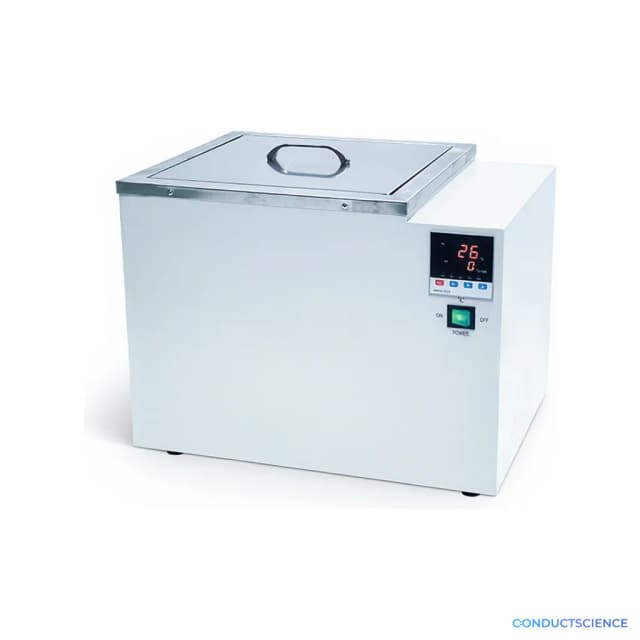
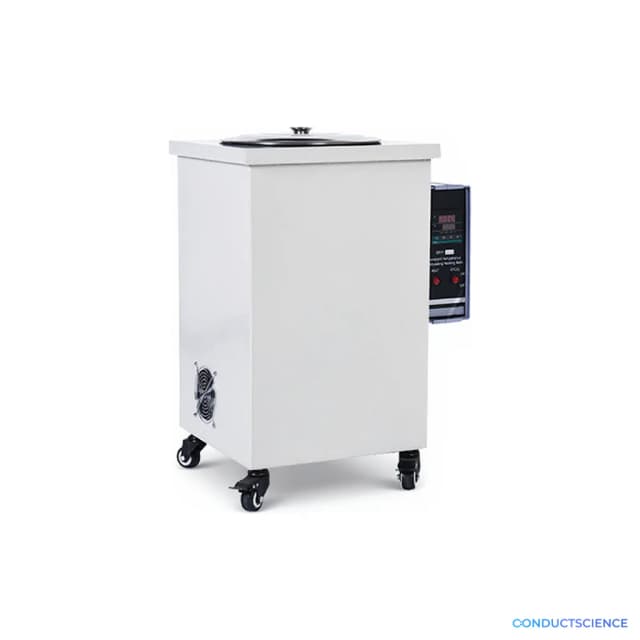
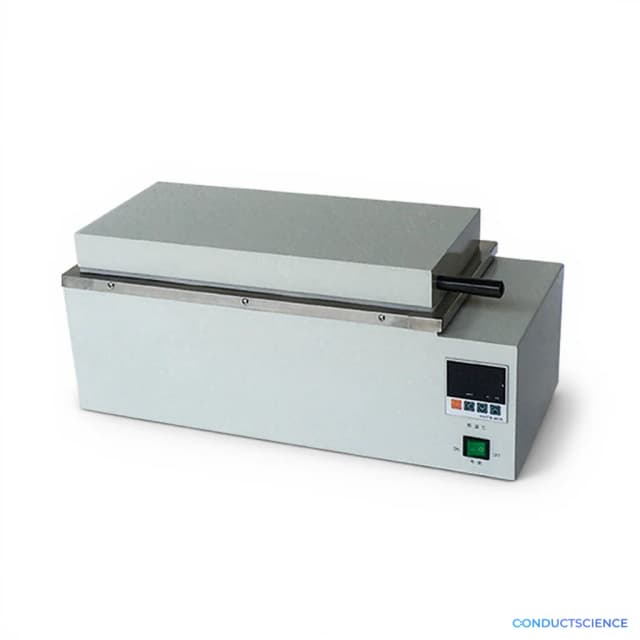
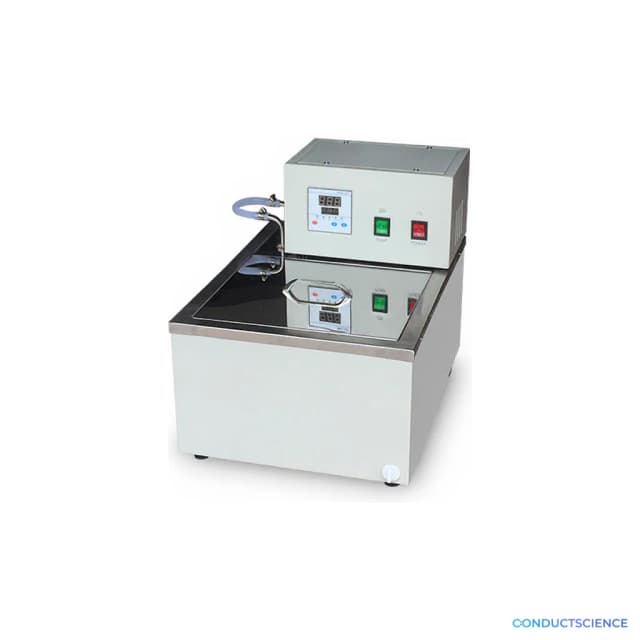
Digital Thermostatic Oil Bath, 3.4L, 300°C
Thermostatic oil bath with 3.4 L capacity and temperature control from RT+5 °C to 300 °C.
Features LED display, stainless steel inner liner, and corrosion-resistant construction for distillation, drying, concentration, and constant-temperature analytical applications.

Louise Corscadden, PhD
Director of Science · ConductScience
Ask Louise about Digital Thermostatic Oil Bath, 3.4L, 300°C fit, setup, configuration, or quote prep.
Already working with us? Sign in to connect this with My Scientist.
Key Specifications
Full details →- Model fit
- Configured during quote
- SKU family
- BIO-0677
- Shipping box
- 15.0 x 18.0 x 18.0 cm
- Ordering
- Online checkout and quote request available
- Category
- Water Baths
- Build notes
- Confirm accessories, station layout, and support needs before purchase
The Digital Thermostatic Oil Bath (BJPX-OB2) provides stable heating from ambient to 300 °C for laboratory distillation, drying, concentration, chemical synthesis, and constant-temperature testing. The stainless steel inner liner is precision-machined for high temperature and corrosion resistance, enabling rapid heat balance with minimal temperature variation. LED display monitoring and thermostatic control maintain reliable, repeatable conditions across routine and analytical procedures.
Technical Specifications
| Parameter | BJPX-OB2 |
|---|---|
| Capacity | 3.4 L |
| Temperature Control Range | RT+5~300 °C |
| Temperature Precision | ±1 °C |
| Temperature Fluctuation | ≤1 °C |
| Power Consumption | 600 W |
| Power Supply | AC 220 V, 50/60 Hz (standard); AC 110 V, 50/60 Hz (optional) |
| External Dimensions (L×W×H) | 235×265×190 mm |
| Packing Dimensions (L×W×H) | 330×330×300 mm |
| Gross Weight | 4 kg |
Key Features
- Stainless steel inner liner with precision machining
- High temperature and corrosion resistant construction
- Rapid heat balance with minimal temperature variation
- LED display for clear temperature monitoring
- Dual-voltage compatible (220 V standard; 110 V optional)
How It Works
The thermostatic oil bath operates through controlled convective heating using thermal oil as the heat transfer medium. The internal heating element maintains oil temperature through feedback control from integrated temperature sensors, providing uniform heat distribution throughout the bath chamber. The LED display continuously monitors and displays actual bath temperature while the thermostatic control system maintains setpoint temperature within ±0.5°C fluctuation.
Oil baths provide superior temperature uniformity compared to air heating systems due to oil's higher heat capacity and thermal conductivity. The liquid medium ensures direct thermal contact with submerged vessels, enabling efficient heat transfer for consistent sample temperature. Temperature precision of ±1°C is maintained through the digital control system that automatically adjusts heating element power output based on thermal feedback.
Features & Benefits
Automation Level
- manual
BK-OB10
- BK-OB15
10L
- 15L
Temp. Range
- RT+5°C~300°C
Temp. Fluctuation
- ±0.5℃
Temp. Precision
- ±1℃
Consumption
- 1000W
1500W
- 1800W
Internal Size(L*W*H)
- 180*180*150mm
260*260*150mm
- 310*310*150mm
External Size(L*W*H)
- 380*270*220mm
460*350*220mm
- 510*400*220mm
Brand
- ConductScience
Research Domain
- Analytical Chemistry
- Environmental Monitoring
- Food Science
- Industrial Hygiene
- Materials Science
- Pharmaceutical QC
Capacity
- 5L
Display Type
- LED display
Power/Voltage
- AC220V, 50/60Hz; 110V, 50/60Hz
Shipping weight
- 4.5 lb
Shipping box
- L: 15.0 cm
- W: 18.0 cm
- H: 18.0 cm
| Feature | This Product | Typical Alternative | Advantage |
|---|---|---|---|
| Temperature Range | RT+5°C to 300°C | Many basic models limited to 200°C maximum | Extended high-temperature capability accommodates demanding analytical procedures requiring temperatures above 200°C |
| Temperature Stability | ±0.5°C fluctuation control | Entry-level units often provide ±1-2°C stability | Tighter temperature control improves reproducibility in temperature-sensitive analytical methods |
| Capacity Options | Three sizes available (5L, 10L, 15L) | Fixed capacity models require purchasing different units for different applications | Multiple capacity options allow selection of optimal size for specific sample volumes and bench space constraints |
| Power Supply Compatibility | Dual voltage (110V/220V, 50/60Hz) | Single voltage models require voltage converters in some locations | Universal voltage compatibility simplifies installation across different laboratory power systems |
| Display System | LED digital display | Basic models may use analog dials or simple LCD displays | Clear digital readout improves temperature monitoring accuracy and documentation for quality control procedures |
This thermostatic oil bath combines extended temperature range capability with precise control and multiple capacity options. The dual voltage compatibility and LED display system provide operational flexibility and monitoring accuracy for demanding laboratory applications.
Practical Tips
Verify temperature accuracy using a calibrated reference thermometer placed at the same depth as your samples.
Why: Temperature can vary slightly with depth in the oil bath, affecting measurement accuracy.
Monitor oil clarity and viscosity regularly, replacing oil when it becomes dark or thick.
Why: Degraded oil reduces heat transfer efficiency and can create temperature gradients.
Allow 15 minutes stabilization time after reaching setpoint temperature before beginning critical procedures.
Why: Full thermal equilibration ensures consistent temperature conditions throughout the procedure.
Never add water or aqueous solutions directly to hot oil above 100°C.
Why: Water contact with hot oil can cause violent spattering and potential burns.
If temperature overshoot occurs, reduce setpoint by 10°C then gradually increase to target temperature.
Why: High thermal mass systems can overshoot target temperatures during rapid heating cycles.
Position sample vessels to avoid contact with heating elements or temperature sensors.
Why: Direct contact can create localized hot spots affecting sample temperature uniformity.
Clean internal surfaces monthly with appropriate solvents when unit is cool and empty.
Why: Residue buildup can affect heat transfer and create contamination sources.
Setup Guide
What’s in the Box
- Thermostatic oil bath main unit
- Power cord
- User manual and operation guide
- Temperature calibration certificate (typical)
- Sample vessel support accessories (typical)
Warranty
ConductScience provides a standard one-year manufacturer warranty covering parts and labor for defects in materials and workmanship. Technical support is available for installation, operation, and maintenance guidance throughout the warranty period.
Compliance
What type of thermal oil should be used and how often should it be replaced?
Use silicone-based thermal oil rated for temperatures exceeding your maximum operating temperature. Replace oil when it becomes darkened, viscous, or shows signs of thermal degradation, typically every 6-12 months depending on usage frequency and temperature exposure.
How long does it take to reach operating temperature from ambient conditions?
Heating time depends on target temperature, oil volume, and ambient conditions. Typically 15-30 minutes to reach 100°C, with higher temperatures requiring proportionally longer heating times. Consult product datasheet for specific heating rate specifications.
Can the bath accommodate different vessel sizes and shapes simultaneously?
Yes, the open bath design accommodates various vessel sizes within the internal dimensions. Ensure adequate oil coverage around all vessels and avoid overcrowding that could create temperature gradients or heating inefficiencies.
What safety considerations apply when operating at maximum temperature?
At 300°C, use appropriate heat-resistant gloves, ensure adequate ventilation, and maintain safe distance from hot surfaces. Install appropriate fume extraction if volatile samples are processed, and never leave unit unattended at high temperatures.
How is temperature uniformity maintained across the bath volume?
Convective circulation within the oil provides temperature uniformity. For critical applications, verify temperature distribution using multiple calibrated probes placed at different locations within the working volume.
Can the unit be used for continuous 24/7 operation?
The unit is designed for laboratory use with appropriate duty cycles. For extended continuous operation, monitor oil condition more frequently and ensure adequate ventilation. Consult manufacturer specifications for maximum continuous operating guidelines.
What maintenance is required for optimal performance?
Regular maintenance includes oil level monitoring, periodic oil replacement, cleaning of internal surfaces, and annual temperature calibration verification. Keep external surfaces clean and ensure unobstructed ventilation around the unit.
Have a question about this product?
Have a question? Just ask.
Send it over and we'll email you a personalized answer — no call, no scheduling.
Prefer to talk it through?
Frequently Bought Together