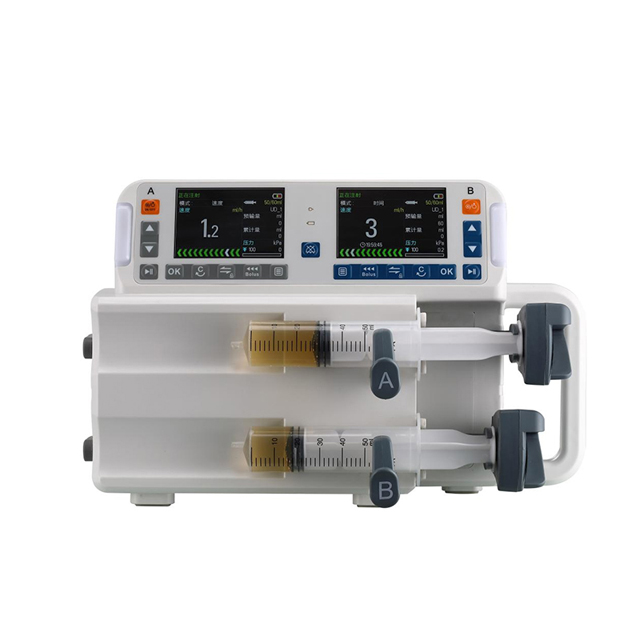
Dual Channel Syringe Pump
Dual-channel syringe pump with two independent 3.5-inch color displays and five infusion modes (rate, time, dose, drug library, sequential).
Supports 5–60 ml syringes at 0.1–2,000 ml/h with ±2% accuracy, 8-hour lithium battery backup, IP44-rated enclosure, and RS-232 interface.

Louise Corscadden, PhD
Director of Science · ConductScience
Ask Louise about Dual Channel Syringe Pump fit, setup, configuration, or quote prep.
Already working with us? Sign in to connect this with My Scientist.
Key Specifications
Full details →- Model fit
- Configured during quote
- SKU family
- BIO-0878
- Shipping box
- 35.0 x 15.0 x 22.0 cm
- Ordering
- Online checkout and quote request available
- Category
- Liquid Handling
- Build notes
- Confirm accessories, station layout, and support needs before purchase
A dual-channel syringe pump designed for precision infusion and dispensing applications requiring simultaneous, independently controlled delivery across two channels. Each channel operates with its own 3.5-inch color display and dedicated power switch. The AB cyclical function enables seamless alternating infusion between channels for continuous-flow protocols without interruption.
Key Features
- Dual independent channels — each with a 3.5-inch color display, individual power switch, and side clamp tube management
- 5 infusion modes: Rate, Time, Dose, Drug Library, and Sequential — covering a full range of dispensing protocols
- Wide flow range: 0.1–2,000 ml/h across 5–60 ml syringes with ±2% accuracy
- 8-hour battery runtime (11.1 V, 2,000 mAh lithium) with AC 100–240 V and DC 12–15 V input support
- 12-alarm safety system with dynamic pressure sensing (DPS, 25 levels, 20–160 kPa), anti-bolus, and anti-siphon protection
- 2,000+ record storage with reviewable and exportable infusion history
- IP44-rated enclosure with wide-angle alarm lighting and RS-232 interface
- 10-category drug library with 17 dose unit options; flow rate adjustable mid-infusion without stopping
Technical Specifications
| Specification | Details |
|---|---|
| Channels | 2 (independent operation, AB cyclical mode) |
| Applicable Syringes | 5, 10, 20, 30, 50, 60 ml |
| Accuracy | ±2% (with calibration) |
| Flow Rate Range | 0.1–2,000 ml/h (syringe-dependent) |
| Total Volume Range | 0.1–9,999.9 ml |
| Purge Rate | 200–1,500 ml/h (syringe-dependent) |
| Bolus Function | Auto / Manual; 1.0–50.0 ml |
| KVO Rate | 0.1–5.0 ml/h (adjustable / disableable) |
| DPS Pressure | 25 levels, 20–160 kPa |
| Infusion Modes | Rate, Time, Dose, Drug Library, Sequential |
| Alarms | 12 types; 3 volume levels (low / medium / high) |
| Drug Library | 10 categories, 17 dose unit options |
| Data Storage | 2,000+ records (reviewable, exportable) |
| Display | Two 3.5-inch color displays |
| Interface | RS-232 |
| Power Supply | AC 100–240 V, 50/60 Hz; DC 12–15 V |
| Battery | 11.1 V, 2,000 mAh lithium; 8-hour runtime |
| Protection | Class I, Type CF, IP44 |
| Dimensions | 350 × 150 × 220 mm |
| Net Weight | 4 kg |
Alarm System
12 independent alarms: syringe holder loose, plunger disengagement, flange insertion error, uncalibrated syringe, occlusion, empty syringe, rate abnormal, battery empty, battery low, no battery, infusion complete, syringe near empty, and no action detected. Alarm volume is user-adjustable across three levels.
Channels
- 2 (independent, AB cyclical)
Applicable Syringes
- 5, 10, 20, 30, 50, 60 ml
Accuracy
- ±2%
Flow Rate Range
- 0.1–2,000 ml/h
Infusion Modes
- Rate, Time, Dose, Drug Library, Sequential
Display
- Two 3.5-inch color displays
Battery
- 11.1 V, 2,000 mAh; 8-hour runtime
Power Supply
- AC 100–240 V, 50/60 Hz; DC 12–15 V
Protection Class
- Class I, Type CF, IP44
Interface
- RS-232
Alarms
- 12 types, 3 volume levels
Shipping weight
- 4 lb
Shipping box
- L: 35.0 cm
- W: 15.0 cm
- H: 22.0 cm
No Q&A yet. Have a question? Ask below.
Have a question about this product?
Have a question? Just ask.
Send it over and we'll email you a personalized answer — no call, no scheduling.
Prefer to talk it through?