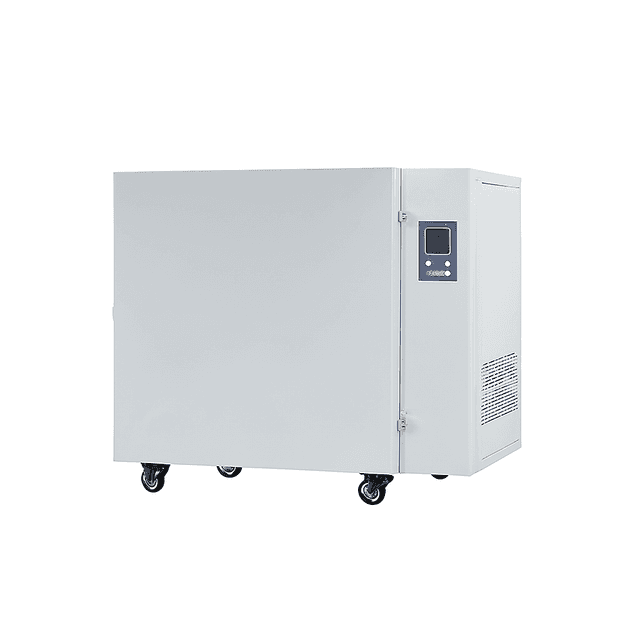
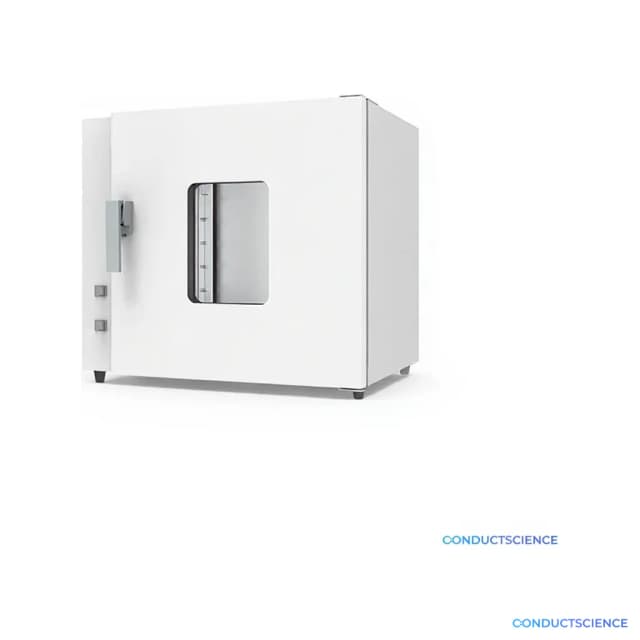
Forced Air Drying Oven(BOV-TF)
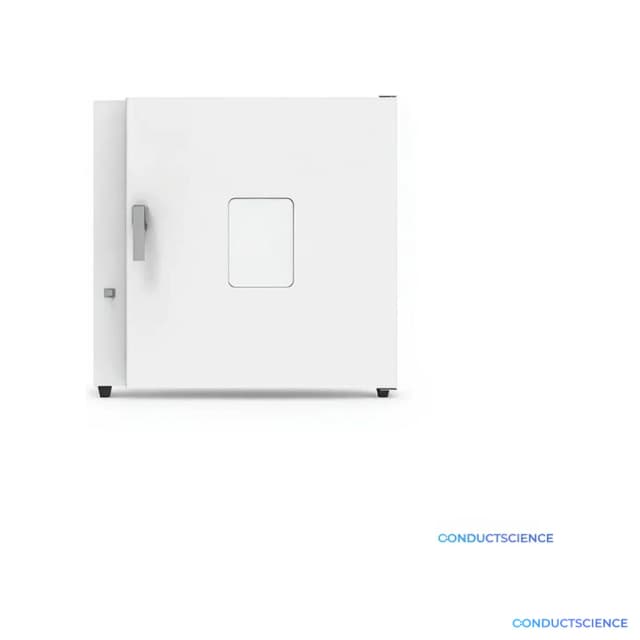
Forced-air drying oven with PID LED controller and stainless steel interior, available in 25–212 L capacities.
Temperature range 50–200°C (±0.1°C precision, ±1°C fluctuation); adjustable shelves, double-layer glass observation window, and over-temperature protection.

Louise Corscadden, PhD
Director of Science · ConductScience
Ask Louise about Forced Air Drying Oven(BOV-TF) fit, setup, configuration, or quote prep.
Already working with us? Sign in to connect this with My Scientist.
Key Specifications
Full details →- Model fit
- 4 selectable configurations
- SKU family
- BIO-0253
- Shipping box
- 29.8 x 29 x 27.4 cm
- Ordering
- Online checkout and quote request available
- Category
- Drying Ovens
- Build notes
- Confirm accessories, station layout, and support needs before purchase
The ConductScience forced-air drying oven (BOV-TF series) provides reliable, precision-controlled convection heating for laboratory drying and thermal processing. The PID control system with LED display maintains temperature to ±0.1°C precision; a double-layer glass observation window with adjustable locks allows monitoring without opening the chamber. Anti-bacteria powder-coated exterior and stainless steel interior with rounded corners support hygiene-sensitive environments.
Technical Specifications
| Parameter | BOV-T25F | BOV-T50F | BOV-T105F | BOV-T200F |
|---|---|---|---|---|
| Capacity | 25 L | 54 L | 108 L | 212 L |
| Temperature Range | 50–200°C | |||
| Temperature Precision | ±0.1°C | |||
| Temperature Fluctuation | ±1°C | |||
| Ambient Temperature | 5–40°C | |||
| Timer Range | 1–9999 min | |||
| Shelves | 2 | |||
| Power Consumption | 650 W | 1000 W | 1600 W | 2500 W |
| Power Supply | 220V ±10%, 50/60 Hz (standard); 110V 60 Hz optional | |||
| Internal Size (W×D×H) | 298×290×274 mm | — | — | 602×498×602 mm |
| External Size (W×D×H) | 580×554×455 mm | — | — | 880×775×785 mm |
| Gross Weight | 51 kg | — | — | 145 kg |
Key Features
- Cold-rolled steel exterior with anti-bacteria powder coating
- Stainless steel interior with rounded corners and adjustable shelves
- Double-layer glass observation window with adjustable locks
- PID LED control system with over-temperature protection mechanism
How It Works
The forced air drying oven operates on the principle of controlled convective heat transfer combined with moisture evaporation. An internal circulation fan distributes heated air throughout the chamber, creating uniform temperature conditions that eliminate thermal gradients common in static ovens. The continuous air movement accelerates moisture removal by maintaining low partial pressure of water vapor at sample surfaces.
Temperature control is achieved through a feedback system monitoring chamber conditions with 0.1°C resolution. The heating elements cycle on and off to maintain setpoint temperature within ±1°C, while the circulation fan operates continuously to ensure homogeneous thermal conditions. This design prevents hot spots and temperature variations that could affect sample integrity or drying uniformity.
The timing system provides automated operation from 1 to 9999 minutes, allowing for standardized protocols and unattended operation. The two-shelf configuration maximizes sample throughput while maintaining adequate air circulation around each sample container.
Features & Benefits
Research Domain
- Analytical Chemistry
- Environmental Monitoring
- Food Science
- Materials Science
- Microbiology
- Pharmaceutical QC
Brand
- ConductScience
Shipping weight
- 11.09 lb
Shipping box
- L: 29.8 cm
- W: 29 cm
- H: 27.4 cm
| Feature | This Product | Typical Alternative | Advantage |
|---|---|---|---|
| Temperature Range | 50-200°C operational range | Entry-level models often limited to 150°C maximum temperature | Higher temperature capability accommodates thermal treatment protocols requiring elevated temperatures beyond basic moisture removal. |
| Temperature Precision | 0.1°C display precision with ±1°C stability | Basic models typically offer ±2-5°C control accuracy | Enhanced precision enables reproducible protocols and meets requirements for quantitative analytical methods. |
| Air Circulation | Forced air convection with internal fan | Static ovens rely on natural convection only | Active circulation eliminates temperature gradients and reduces drying times compared to passive heating systems. |
| Timer Range | 1-9999 minute digital timing control | Mechanical timers often limited to shorter durations | Extended timing capability supports long-duration protocols and eliminates need for manual monitoring of extended runs. |
| Power Supply Options | Standard 220V with optional 110V configuration | Fixed voltage requirements vary by manufacturer | Dual voltage compatibility simplifies installation in laboratories with different electrical infrastructure. |
| Chamber Capacity | 25L internal volume with two adjustable shelves | Compact models often provide smaller capacity | Mid-range capacity balances sample throughput with bench space requirements for typical laboratory workflows. |
The BOV-TF provides enhanced temperature precision and extended timing capability in a forced air design that improves upon basic static oven performance. The dual voltage compatibility and mid-range capacity make it suitable for diverse laboratory environments requiring reliable thermal processing capabilities.
| Model | SKU | Listed price | Status | Shipping box |
|---|---|---|---|---|
| BOV-T200F | BIO-0253 | $1,899.00 | Available | 29.8 x 29 x 27.4 cm |
| BOV-T105F | BIO-0253 | $1,299.00 | Available | 29.8 x 29 x 27.4 cm |
| BOV-T50F | BIO-0253 | $849.00 | Available | 29.8 x 29 x 27.4 cm |
| BOV-T25F | BIO-0253 | $599.00 | Available | 29.8 x 29 x 27.4 cm |
Practical Tips
Verify temperature accuracy quarterly using a calibrated thermometer placed in the chamber center during normal operation.
Why: Temperature accuracy directly affects reproducibility of moisture analysis and thermal treatment protocols.
Clean chamber and shelves monthly with mild detergent solution, ensuring complete drying before next use.
Why: Residue buildup can affect air circulation patterns and introduce contamination to subsequent samples.
Allow adequate spacing between sample containers for proper air circulation, avoiding overcrowding of shelves.
Why: Restricted airflow creates temperature variations and uneven drying that compromises result consistency.
Use heat-resistant gloves and tools when handling hot samples or adjusting shelves during operation.
Why: Chamber temperatures up to 200°C present burn hazards that require appropriate personal protective equipment.
Record both set temperature and actual displayed temperature at start of each drying cycle for protocol documentation.
Why: Temperature logs provide traceability for quality control and help identify calibration drift over time.
If temperature distribution appears uneven, check that circulation fan is operating and door seals properly.
Why: Poor air circulation or heat loss through damaged seals are common causes of temperature uniformity problems.
Preheat empty chamber to setpoint temperature before loading samples for consistent initial conditions.
Why: Thermal equilibration eliminates temperature overshoot that can occur when cold samples are placed in a heating chamber.
Setup Guide
What’s in the Box
- Forced air drying oven main unit
- Two adjustable shelves
- Power cord
- User manual and operating instructions
- Warranty documentation (typical)
Warranty
ConductScience provides a standard one-year manufacturer warranty covering defects in materials and workmanship. Technical support is available for installation guidance, operation questions, and troubleshooting assistance.
Compliance
What is the temperature uniformity across the chamber volume?
The forced air circulation system maintains ±1°C temperature fluctuation throughout the chamber, with continuous air movement preventing thermal stratification common in static ovens.
Can this oven handle volatile solvents or flammable materials?
This is a standard laboratory drying oven not specifically designed for volatile or flammable materials. Consult safety data sheets and consider specialized explosion-proof equipment for such applications.
What types of containers and materials are compatible?
The oven accommodates heat-resistant glassware, ceramics, and metals stable at operating temperatures. Avoid plastics that may deform above their glass transition temperature.
How does the timer function affect heating cycles?
The digital timer controls total operation duration from 1-9999 minutes, with heating elements cycling as needed to maintain setpoint temperature throughout the programmed time.
What maintenance is required for optimal performance?
Regular cleaning of chamber and shelves, periodic verification of temperature accuracy with calibrated instruments, and inspection of door seals for proper closure.
How does this compare to vacuum drying methods?
Forced air drying operates at atmospheric pressure with convective heat transfer, suitable for most moisture removal applications but less effective than vacuum drying for heat-sensitive materials.
Can the shelves support heavy sample loads?
Two shelves are provided for the 25L chamber; consult product datasheet for specific weight capacity per shelf to ensure safe operation.
Is external temperature monitoring possible?
The unit includes internal temperature control and display; external monitoring capability depends on available ports or connections not specified in basic product information.
Have a question about this product?
Have a question? Just ask.
Send it over and we'll email you a personalized answer — no call, no scheduling.
Prefer to talk it through?
Accessories
Enhance your setup with compatible accessories