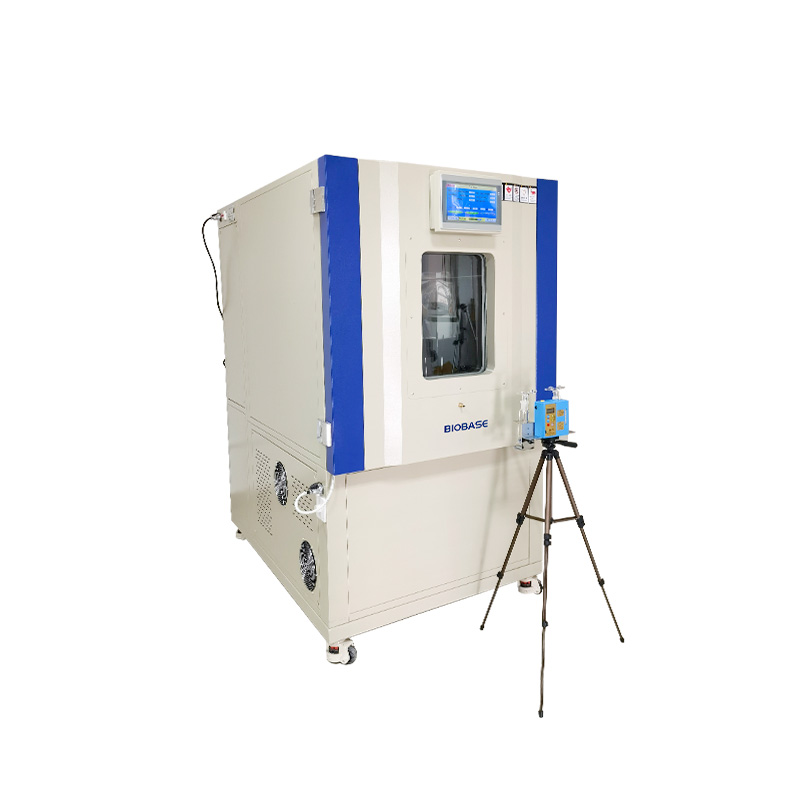
Formaldehyde Climate Chamber
Environmental testing chamber for formaldehyde emission studies with precise temperature control, adjustable air flow, and integrated sampling system for indoor air quality research.
| Automation Level | semi-automated |
| Temp. Range | 15~40℃ |
| Temp. Fluctuation | ±0.5℃ |
| Air Replacement Rate | 0.2~2.0 times/hour |
| Air Velocity | 0.1~0.5m/s(Adjustable continuously) |
| Samplers Suction Speed | 0.25~2.5L/min |
The Formaldehyde Climate Chamber is a specialized environmental testing system designed for controlled formaldehyde emission studies and indoor air quality research. This benchtop instrument maintains precise temperature control (15-40°C ± 0.5°C) with adjustable air replacement rates (0.2-2.0 times/hour) and continuous air velocity regulation (0.1-0.5 m/s) to simulate real-world environmental conditions for material emission testing.
The system features integrated sampling capabilities with variable suction speeds (0.25-2.5 L/min) and ±5% adjustment accuracy, enabling researchers to collect air samples under standardized conditions. Operating under micro-positive pressure (10±5 Pa) with low noise levels (≤60 dB), the chamber supports extended experimental protocols with continuous operation capability up to 40 days, making it suitable for long-term emission characterization studies.
How It Works
The Formaldehyde Climate Chamber operates on controlled environmental simulation principles, maintaining precise temperature regulation through integrated heating and cooling systems with ±0.5°C stability. The chamber creates a controlled microenvironment where test materials can off-gas under standardized conditions, with adjustable air replacement rates allowing researchers to simulate various ventilation scenarios from 0.2 to 2.0 air changes per hour.
Air circulation is maintained through variable-speed fans providing continuous air velocity control from 0.1 to 0.5 m/s, ensuring uniform mixing and preventing concentration gradients within the test chamber. The system maintains micro-positive pressure (10±5 Pa) to prevent external air infiltration while integrated sampling ports allow collection of representative air samples at controlled flow rates from 0.25 to 2.5 L/min with ±5% accuracy.
The extended operational capability (≥40 days continuous operation) enables long-term emission studies where formaldehyde release rates may change over time due to material aging, temperature cycling, or depletion of emission sources. The low-noise design (≤60 dB) allows placement in laboratory environments without disrupting adjacent work areas.
Features & Benefits
Automation Level
- semi-automated
Temp. Range
- 15~40℃
Temp. Fluctuation
- ±0.5℃
Air Replacement Rate
- 0.2~2.0 times/hour
Air Velocity
- 0.1~0.5m/s(Adjustable continuously)
Samplers Suction Speed
- 0.25~2.5L/min
Suction Speed Adjustment Accuracy
- ±5%
Pressure Difference
- 10±5Pa(Micro-positive pressure)
Noise
- ≤60dB
Continuous Working Hours
- ≤40 days
Consumption
- 3KW
External Size(W*D*H)
- 1100*1760*1820mm
Packing Size(W*D*H)
- 1250*1900*2100mm
Brand
- ConductScience
Research Domain
- Analytical Chemistry
- Environmental Monitoring
- Food Science
- Industrial Hygiene
- Materials Science
- Pharmaceutical QC
Power/Voltage
- AC220V, 50Hz
Weight
- 480kg
Weight
- 480.0 kg
Dimensions
- L: 182.0 mm
- W: 110.0 mm
- H: 176.0 mm
Comparison Guide
| Feature | This Product | Typical Alternative | Advantage |
|---|---|---|---|
| Temperature Range | 15-40°C with ±0.5°C stability | Entry-level models often offer narrower temperature ranges with less precise control | Broader temperature range enables testing under various seasonal and indoor conditions |
| Air Flow Control | 0.2-2.0 air changes/hour with 0.1-0.5 m/s velocity control | Fixed air flow rates with limited velocity adjustment options | Variable air flow simulation allows testing under different ventilation scenarios |
| Sampling System | 0.25-2.5 L/min with ±5% accuracy and integrated sampling ports | External sampling systems with manual flow control | Integrated sampling eliminates setup complexity and provides consistent flow accuracy |
| Operation Duration | ≥40 days continuous operation | Shorter operational periods requiring frequent maintenance breaks | Extended operation enables long-term emission studies and material aging protocols |
| Chamber Volume | 1100×1760×1820mm internal dimensions | Smaller desktop units with limited sample capacity | Large volume accommodates substantial specimens including furniture components |
| Pressure Control | Micro-positive pressure 10±5 Pa | Atmospheric pressure operation without contamination prevention | Positive pressure prevents external air infiltration affecting emission measurements |
This chamber combines precise temperature control, variable air flow simulation, and integrated sampling capabilities in a large-volume format suitable for extended emission studies. The system provides laboratory-grade environmental control with continuous operation capability for comprehensive material testing protocols.
Practical Tips
Verify temperature calibration using certified reference thermometers at multiple points within the chamber volume before each testing campaign.
Why: Temperature uniformity affects emission rates and ensures data comparability between studies.
Clean chamber surfaces with appropriate solvents between tests and perform background measurements to verify low baseline formaldehyde levels.
Why: Residual contamination from previous tests can affect emission measurements and data quality.
Allow chamber to equilibrate at target temperature for several hours before introducing test specimens.
Why: Temperature stability ensures consistent emission conditions from the start of the measurement period.
Position test specimens to avoid blocking air circulation patterns and sampling port access.
Why: Uniform air flow around specimens ensures representative emission measurements and prevents concentration gradients.
Record ambient laboratory conditions and chamber parameters throughout extended testing periods.
Why: Environmental changes can affect chamber performance and provide context for emission rate variations.
Monitor pressure differential regularly during operation to detect potential seal leaks or ventilation issues.
Why: Pressure changes indicate system integrity problems that can affect air flow patterns and emission measurements.
Ensure adequate laboratory ventilation when venting chamber air containing formaldehyde emissions.
Why: Formaldehyde exposure limits require proper handling of chamber exhaust air to protect laboratory personnel.
Calibrate sampling flow rates using certified flow measurement devices at regular intervals during extended studies.
Why: Flow rate accuracy directly affects emission rate calculations and data reproducibility.
Setup Guide
What’s in the Box
- Formaldehyde Climate Chamber main unit
- Temperature control system
- Air circulation and flow control modules
- Sampling port assemblies (typical)
- Power cable for AC220V connection
- User manual and operation guide (typical)
- Calibration documentation (typical)
Warranty
ConductScience provides standard manufacturer warranty coverage with technical support for calibration assistance and operational guidance. Extended service plans available for applications requiring periodic calibration verification.
Compliance
References
Background reading relevant to this product:
What is the temperature uniformity across the chamber volume?
The system maintains ±0.5°C temperature fluctuation; consult product datasheet for specific spatial uniformity specifications across the 1100×1760×1820mm internal volume.
How is the chamber calibrated for air flow measurements?
Air velocity and sampling flow rates require calibration using certified flow measurement equipment; the system provides ±5% accuracy for sampling flow rates between 0.25-2.5 L/min.
What background formaldehyde levels can be achieved?
Background formaldehyde concentrations depend on chamber conditioning and cleaning protocols; consult product datasheet for achievable detection limits and baseline specifications.
Can the chamber accommodate multiple samples simultaneously?
The large internal volume (1100×1760×1820mm) allows multiple specimens; however, spatial arrangement must ensure uniform air flow distribution around each sample.
What data logging capabilities are included?
Consult product datasheet for specific data acquisition and logging features; basic temperature and flow monitoring are standard with 40+ day continuous operation capability.
How does this compare to dynamic emission testing methods?
This static chamber approach provides controlled conditions for standardized emission testing, while dynamic methods may offer different air exchange characteristics and sampling protocols.
What maintenance is required for extended operation?
Regular calibration verification of temperature and flow systems is recommended; specific maintenance intervals depend on usage frequency and environmental conditions.
What sample preparation is required for emission testing?
Sample preparation follows standard protocols for the specific material type; chamber design accommodates various specimen configurations within the available volume.