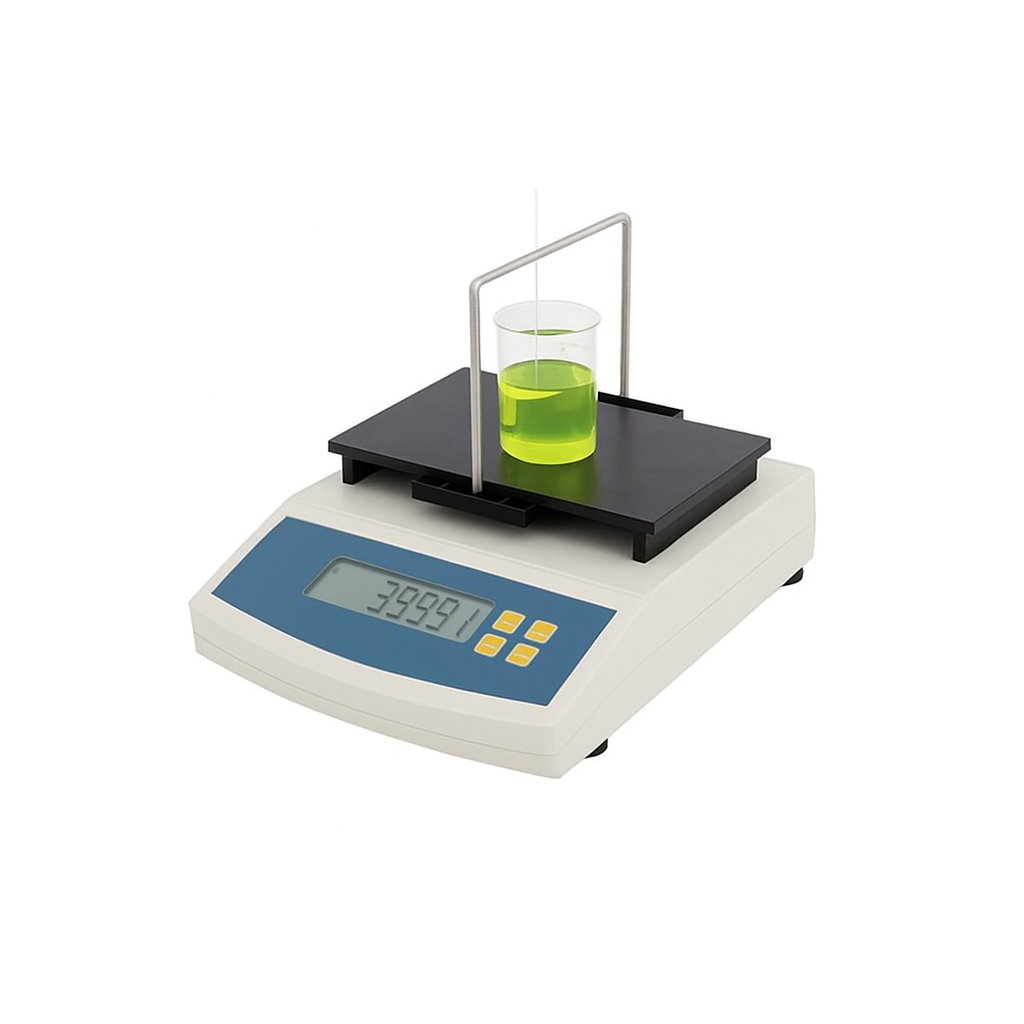
High-precision Solid And Liquid Densimeter
High-precision benchtop densimeter measuring solid and liquid materials from 0.001-120g using Archimedes principle with 5-second measurement time and automatic correction capabilities.
| Automation Level | Semi-automated |
| Measuring Time | About 5s |
| Calibration Mode | Auto correction, auto detection |
| Optional Accessories | DE-40 printer, DE-20B anti corrosive liquid measuring assembly |
| Density Resolution | 0.001g/cm3 |
| Density Range | 0.001~99.999g/cm3 |
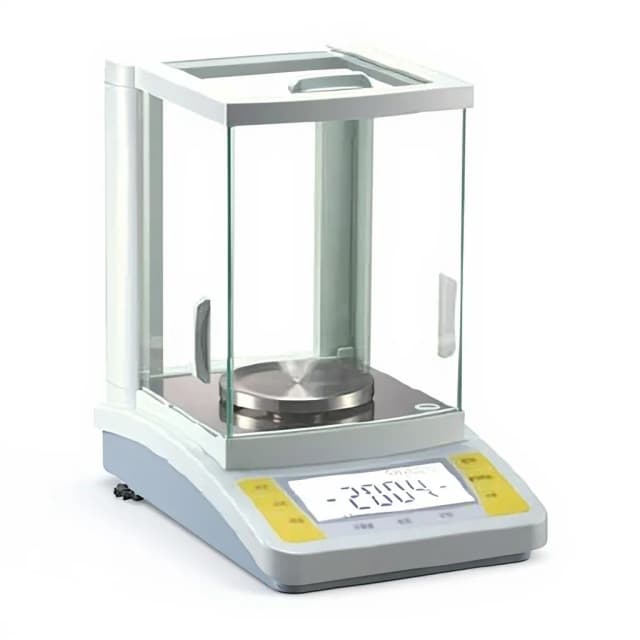
The High-precision Solid And Liquid Densimeter is a benchtop analytical instrument that measures density of both solid and liquid materials using the Archimedes principle displacement method. With a capacity range of 0.001-120g and measurement time of approximately 5 seconds, this densimeter provides rapid density determinations and displays results as both density values and Baumé degrees. The instrument features automatic correction and detection capabilities with distilled water testing for result validation.
The densimeter allows free setting of density values for main and subordinate materials and displays both density values and percentage composition of the main material. Auto correction and detection functions ensure measurement accuracy, while optional accessories including the DE-40 printer and DE-20B anti-corrosive liquid measuring assembly extend the instrument's analytical capabilities. The compact 195×230×197mm footprint and universal AC power supply make it suitable for diverse laboratory environments.
How It Works
The densimeter operates on Archimedes principle, which states that the buoyant force on a submerged object equals the weight of the displaced fluid. For solid samples, the instrument measures the sample's weight in air and then its apparent weight when submerged in a reference liquid (typically distilled water). The density is calculated from the difference between these two measurements, accounting for the known density of the reference liquid and environmental conditions.
For liquid measurements, the displacement method involves measuring the volume displaced by a known mass of sample or using a calibrated sinker of known volume. The instrument's measurement system automatically corrects for temperature variations and provides rapid density determinations within approximately 5 seconds. Distilled water testing validates measurement accuracy, while the auto-detection function ensures proper measurement conditions are maintained throughout the analysis.
Features & Benefits
Automation Level
- Semi-automated
Measuring Time
- About 5s
Calibration Mode
- Auto correction, auto detection
Optional Accessories
- DE-40 printer, DE-20B anti corrosive liquid measuring assembly
Density Resolution
- 0.001g/cm3
Density Range
- 0.001~99.999g/cm3
Power/Voltage
- AC 100~240V, 50/60Hz
External Size (WxDxH)
- 195x230x197mm
Package Size (WxDxH)
- 440x180x345mm
Brand
- ConductScience
Capacity
- 0.005~600g
Solid Mode Measuring Principle
- Archimedes principle general solid test method
Liquid Mode Measuring Principle
- Archimedes principle displacement method
Standard Accessories
- Common: Tweezer, thermometer, 100G weight, windshield, power transformer. Solid: Tank, testing board, particle measuring assembly, floating body measuring assembly. Liquid: Measuring plate, measuring frame, DE-20A standard liquid measuring assembly
Net Weight
- 1.79kg
Gross Weight
- 4.5kg
Research Domain
- Analytical Chemistry
- Environmental Monitoring
- Food Science
- Industrial Hygiene
- Materials Science
- Pharmaceutical QC
Weight
- 1.59 kg
Dimensions
- L: 11.6 mm
- W: 13.5 mm
- H: 5.0 mm
Comparison Guide
| Feature | This Product | Typical Alternative | Advantage |
|---|---|---|---|
| Measurement Time | Approximately 5 seconds | Entry-level models often require 30-60 seconds per measurement | Enables higher sample throughput and reduces analysis bottlenecks in busy laboratories |
| Capacity Range | 0.001-120g | Basic instruments typically handle 10-100g ranges | Accommodates both micro-samples and larger specimens in a single instrument platform |
| Calibration System | Auto correction with distilled water testing validation | Manual calibration procedures with external standards | Reduces operator error and ensures consistent measurement accuracy without extensive training |
| Display Options | Density values, Baumé degrees, and percentage of main material | Single density value output in basic models | Provides comprehensive results in multiple formats to meet diverse analytical requirements |
| Material Compatibility | Standard configuration with optional anti-corrosive assembly | Limited chemical compatibility in standard instruments | Extends analytical capabilities to aggressive chemicals with appropriate accessories |
| Power Requirements | Universal AC 100-240V, 50/60Hz | Fixed voltage requirements in many models | Ensures global compatibility without voltage converters or modifications |
This densimeter combines rapid 5-second measurements with broad 0.001-120g capacity range and automatic correction capabilities. The instrument offers comprehensive display options including density, Baumé values, and material percentages, while optional accessories extend compatibility to corrosive materials.
Practical Tips
Perform distilled water testing at the beginning of each analytical session to verify measurement accuracy.
Why: Environmental conditions can drift throughout the day, affecting measurement precision.
Clean measurement surfaces with appropriate solvents and dry thoroughly between different sample types.
Why: Residual contamination can bias density measurements and affect subsequent analyses.
Allow samples to equilibrate to room temperature before measurement to minimize thermal effects.
Why: Temperature variations affect both sample density and the reference liquid properties.
Remove all air bubbles from liquid samples using gentle agitation or vacuum degassing.
Why: Trapped air reduces apparent density and creates measurement errors in displacement calculations.
Perform multiple measurements on critical samples and calculate average values for improved precision.
Why: Replicate measurements help identify outliers and improve statistical confidence in results.
If measurements show excessive drift, check for vibration sources and air currents around the instrument.
Why: External disturbances can affect the sensitive measurement balance and cause inconsistent results.
Use appropriate personal protective equipment when handling corrosive samples with the anti-corrosive assembly.
Why: Chemical compatibility accessories protect the instrument but do not eliminate operator exposure risks.
Setup Guide
What’s in the Box
- High-precision densimeter main unit
- Power adapter and cord
- Sample holders and measurement accessories (typical)
- Distilled water reference container (typical)
- User manual and calibration certificate (typical)
- Measurement beaker and sample tools (typical)
Warranty
ConductScience provides a standard one-year manufacturer warranty covering defects in materials and workmanship. Technical support and calibration services are available throughout the warranty period and beyond.
Compliance
What is the measurement precision and accuracy of density determinations?
The instrument uses Archimedes principle with auto correction and distilled water testing validation. Consult product datasheet for specific precision and accuracy specifications.
Can the densimeter handle corrosive or aggressive chemical samples?
The optional DE-20B anti-corrosive liquid measuring assembly extends capabilities to corrosive materials. Standard configuration is suitable for non-aggressive samples.
How does the auto correction function compensate for environmental variations?
The auto detection system monitors environmental conditions and automatically adjusts measurements. Distilled water testing provides reference validation for accuracy verification.
What sample preparation is required for solid and liquid measurements?
Solid samples should be clean, dry, and free of air bubbles. Liquid samples require air bubble removal and temperature equilibration. Sample size must be within 0.001-120g range.
Can measurement data be exported or printed for documentation?
The optional DE-40 printer accessory provides hardcopy documentation of measurement results including density values and Baumé degrees.
How frequently does the instrument require calibration or validation?
Built-in distilled water testing provides routine validation. Formal recalibration frequency depends on usage intensity and quality requirements - consult with technical support.
What is the minimum sample volume required for accurate measurements?
Minimum sample size is 0.001g. Actual volume requirements depend on sample density and measurement method - consult product datasheet for specific volume specifications.