Portable Handheld Turbidimeter
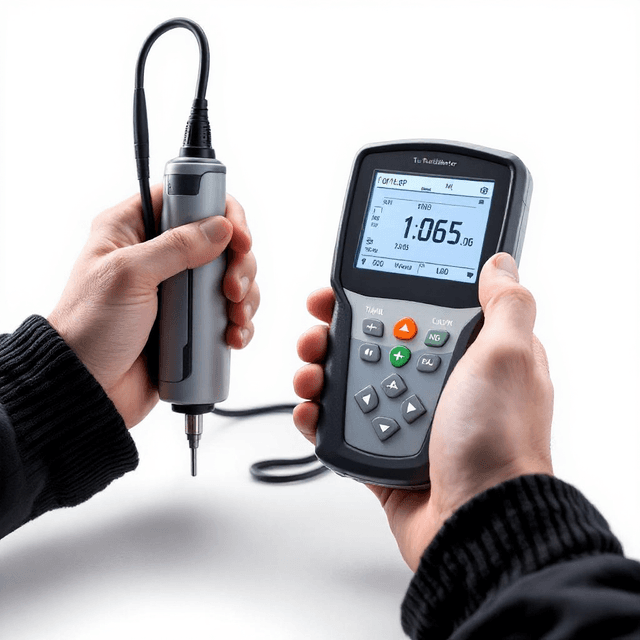
Battery-powered handheld turbidimeter with IP67 waterproof rating for field measurement of water turbidity using 90-degree nephelometric detection.

Louise Corscadden, PhD
Director of Science · ConductScience
Ask Louise about Portable Handheld Turbidimeter fit, setup, configuration, or quote prep.
Already working with us? Sign in to connect this with My Scientist.
Key Specifications
Full details →- Model fit
- Configured during quote
- SKU family
- _old_BIO-PT-201A
- Shipping box
- 39.2 x 49.0 x 38.0 cm
- Ordering
- Online checkout and quote request available
- Category
- Analytical Instruments
- Build notes
- Confirm accessories, station layout, and support needs before purchase
The Portable Handheld Turbidimeter (BIO-PT-201A) provides nephelometric turbidity measurement for field and laboratory water quality assessment. The instrument utilizes a 90-degree light scattering detection system to quantify suspended particle concentrations in aqueous samples, delivering turbidity readings in Nephelometric Turbidity Units (NTU). Its IP67-rated waterproof housing and battery operation enable direct measurement in aquatic environments without laboratory sample transport.
The device incorporates automatic calibration protocols and integrated data storage with USB export functionality for workflow integration. The handheld form factor allows single-operator deployment in diverse sampling locations, from surface water bodies to point-of-use drinking water systems. Built-in memory capacity supports extended field campaigns with batch data transfer capabilities.
How It Works
The turbidimeter operates on the principle of 90-degree nephelometric light scattering, where a collimated light beam passes through the sample and scattered light is detected perpendicular to the incident beam path. Suspended particles and dissolved substances in the water sample scatter the incident light proportionally to their concentration and size distribution. The photodetector measures the intensity of scattered light, which correlates directly with turbidity levels according to established nephelometric standards.
Internal optical components include a stable light source and precision photodetector positioned at the optimal 90-degree angle to minimize interference from sample color and dissolved organic matter. The instrument's microprocessor converts the scattered light intensity to turbidity units through calibrated algorithms, while automatic ranging adjusts sensitivity across the measurement span. Temperature compensation algorithms account for thermal effects on optical properties during field deployment.
Features & Benefits
Automation Level
- semi-automated
Research Domain
- Aquaculture
- Environmental Monitoring
- Hydrology
- Water Quality Analysis
Shipping weight
- 1.0 lb
Shipping box
- L: 39.2 cm
- W: 49.0 cm
- H: 38.0 cm
| Feature | This Product | Typical Alternative | Advantage |
|---|---|---|---|
| Portability | Compact handheld design with battery operation | Many field turbidimeters require external power or larger form factors | Enables single-operator deployment in remote sampling locations without infrastructure requirements. |
| Environmental Protection | IP67 waterproof rating | Entry-level models often provide basic splash resistance only | Allows direct measurement in wet conditions and protects against submersion during field work. |
| Calibration System | Auto-calibration functionality | Manual calibration procedures vary by manufacturer | Reduces calibration errors and ensures consistent measurement protocols across field teams. |
| Data Management | Integrated memory with USB export | Some field instruments lack data storage capabilities | Eliminates manual transcription errors and supports comprehensive field documentation workflows. |
This turbidimeter combines field portability with automated calibration and integrated data management. The IP67 rating and battery operation support deployment in challenging aquatic environments where laboratory-based analysis is impractical.
Practical Tips
Perform calibration verification at the beginning of each field session using fresh standards prepared according to manufacturer protocols.
Why: Ensures measurement accuracy throughout the sampling campaign and identifies potential instrument drift.
Clean optical windows with distilled water immediately after field use and store in the protective case to prevent scratching.
Why: Maintains optical clarity and prevents measurement artifacts from surface contamination or damage.
Allow samples to equilibrate to ambient temperature and remove air bubbles before measurement to minimize optical interference.
Why: Temperature variations and air bubbles scatter light inconsistently, leading to measurement errors.
If readings appear unstable, check for sample cell cleanliness and ensure complete filling without air gaps.
Why: Optical path obstructions and incomplete sample volumes are common sources of measurement variability.
Record sampling location coordinates and environmental conditions alongside turbidity measurements for comprehensive documentation.
Why: Contextual information enables proper data interpretation and supports quality assurance protocols.
Rinse the instrument with fresh water after use in saltwater environments to prevent corrosion of external components.
Why: Salt deposits can compromise sealing integrity and affect long-term instrument reliability.
Setup Guide
What’s in the Box
- Handheld turbidimeter main unit
- Sample cells and caps (typical)
- Turbidity calibration standards kit (typical)
- USB data cable (typical)
- Battery charger/power adapter (typical)
- Carrying case (typical)
- User manual and quick reference guide (typical)
Warranty
ConductScience provides a standard one-year manufacturer warranty covering defects in materials and workmanship. Technical support includes calibration guidance, troubleshooting assistance, and application protocol consultation throughout the warranty period.
Compliance
What calibration standards are required for accurate turbidity measurement?
The instrument requires formazin-based turbidity standards prepared according to EPA or ISO protocols. Auto-calibration typically uses 0, 20, 200, and 2000 NTU standards, though specific requirements should be confirmed in the product datasheet.
How does sample temperature affect measurement accuracy?
Temperature variations can influence light scattering properties and detector sensitivity. The instrument includes temperature compensation algorithms, but samples should equilibrate to ambient temperature for optimal accuracy.
What maintenance is required for the optical components?
Optical windows require regular cleaning with distilled water and lint-free cloths. Avoid touching optical surfaces directly and inspect for scratches or deposits that could affect light transmission.
Can the instrument measure highly turbid samples directly?
Measurement range and dilution requirements depend on the specific model specifications. Samples exceeding the upper range may require serial dilution with turbidity-free water.
How is data exported for statistical analysis?
The USB interface allows direct data transfer to computers in common formats compatible with spreadsheet and statistical software. Data typically includes measurement values, timestamps, and instrument settings.
What factors can interfere with nephelometric measurements?
Sample color, dissolved organic matter, and air bubbles can affect readings. The 90-degree detection angle minimizes color interference, but highly colored samples may require alternative measurement approaches.
Have a question about this product?
Have a question? Just ask.
Send it over and we'll email you a personalized answer — no call, no scheduling.
Prefer to talk it through?