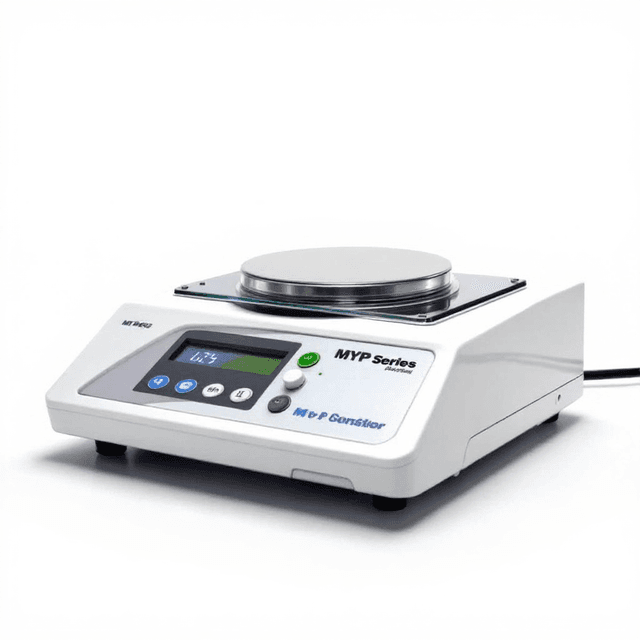
Hotplate Magnetic Stirrer MS4-H380-E
Benchtop magnetic stirrer with heating capability, featuring 0-2000 rpm speed range, RT+5°C to 380°C temperature control, and 2L maximum stirring capacity with PT1000 temperature sensor.

Louise Corscadden, PhD
Director of Science · ConductScience
Ask Louise about Hotplate Magnetic Stirrer MS4-H380-E fit, setup, configuration, or quote prep.
Already working with us? Sign in to connect this with My Scientist.
Key Specifications
Full details →- Model fit
- Configured during quote
- SKU family
- BIO-0787
- Shipping box
- 9.0 x 23.5 x 14.0 cm
- Ordering
- Online checkout and quote request available
- Category
- Benchtop Instruments
- Build notes
- Aluminum
The MS4-H380-E Hotplate Magnetic Stirrer is a benchtop instrument designed for simultaneous heating and magnetic stirring applications in laboratory environments. This unit combines precise temperature control from room temperature plus 5°C to 380°C with variable speed magnetic stirring from 0 to 2000 rpm, accommodating solutions up to 2 liters in volume.
The instrument features a 120mm × 120mm aluminum work plate with IP21 protection class rating for enhanced durability in laboratory conditions. The integrated PT1000 temperature sensor with support clamp enables accurate temperature monitoring and control during heating operations. The DC brush motor provides consistent stirring performance with 5W motor output, while the heating element delivers 200W power for rapid temperature achievement.
Dual voltage compatibility (AC110V or AC220V, 50/60Hz) ensures global laboratory integration, while the compact design and standard accessories make this stirrer suitable for routine sample preparation, reaction heating, and solution mixing protocols across multiple research disciplines.
How It Works
The MS4-H380-E operates on the principle of electromagnetic induction for stirring combined with resistive heating for temperature control. The magnetic stirring mechanism uses a rotating magnetic field generated beneath the aluminum work plate to drive a magnetic stir bar placed in the solution. The DC brush motor creates this rotating field at speeds from 0 to 2000 rpm, providing consistent mixing action for solutions up to 2 liters with magnetic bars up to 50mm in length.
Temperature control is achieved through a 200W heating element integrated into the work plate assembly. The PT1000 temperature sensor provides real-time temperature feedback to maintain precise control from room temperature plus 5°C up to 380°C. The aluminum work plate material ensures uniform heat distribution across the sample vessel, while the IP21 protection rating provides resistance to solid particles and vertical water drops.
The control system manages both heating and stirring functions independently, allowing researchers to adjust parameters based on specific protocol requirements. The instrument's 205W total power consumption reflects the combined operation of both heating and stirring mechanisms during simultaneous use.
Features & Benefits
Automation Level
- manual
Item No.
- 8010116015
Work Plate Size
- 120*120mm
Work Plate Material
- Aluminum
Speed Range
- 0~2000rpm
Heating Temperature Range
- RT+5°C~380°C
Max. Stirring Quantity(H₂O)
- 2L
Max. Magnetic Bar(Length)
- 50mm
Protection Class
- IP21
Motor Type
- DC brush motor
Standard Accessories
- PT1000-A, temperature sensor(18901898); Support clamp of PT1000(18902044)
Motor Rating Ouput Consumption
- 5W
Heating Consumption
- 200W
Consumption
- 205W
Brand
- ConductScience
Research Domain
- Analytical Chemistry
- Environmental Monitoring
- Food Science
- Materials Science
- Microbiology
- Pharmaceutical QC
Power/Voltage
- AC110V±10%, 50/60Hz or AC220V±10%, 50/60Hz
Shipping weight
- 1.4 lb
Shipping box
- L: 9.0 cm
- W: 23.5 cm
- H: 14.0 cm
| Feature | This Product | Typical Alternative | Advantage |
|---|---|---|---|
| Temperature Range | RT+5°C to 380°C with 200W heating power | Many entry-level models limit maximum temperature to 300°C or lower | Extended temperature range enables high-temperature synthesis and specialized analytical procedures requiring elevated heating conditions. |
| Stirring Speed Range | 0-2000 rpm variable speed control | Basic models often provide 100-1500 rpm ranges with limited low-speed control | Wide speed range accommodates both gentle mixing for sensitive samples and vigorous stirring for challenging dissolution applications. |
| Work Plate Material | 120mm × 120mm aluminum construction | Ceramic or coated steel plates are common in this size range | Aluminum provides excellent thermal conductivity for uniform heat distribution and rapid temperature response during heating protocols. |
| Temperature Sensing | PT1000 sensor with support clamp included | Basic models may rely on plate sensors without external temperature probes | Direct solution temperature monitoring enables more accurate control than plate-based sensing, critical for precise thermal protocols. |
| Maximum Capacity | 2L maximum stirring volume with 50mm magnetic bar compatibility | Compact stirrers often limit capacity to 1L or smaller volumes | Higher capacity accommodates larger batch sizes and reduces need for multiple preparation steps in scaled protocols. |
| Motor Type | DC brush motor with 5W output | Entry-level units may use lower power motors with limited torque | Dedicated motor power ensures consistent stirring performance across the speed range, even with viscous solutions or challenging mixing conditions. |
The MS4-H380-E combines high-temperature capability up to 380°C with precise PT1000 temperature sensing and robust 2L stirring capacity. The aluminum work plate construction and 5W DC motor provide reliable performance for demanding laboratory applications requiring both accurate temperature control and consistent mixing performance.
Practical Tips
Verify temperature accuracy using certified reference materials at multiple points across the operating range, especially at commonly used temperatures for your protocols.
Why: Temperature calibration ensures reproducible results and maintains protocol validity across different experimental sessions.
Clean the aluminum work plate regularly with appropriate solvents to remove chemical residues that could affect heat transfer or cause contamination.
Why: Residue buildup can create hot spots and reduce heating efficiency, leading to temperature inconsistencies during operation.
Position the PT1000 sensor close to but not touching the sample vessel, ensuring the sensor tip is immersed in the solution for accurate temperature reading.
Why: Proper sensor placement provides true solution temperature rather than ambient or plate temperature, critical for temperature-sensitive reactions.
Select magnetic stir bar size appropriate to vessel geometry - typically one-third to two-thirds the internal diameter for optimal mixing efficiency.
Why: Proper stir bar sizing ensures complete solution mixing without vortex formation or bar decoupling at higher speeds.
If stirring becomes erratic or stops, check for magnetic interference from nearby equipment and verify the stir bar has not become demagnetized.
Why: Magnetic coupling loss can occur due to overheating of the stir bar or interference from other magnetic fields in the laboratory.
Allow adequate cool-down time before handling the work plate or sample vessels, as the aluminum surface retains heat after heating operations.
Why: Aluminum's high thermal conductivity means the work plate surface remains hot longer than visual indicators might suggest, creating burn hazards.
Record both set point and actual temperatures from the PT1000 sensor to document temperature control performance during critical procedures.
Why: Temperature documentation provides traceability for regulatory compliance and enables troubleshooting of temperature-related experimental variability.
Gradually increase heating and stirring rates when starting procedures to prevent thermal shock to glassware and maintain stable mixing conditions.
Why: Gradual parameter changes prevent solution splashing, reduce glassware stress, and establish stable thermal and mixing equilibrium conditions.
Setup Guide
What’s in the Box
- MS4-H380-E Hotplate Magnetic Stirrer main unit
- PT1000 temperature sensor (Item No. 18901898)
- PT1000 sensor support clamp (Item No. 18902044)
- Power cord (typical)
- User manual and documentation (typical)
- Calibration certificate (typical)
Warranty
ConductScience provides a standard one-year manufacturer warranty covering defects in materials and workmanship, with technical support available for operational questions and troubleshooting assistance.
Compliance
References
Background reading relevant to this product:
What is the temperature accuracy and stability of the heating system?
Temperature performance specifications are not provided in the technical data. Consult the product datasheet for accuracy, stability, and resolution specifications of the PT1000 temperature control system.
Can this stirrer handle viscous solutions or suspensions effectively?
The 5W DC brush motor provides consistent torque for stirring up to 2L volumes with magnetic bars up to 50mm. Performance with highly viscous solutions depends on specific viscosity and mixing requirements - consult technical specifications for torque curves.
What safety features are included for over-temperature protection?
The unit includes IP21 protection against particles and water drops. Additional safety features such as over-temperature cutoffs or heating element protection are not specified - refer to the user manual for complete safety information.
Is the temperature sensor calibration traceable to national standards?
The PT1000 sensor is included as standard equipment. Calibration traceability and certification details should be verified with the calibration certificate provided or through ConductScience technical support.
What types of vessels and containers are compatible with this stirrer?
The 120mm × 120mm aluminum work plate accommodates standard laboratory glassware up to 2L capacity. Vessel compatibility depends on base diameter, material, and magnetic bar coupling - flat-bottomed vessels work best.
How does the stirring performance change with temperature?
Motor specifications indicate 5W output with 0-2000 rpm range. Temperature effects on motor performance and magnetic coupling are not specified - consult technical documentation for thermal derating information.
What maintenance procedures are required for optimal performance?
Regular maintenance typically includes work plate cleaning, temperature sensor calibration verification, and motor performance checks. Specific maintenance intervals and procedures should be followed per the user manual.
Can multiple units be operated simultaneously in the same laboratory space?
Multiple units can typically operate simultaneously, though magnetic field interference should be considered with close spacing. Maintain adequate separation distance and avoid placement near other magnetic equipment.
Have a question about this product?
Have a question? Just ask.
Send it over and we'll email you a personalized answer — no call, no scheduling.
Prefer to talk it through?